Human Skills
Is It Still Safe to Eat? Meat and Fish
Spoilage signs, the smell-test trap and power cut rules
5 minBeginnerUpdated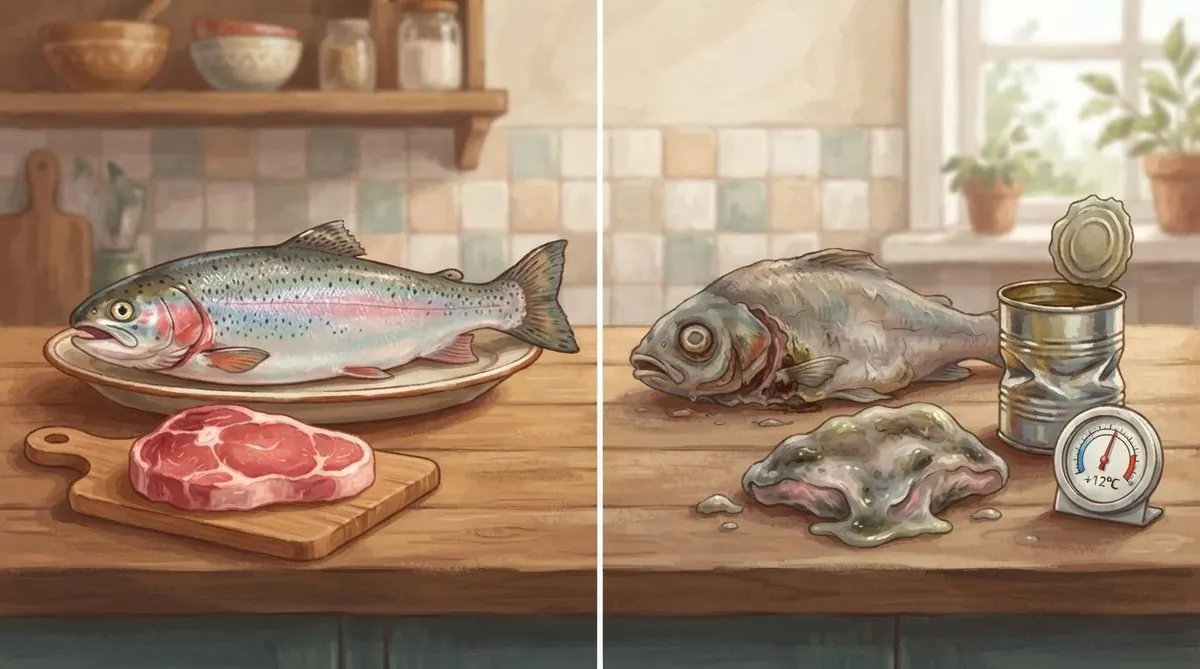
- Recognise the signs that meat and fish have spoiled
- Explain why a normal smell does not prove food is safe
- Apply time, temperature and power cut rules
Signs that meat or fish has gone off
Spoiled meat and fish usually give clear warnings. A sour, rotten or ammonia smell. A slimy or sticky surface. Meat turning grey, green or brown in patches, and fat turning yellow and rancid. Packaging that has bloated with gas. For fish, look at the eyes and gills: fresh fish have clear, bulging eyes and bright red gills; old fish have cloudy, sunken eyes and brown or grey gills, and the flesh stays dented when you press it instead of springing back. Any one of these signs means throw it out. Do not wash, trim or marinate it to cover the smell.
The smell test only says no
Here is the trap: the bacteria that make food smell bad are mostly not the ones that make you ill. Salmonella, Listeria, E. coli and Clostridium botulinum can grow to dangerous levels without any smell, slime or colour change. A chicken breast left in a warm car for 3 hours can look and smell perfect and still put you in hospital. So the smell test can only reject food, never approve it. If it smells bad, it goes. If it smells fine, you still decide by time and temperature: how long was it out of the cold, and how warm was it?
Time and temperature rules
Perishable meat and fish should not spend more than 2 hours in total between 5 and 60 °C, or 1 hour when the air is above 32 °C, such as in a hot car or at a summer barbecue. After that, throw it out, even if it was later chilled. Keep your fridge at 0 to 4 °C and the freezer at −18 °C or colder, and check with a fridge thermometer. Raw mince and poultry keep 1 to 2 days in the fridge, raw fish 1 to 2 days, steaks and joints 3 to 5 days, cooked leftovers 3 to 4 days. Thaw in the fridge, never on the counter.
Bulging cans and jars
A can or jar with a bulging lid, a swollen or leaking can, liquid spurting when opened, a broken seal, cloudy liquid, mould or a bad smell may contain botulinum toxin. A tiny amount can paralyse and kill, and the toxin often has no taste. Do not open it to check and never taste it. Put the container in a sealed bag, put it in the bin out of reach of people and pets, wash your hands and any surface it touched with a bleach solution, and throw away sponges and cloths used. Deep dents along a seam and rust that does not wipe off also mean bin.
After a power cut
Keep the doors shut. A closed fridge keeps food cold for about 4 hours. A full closed freezer holds its temperature for about 48 hours, a half-full one about 24 hours. When the power returns, check. Meat, fish, poultry and leftovers in the fridge that sat above 4 °C for more than 2 hours must be thrown out. Frozen food that still has ice crystals, or is at 4 °C or below, can be refrozen safely, though quality may drop. Anything that has fully thawed and warmed above 4 °C, or that you cannot check, goes in the bin. Keep a thermometer in both fridge and freezer.
When in doubt, throw it out
Cooking does not fix spoiled food. Heat kills many bacteria, but toxins made by Staphylococcus aureus, Bacillus cereus and Clostridium botulinum, and histamine in fish, survive normal cooking and still make you ill. So do not reheat it hard, add spices or smell it again in the hope it improves. Never taste food to test whether it is safe; a small bite can carry a full dose of toxin. Throwing away a packet of mince costs a few euros. Food poisoning can cost days of illness, a hospital visit, or worse for children, pregnant women and older people. When in doubt, throw it out.
Check yourself
Dangerous bacteria often produce no smell. Over 2 hours in the danger zone means it goes in the bin.
A full freezer holds its temperature about 48 hours if the door stays closed; a half-full one about 24 hours.
Bulging lids can mean botulinum toxin. Never taste it; seal it in a bag and throw it out.
Cloudy, sunken eyes, brown gills and flesh that stays dented all mean the fish is old.
Try it for real: Run a fridge check
- Place a thermometer in your fridge and freezer
- Confirm the fridge is 0 to 4 °C and the freezer −18 °C or colder
- Check every meat and fish item for its date and any spoilage signs
- Throw out anything doubtful and set up a frozen cup with a coin for power cuts
🛒 Gear for this skill
As an Amazon Associate I earn from qualifying purchases. It costs you nothing extra and keeps this site free.
Next lesson: Building a Basic Pantry →
Written and checked by the Human Skills team against the sources below. How we check our content
- USDA FSIS Food Safety in a Power Outage
- USDA FSIS Danger Zone
- CDC Botulism
- WHO Five Keys to Safer Food
- EFSA Food Safety