Human Skills
Heat and Cooking From Wood
Seasoning, stoves, chimneys and the law
6 minIntermediateUpdated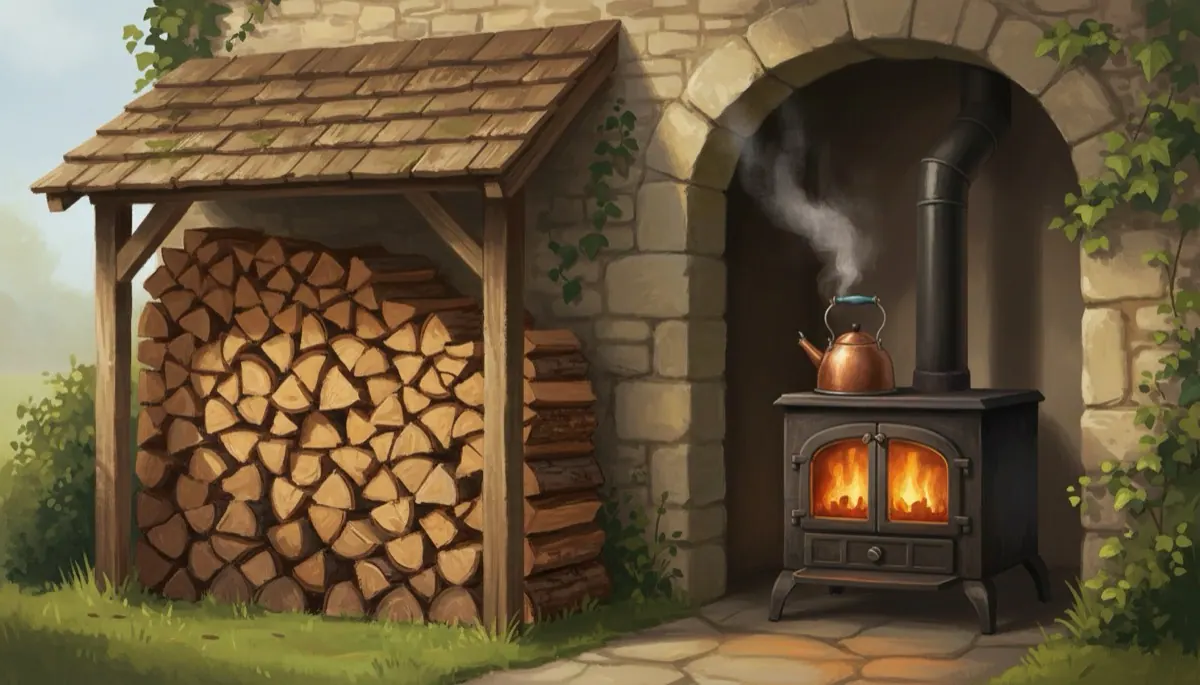
- Estimate a year of firewood for a household
- Season and stack wood to under 20 percent moisture
- Prevent chimney fires and carbon monoxide
How much wood a year really is
A small well-insulated house heated by one efficient stove burns roughly 3 to 5 cubic metres of stacked seasoned hardwood a year in a mild climate, and 8 to 15 in a cold one or a draughty stone house. Cooking on wood adds more. That is not an afternoon of work: cutting, splitting, hauling and stacking a winter's wood is several full days of physical labour, repeated every year, plus the cost of a saw, fuel, chains and protective kit. Buying it delivered in Portugal typically runs tens of euros per stacked cubic metre and varies hugely by region and species.
Seasoning and moisture content
Fresh-cut wood is around half water. Burning it wastes most of the heat boiling that water off, fills the flue with tar and blackens the glass. Split it soon after felling, because bark stops drying, and give it time: 6 to 12 months for softwood, 12 to 24 months for dense hardwood like oak and olive. The target is under 20 percent moisture, measured with a cheap pin meter on a freshly split face, not on the outside of the log. Dry wood is lighter, rings rather than thuds when two pieces knock together, and often shows cracks across the end grain.
Stacking and stove efficiency
Stack off the ground on pallets or rails, in single rows with gaps for air, ends exposed to sun and prevailing wind, with a cover over the top only. A tarp down the sides traps moisture and grows mould. Keep the stack away from the house walls because it houses insects and rodents. On the stove itself: an open fireplace returns perhaps 10 to 20 percent of the wood's energy to the room, a modern closed stove 70 to 80 percent. Burn hot and bright with the air open rather than damping it down overnight, which is exactly what coats a flue in creosote.
Chimneys, creosote and sweeping
Creosote is condensed tar from cool smoke, and it burns. A chimney fire roars like a jet, throws flame from the pot and can reach 1000 degrees Celsius, cracking the flue and setting the roof alight. Prevent it: burn dry wood hot, and have the chimney swept at least once a year, twice if you burn resinous softwood or use the stove daily. Fit a spark arrestor where roofs and countryside are dry. If a chimney fire starts, close the stove air, get everyone out, call the emergency number, and do not throw water up the flue. Keep a working extinguisher near the stove.
Carbon monoxide and the Portuguese rules
Carbon monoxide has no smell, no colour and no taste, and it kills people asleep in their beds every winter from blocked flues, poorly fitted stoves and generators or braziers used indoors. Fit an audible CO alarm to the standard in every room with a burning appliance and outside the bedrooms, and test it monthly. Separately, learn the law: in Portugal burning of cut vegetation and agricultural piles is restricted and usually banned outright during the critical fire period, roughly July to September, and cutting certain trees such as cork oak and holm oak requires authorisation. ICNF and your camara municipal hold the current rules.
Check yourself
Under 20 percent, measured on a freshly split face, gives most of the heat to the room instead of boiling off water and tarring the flue.
Cool smouldering smoke condenses as tar inside the flue. Hot, bright fires and dry wood keep the chimney clean.
Starve it of air, get everyone out and call the emergency number. Water on a hot flue can crack it and scald you.
You cannot sense it at all, which is why an audible alarm near every burning appliance and outside bedrooms is essential.
Try it for real: Get one winter of wood right
- Measure your stack and record the cubic metres you burned last winter
- Buy a moisture meter and test three logs on freshly split faces
- Restack one row off the ground, single width, covered on top only
- Book a chimney sweep for early autumn
- Fit and test a CO alarm in the room with the stove
🛒 Gear for this skill
As an Amazon Associate I earn from qualifying purchases. It costs you nothing extra and keeps this site free.
Next lesson: Keeping Food Without Electricity →
Written and checked by the Human Skills team against the sources below. How we check our content
- ICNF (Instituto da Conservacao da Natureza e das Florestas)
- WHO Guidelines for Indoor Air Quality
- US EPA Burn Wise