 Human Skills
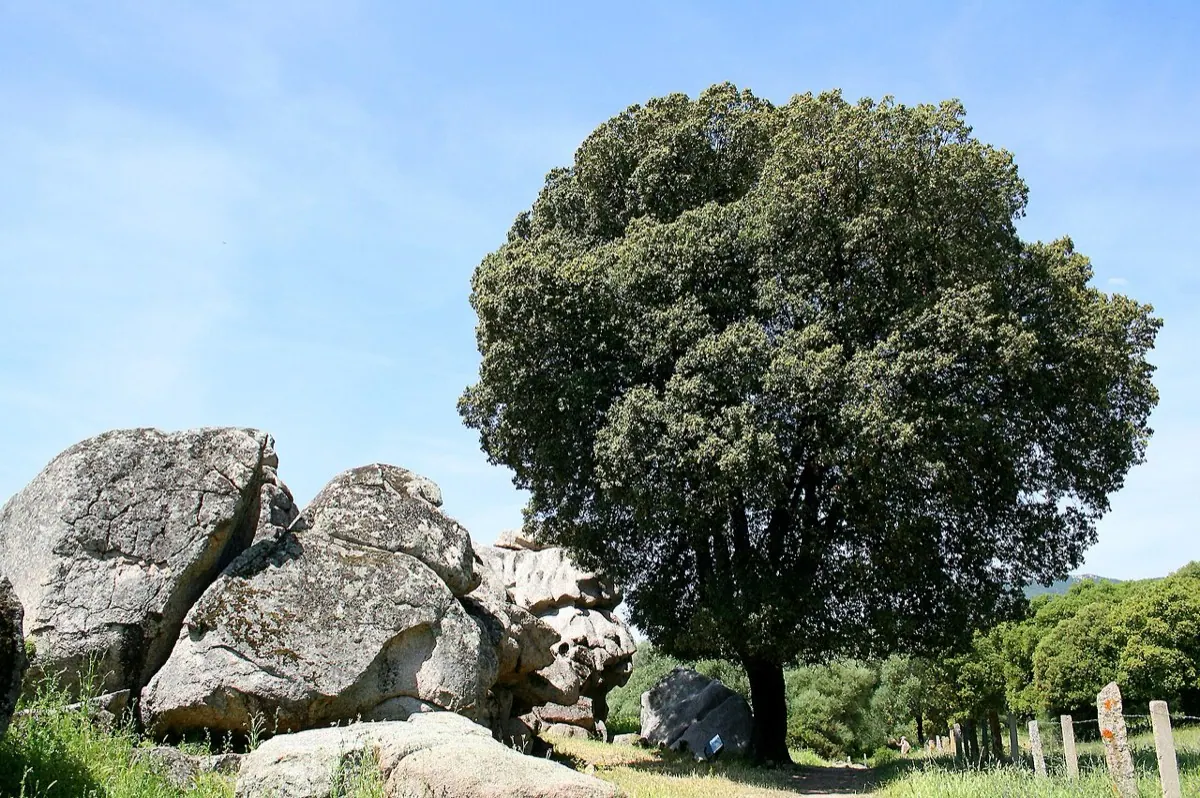
Photo: Jean-Pol GRANDMONT, CC BY 3.0, Wikimedia Commons

Acorn (Holm and Cork Oak)
Quercus ilex, Quercus rotundifolia and Quercus suber
EdibleA serious wild staple hidden behind bitter tannin, and the Portuguese montado holm oak gives the sweetest acorns in Europe once they are leached.
Confused with
Danger: Toxic, causing vomiting and stomach pain. Not deadly for an adult, but genuinely unpleasant and it will not leach out.
How to tell: An acorn sits in a scaly cup and comes from a tree with simple lobed or oval leaves. A conker comes from a thick green husk with a few blunt spikes on a tree with hand-shaped compound leaves. Leaching does nothing to a conker: it stays toxic. Never mix nuts from two trees in one leaching batch.
Danger: None are toxic, but some are far more tannic and the kermes oak acorn is small and barely worth the work.
How to tell: All acorns are edible after leaching; the only difference is how much leaching. Holm oak acorns from a good tree are long, plump and comparatively sweet. Taste only after leaching, never before, and treat every batch as needing the full process.
Leaves
Evergreen, alternate, leathery, 3-8 cm, oval to lance-shaped, dark glossy green above and densely grey-white felted underneath so the tree looks two-toned in a breeze. Edges may be smooth or spiny-toothed, and juvenile and low branches are usually the spiniest, which is the tree defending itself from browsing.
Flowers
Yellow-green hanging catkins in April and May, followed by acorns that ripen in the same autumn. Cork oak acorns sit in a cup with loose spreading upper scales; holm oak cups have tight flat scales.
Stem
Cork oak is instantly known by its thick, spongy, deeply fissured pale bark that you can press with a thumb, or by the smooth red-brown trunk where the cork has been stripped. Holm oak bark is dark grey-black, finely cracked into small squares, and hard.
Smell or taste
Little smell. Do not taste a raw acorn to judge the tree: raw acorns are harshly bitter and astringent, and tasting is not an identification method. After leaching, the meal is confirmed safe and tastes mild, nutty and faintly sweet.
Habitat
The montado and dehesa of Alentejo and southern Portugal, plus dry hillsides, terraces and open woodland throughout the Mediterranean. Cork oak prefers slightly damper, more acid ground than holm oak.
Edible parts
The nut kernel, only after tannin leaching.
Preparation
Raw acorns are loaded with tannic acid. Eaten unleached they are violently astringent, cause stomach pain and nausea, and long-term tannin intake damages the kidneys. Leaching is not optional and it is not a flavour improvement. Step 1, gather and sort. Collect from the ground in October and November, taking plump brown acorns with the cap coming off cleanly. Float them in water and throw away every floater and every acorn with a small round hole, since those are weevil-drilled. Step 2, shell. Dry the acorns for a day or two so the shells crack, then crack them with a stone, a nutcracker or a rolling pin and pick out the kernels. Rub off as much of the papery inner skin as you can, because it is the most bitter part. 1 kg of whole acorns gives roughly 500 g of kernel. Step 3, grind. Chop or mill the kernels to a coarse meal, about the texture of breadcrumbs. Finer leaches faster; too fine and it washes away. Step 4, cold leach, which is the method that keeps the starch usable for flour. Put the meal in a jar or bowl, cover with plenty of cold water, stir, and let it settle. Pour off the brown water and replace it with fresh cold water. Do this at least twice a day. The water comes off dark tea-brown at first and gets paler each time. Keep going until the water runs clear and the meal is no longer bitter at all. With holm oak this typically takes 5 to 10 changes over 2 to 4 days; with a very tannic oak it can take a week or more. Do not stop early. Test by taking a pinch of the leached meal and tasting it: this is the one place tasting is correct, because the plant is already positively identified and the only question is bitterness. It must taste bland and nutty with no pucker and no drying sensation at the back of the tongue. If there is any astringency left, change the water again. Cold leaching in a stream in a cloth bag works well and saves labour, if the stream is clean and above livestock. Step 5, hot leach as the fast alternative. Boil the meal in a pan of water for 10 to 15 minutes, strain through a cloth, and tip it into a second pan of already boiling water. Repeat with fresh boiling water, typically 4 to 8 times, until the water stays clear and the meal is bland. Always move the meal into water that is already boiling; if you let it come up to the boil with cold water, the tannin sets into the starch. Hot leaching is quicker but it kills the starch, so the result works for porridge, patties and thickening but will not rise as bread flour. Step 6, dry and store. Spread the leached meal on trays and dry at 50 to 60 C for 4 to 8 hours, or in the sun for a day or two, until it snaps rather than bends. Mill to flour. Store in a sealed jar in the dark, or in the freezer, because acorn flour is oily and goes rancid within a few months at room temperature. Use it at up to 30 to 50 per cent of the flour in a bread or a pancake batter, since it has no gluten, or make it into a porridge with 1 part flour to 4 parts water simmered 10 minutes.
Traditional use
A staple food across Iberia, Sardinia, California and Korea, and in Portugal the bolota fed both people and the black Iberian pigs whose acorn diet gives presunto de bolota its character. There is no meaningful folk-medicine use; the tannin-rich bark was traditionally used for tanning leather and as an external astringent wash, not as an internal remedy.
Harvest rule
Cork and holm oaks are legally protected trees in Portugal. Under the sobreiro and azinheira legislation you may not cut, prune or damage them without authorisation, and stripping cork is a licensed operation on a nine-year cycle: never cut into, carve, nail or strip bark from either tree, and never light a fire under one. Gather only fallen acorns from the ground, never beat or shake the branches, and remember the acorn crop in a montado is a working farm resource fed to pigs, so it belongs to the landowner. Ask permission before gathering on any montado. Leave the bulk of the crop: acorns also feed jays, wood pigeons, wild boar and the trees own regeneration. Foraging law varies by country; inside ICNF protected areas and Rede Natura sites check the rules before collecting.
Bolota, lande (PT), bellota (ES), gland (FR)