 Human Skills
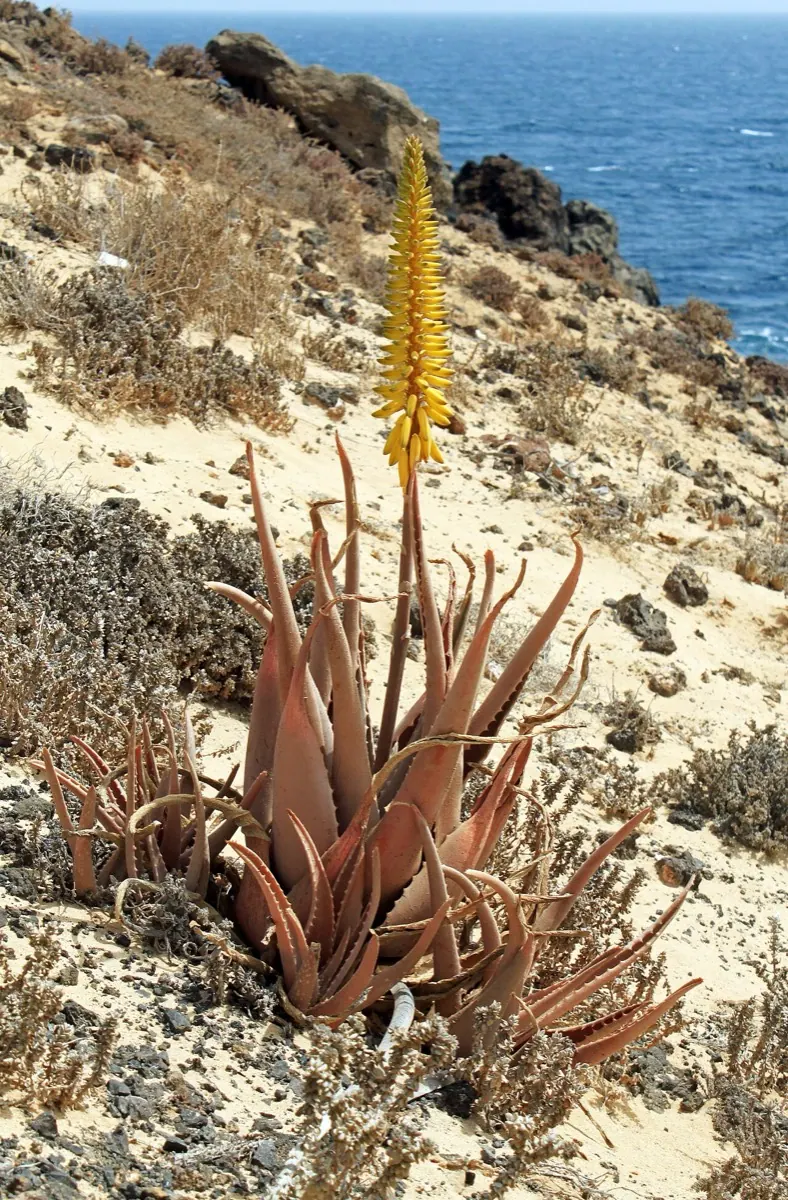
Photo: H. Zell, CC BY-SA 3.0, Wikimedia Commons

Aloe Vera
Aloe vera
A thick-leaved succulent whose clear inner gel is the classic burn plant, and whose bitter yellow sap just under the skin is a harsh laxative.
Confused with
Danger: Genuinely nasty. Agave sap contains calcium oxalate needles and saponins that cause severe burning, blistering dermatitis that can last weeks, and its terminal spine causes deep puncture wounds.
How to tell: Agave leaves are far larger, up to 2 m, rigid and fibrous rather than juicy, grey-blue, with a single vicious hard black spine at the tip and large hooked teeth along the edge. Cut one and it gives watery irritant sap, not clear jelly. Aloe is smaller, soft, juicy, with small pale soft teeth and no terminal spine.
Danger: Not deadly, though some are more strongly purgative than Aloe vera.
How to tell: Aloe arborescens forms a branching shrub on a woody trunk with narrower, strongly toothed curved leaves and orange-red flowers. Aloe vera is a stemless rosette with broad leaves and yellow flowers.
Danger: Harmless but useless, and no source of gel.
How to tell: They are much smaller, usually under 15 cm, with hard, dark, often window-patterned or bumpy leaves, and they do not hold a thick clear jelly.
Leaves
In a dense rosette from the base, thick and fleshy, 30 to 60 cm long and 5 to 10 cm wide at the base, tapering to a point, grey-green to bright green, often speckled white when young. The edges carry small pale firm teeth about 2 mm, spaced roughly 1 cm apart. Cut one across and there are three layers: a tough green skin, a thin lining that weeps bitter yellow sap, and a thick clear jelly in the middle.
Flowers
A tall unbranched or lightly branched spike carrying many drooping tubular yellow flowers, each 2 to 3 cm long, in the upper third. Flowers in late winter and spring in Portugal.
Stem
Effectively none: the leaves arise directly from a very short woody base. Offsets, called pups, grow around the parent to form a clump.
Smell or taste
The clear gel smells of almost nothing and is slippery. The yellow sap under the skin smells sharply bitter and stains. Do not taste it: the bitterness is the latex and that is exactly the part to avoid.
Habitat
Gardens, pots, balconies, dry walls, roadside plantings and coastal gardens throughout Portugal, the Algarve, Madeira and the Canaries. Widely naturalised in the Mediterranean and thoroughly at home in a Portuguese summer.
Preparation
Cut an outer, older leaf close to the base with a clean knife. Stand it cut-end down in a glass or on a tilted board for ten to fifteen minutes and let the bitter yellow sap drain out and be discarded. This draining step is the whole safety procedure and it is not optional. Then lay the leaf flat, slice off the spiny edges, cut away the green skin from one face, and lift or spoon out the clear inner gel, leaving any yellow-tinged layer behind with the skin. Rinse the gel to remove the last of the latex. The gel goes straight onto intact skin. It has no preservative in it, so it spoils quickly: keep it in a covered container in the fridge and use it within about three or four days, or freeze it in an ice tray. This guide gives no internal preparation and no dose. Whole-leaf and latex preparations taken internally are a different matter entirely and are covered in the cautions.
Traditional use
Babosa sits on windowsills all over Portugal for exactly one reason: when someone catches the edge of a hot pan or comes home burnt from the beach, a leaf gets cut and the cool jelly goes on the skin. That is the oldest and most widespread traditional use, recorded around the Mediterranean and North Africa for thousands of years, along with its use on dry skin and chapped hands. The bitter yellow latex has a separate and much older history as a violent purgative, used in classical and medieval medicine, and that history is not one to revive. Tradition and household custom, recorded here as history and not as a treatment.
Harvest rule
Grow your own. Aloe vera is easy in a pot in Portugal, needs little water, and pups freely, so one plant becomes a shelf of them and nobody needs to cut a stranger's. Take only the outer leaves, no more than two or three at a time from a mature plant, and never cut the central growing leaves. Do not cut aloes planted in public spaces or on roadsides, which are municipal property. In Madeira, the Canaries and mainland Iberia some native and introduced aloes are protected or regulated, so check local rules, which vary by country, and always ask the landowner first.
Aloé-vera, babosa (PT); aloe vera, sábila (ES)