 Human Skills
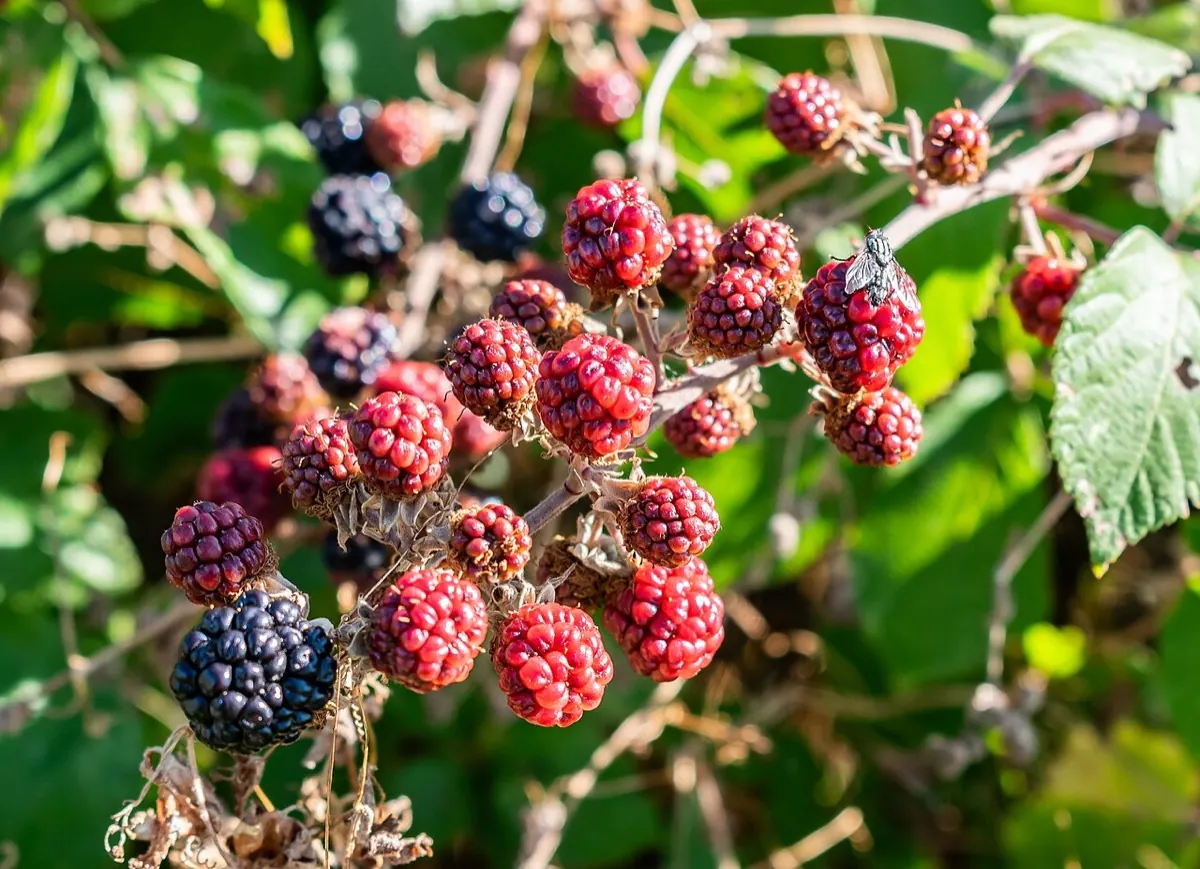
Photo: Tournasol7, CC BY 4.0, Wikimedia Commons

Blackberry
Rubus fruticosus agg.
EdibleThe safest wild fruit in Europe: a thorny arching bramble with a clustered fruit made of many little beads, and no dangerous lookalike.
Confused with
Danger: None. Edible and good.
How to tell: Fewer, larger beads per fruit with a distinct blue-grey waxy bloom, and weaker trailing canes. Eat it the same way.
Danger: Black nightshade berries contain solanine; elderberries must be cooked. Neither is deadly in a single berry, but neither is blackberry.
How to tell: A blackberry is an aggregate: one fruit made of many small shiny beads pressed together, growing on a thorny arching cane with palmate leaves. Nightshade and elder berries are single smooth round berries on soft or woody non-thorny plants. If the fruit is one smooth sphere rather than a cluster of beads, it is not a blackberry.
Leaves
Alternate, palmate: three or five leaflets spreading from one point like a hand. Each leaflet 4-10 cm, oval, pointed, sharply and evenly toothed, dark green above and noticeably paler and downy underneath. Small hooked prickles run along the underside of the leaf midrib.
Flowers
White to pale pink, 2-3 cm across, five petals, many stamens in the centre, in loose clusters at the cane tips from May to August. Heavily worked by bees.
Stem
Long arching canes, angled or grooved rather than round, green to purple-red, armed with stout curved thorns that hook backwards. Biennial: a cane grows in year one and fruits in year two.
Smell or taste
Almost no smell from crushed leaves, a faint green astringency. The ripe fruit is confirmed safe and tastes sweet and slightly winey; unripe red fruit is harshly sour.
Habitat
Hedges, woodland edges, abandoned terraces, scrub, roadsides, riverbanks, old walls. Everywhere in Portugal and often dominant on abandoned farmland.
Edible parts
Ripe fruit, young leaves for tea, and the peeled young shoot tips in spring.
Preparation
Pick fruit that is fully black, dull rather than shiny, and comes away with almost no pull. A fruit you have to tug is not ripe and will be sour. Traditionally people stop picking after late September or early October, when the fruit gets watery and mouldy; the old story about the devil spitting on them is a sensible note about fungal spoilage. Eat fresh, or freeze spread on a tray then bagged. For jam, use 1 kg of fruit to 750 g of sugar and the juice of a lemon, since blackberries are low in pectin, and boil hard to 105 C. For jelly, simmer 1 kg of fruit in 300 ml of water for 20 minutes, strain overnight through a cloth without squeezing, then boil the juice with 450 g of sugar per 600 ml. Young leaves picked in spring make a good tea: dry them in shade for 3 to 4 days, or ferment them by bruising, sealing in a jar for 24 hours and then drying, which gives a much better flavour. Use 1 to 2 teaspoons per 250 ml, steeped 8 minutes. Peeled young shoots in April can be eaten raw or briefly steamed.
Traditional use
Blackberry leaf has an old European reputation as an astringent, traditionally taken as a tea for mild diarrhoea and used as a gargle for sore throats and mouth ulcers. The fruit is straightforward food, rich in vitamin C and anthocyanins.
Harvest rule
Leave plenty of fruit: blackberries are a critical autumn food for birds, foxes and dormice, and the flowers are major bee forage. Take from the outside of a thicket and move on rather than stripping one bush. Foraging law varies by country, and in several European countries picking wild fruit for personal use on unenclosed land is expressly allowed while commercial picking is not. In Portugal, ask before entering enclosed land, do not damage hedges and walls, and check ICNF rules in protected areas. Brambles often mark abandoned private terraces that still have an owner.
Amora-silvestre, silva (PT), zarzamora (ES), mure (FR)