 Human Skills
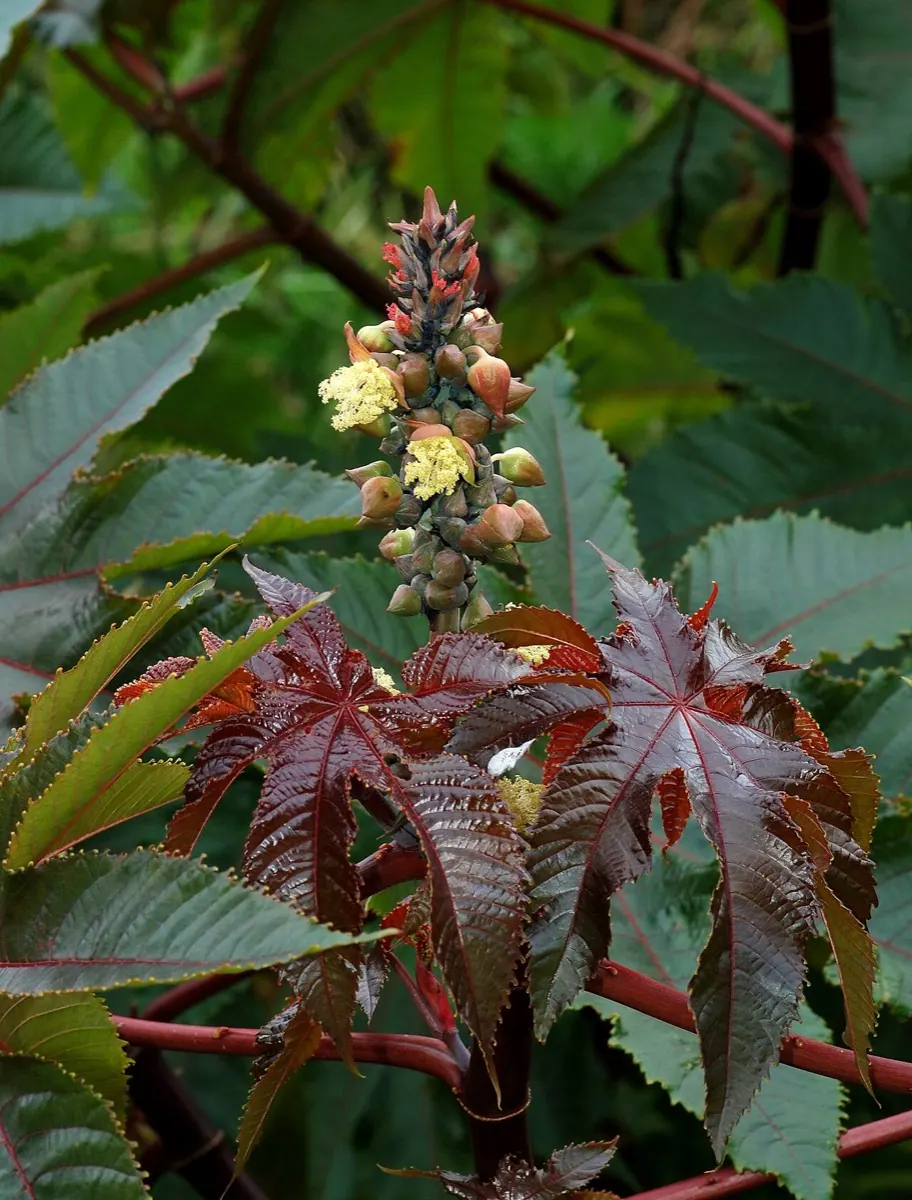
Photo: Alvesgaspar, CC BY-SA 3.0, Wikimedia Commons

Castor Bean
Ricinus communis
PoisonousIts mottled seeds contain ricin, one of the most poisonous substances known, and a few chewed seeds can kill an adult.
Confused with
Danger: Ricin destroys cells in the gut and then the liver and kidneys. Severe vomiting and bloody diarrhoea start within hours, then dehydration and organ failure over days. There is no antidote. Two to eight chewed seeds can kill an adult, fewer in a child.
How to tell: The seed itself is the check: glossy, oval, and mottled brown and grey with a small pale wart at one end, exactly like a blood-filled tick. No edible bean is mottled like that or comes from a spiny round capsule on a giant hand-shaped-leaved plant. If a bean came off a wild plant with spiny fruits, it is not food.
Danger: Seeds drilled for beads have poisoned the people making them. Swallowing an intact seed usually passes through, but any seed that is chewed or cracked releases ricin.
How to tell: Do not string, drill or handle unknown mottled seeds. If in doubt about a seed's identity, it is not a bead.
Leaves
Huge, 15 to 45 cm across, palmate like an open hand with 5 to 11 pointed toothed lobes radiating from the centre, glossy, green or bronze-red, on a long stalk attached to the underside of the leaf rather than at the edge. Alternate.
Flowers
A stiff upright spike with greenish yellow male flowers below and spiky red female flowers above. The fruit is unmistakable: a cluster of round capsules 1.5 to 2.5 cm covered in soft red or green spines, each splitting into three shiny seeds mottled brown, grey and cream like a swollen tick.
Stem
Thick, hollow, smooth, jointed, green, red or purple with a waxy bloom, hollow between the joints.
Smell or taste
Little smell. Never taste any part. The seeds are attractive and bean-like and have killed children who chewed them.
Habitat
Waste ground, riverbanks, roadsides, coastal scrub, abandoned plots and gardens throughout Portugal and the Mediterranean. Planted as an ornamental and thoroughly naturalised.
Preparation
There is no home preparation that makes the seed safe. Commercial castor oil is safe only because the pressing process is followed by heat treatment that destroys ricin under controlled conditions, and the residue cake is a known agricultural poison. You cannot reproduce that at home, and pressing seeds in a kitchen leaves the ricin in the oil.
Traditional use
Castor oil has a long history as a purgative and as a lamp and machine oil, and it is still produced industrially. That oil is heat-treated, tested and bottled under laboratory control. The raw seed remains one of the most toxic plant materials in the world, and attempting to press or extract it at home is lethal. Do not try.
Harvest rule
Remove rather than harvest. Gloves, long sleeves, eye protection and a dust mask, cut before the capsules ripen so seed is not spread, and bag all the fruiting heads. Do not burn large amounts near people and do not compost the seeds. It is an invasive species in many regions, so cutting it back on waste ground is usually welcome, but get the landowner's permission and check whether your region lists it as invasive with specific disposal rules.
Ricino, carrapateira, mamona (PT); castor oil plant (EN)