 Human Skills
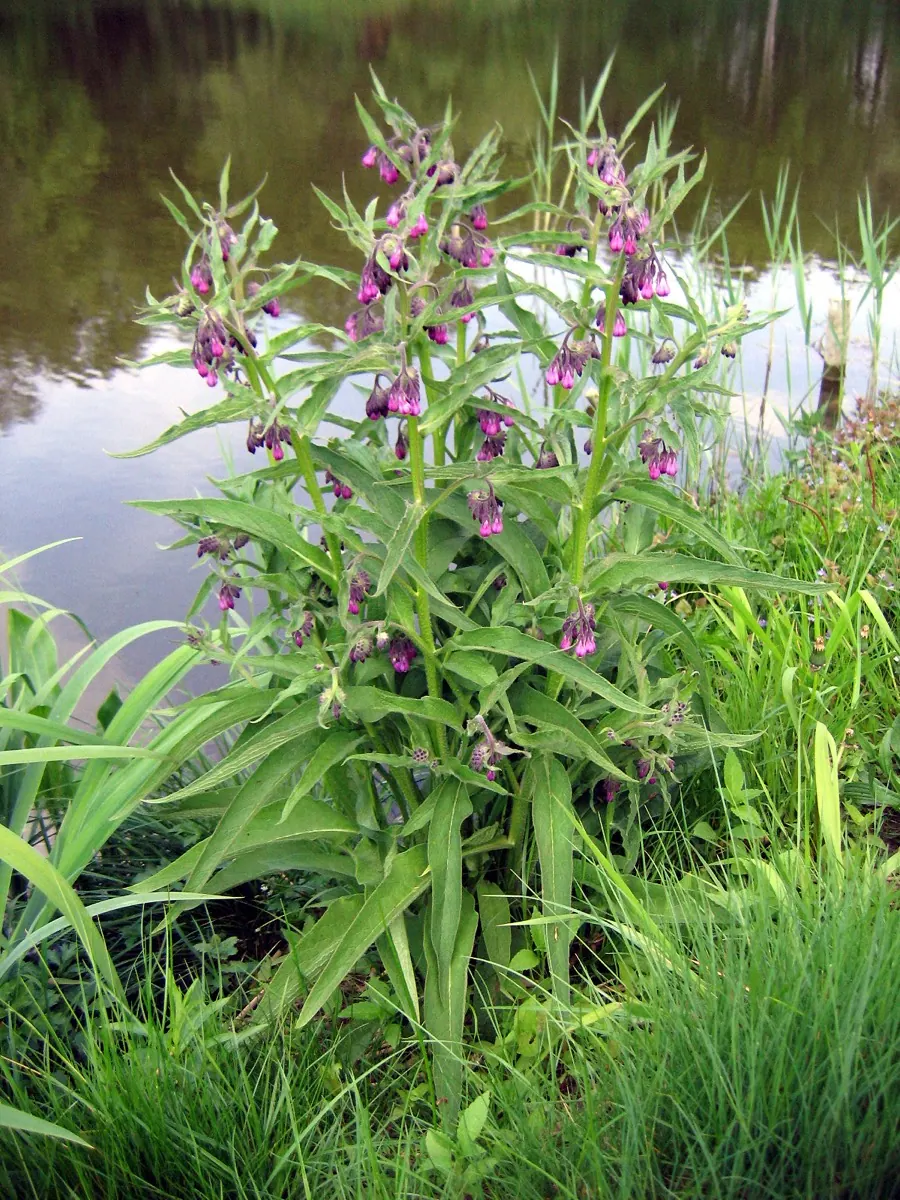
Photo: Agnieszka Kwiecień (Nova), CC BY 2.5, Wikimedia Commons

Comfrey
Symphytum officinale
PoisonousA bristly, black-rooted riverside plant famous as the bone-knit herb, which must never be taken internally and is easily confused with deadly foxglove.
Confused with
Danger: Deadly. Foxglove contains digitalis-type cardiac glycosides that slow and disorder the heartbeat. People have died from tea made with foxglove leaves picked in mistake for comfrey, and the poisoning is slow, frightening and hard to treat. Symptoms include nausea, vomiting, disturbed yellow-green vision, and an irregular or very slow pulse.
How to tell: Check all four, and if even one does not match, walk away. 1. Leaf edge: foxglove leaves are clearly and evenly toothed or scalloped all the way round. Comfrey leaves have a smooth, untoothed edge. 2. Surface: foxglove leaves are deeply net-veined and quilted, with the surface sunk into pits between a raised network of veins, and they feel soft, downy and grey-green. Comfrey leaves feel harsh and bristly, like a cat's tongue, and are dark green without the pitted quilting. 3. Leaf base: comfrey leaf bases run down the stem as a raised wing, so the stem looks winged. Foxglove leaves sit on a distinct winged stalk but do not run down the stem in the same way, and the rosette leaves are clearly stalked. 4. Flowers: foxglove carries a tall one-sided spike of large tubular bells 4 to 5 cm long, purple or white, heavily spotted inside. Comfrey carries small bells under 2 cm in a coiled, uncurling cluster. The dangerous moment is spring, before either plant flowers, when both are rosettes. If there is no flower, use the leaf edge and the bristles, and if you are not certain, do not pick.
Danger: Not dangerous, but a different plant with different traditional uses.
How to tell: Mullein leaves are pale grey and covered in soft woolly felt like flannel. Comfrey leaves are dark green with stiff bristles that prickle.
Danger: More dangerous, not less: these hybrids generally contain higher levels of the liver-damaging alkaloids than common comfrey.
How to tell: They are coarser, often taller, usually with blue or purple flowers, and the leaf bases run less far down the stem. It does not matter much for safety, because the rule is the same for all of them: external use only.
Danger: Related bristly plants that also contain pyrrolizidine alkaloids, so the same internal warning applies to them.
How to tell: Both carry flat, open, bright blue star-shaped flowers rather than hanging bells. Comfrey's flowers hang as bells from a coiled stalk.
Leaves
Alternate, very large at the base, 15 to 45 cm long, oval and tapering to a point, dark green, with a smooth untoothed edge, covered in stiff bristly hairs that feel rough and prickly when stroked in either direction. The base of the leaf runs down the stem as a raised wing, and the veins are strongly marked but the surface between them is not deeply pitted or wrinkled.
Flowers
Hanging bells 12 to 18 mm long, in a one-sided coiled cluster at the shoot tips that uncurls like a scorpion's tail as the flowers open. Colours run from creamy white and yellow to pink, purple and mauve depending on the plant. Bumblebees bite holes in the base of the bells to reach the nectar.
Stem
Stout, angled and winged by the running leaf bases, hollow in the older lower part, and densely covered in stiff bristles. It branches in the upper half.
Smell or taste
A faint, damp, green, cucumber-like smell when bruised. Never taste this plant. Its roots are black outside and white and slimy inside, and no part of it belongs in your mouth.
Habitat
Damp ground: riverbanks, ditches, wet meadows, stream edges, canal sides, damp waste ground and old gardens. Widespread across Europe and found in damp ground in northern and central Portugal, often as a garden escape.
Preparation
External use only. That is not a precaution, it is the whole rule for this plant. Poultice, the traditional form: fresh leaves are wilted for a few seconds in hot water or crushed to a mash, cooled to comfortable skin temperature, spread on a clean cloth and bound over an intact, unbroken area of skin for twenty to thirty minutes, then removed and the skin washed. Infused oil and salve: fully dried leaves are packed loosely into a jar, covered with olive oil, left warm for three to four weeks with daily shaking, then strained through cloth. The oil can be warmed with about one part beeswax to eight parts oil to set as a salve. Use dried leaf only, because fresh leaf brings water into the oil and spoils it. Drying for storage: cut leaves in dry weather, spread them singly on mesh in a warm airy dark place for one to two weeks until brittle, and store in a labelled sealed jar, clearly marked external use only so that nobody in the house ever brews it. Comfrey is also outstanding as a garden feed: leaves left to rot in a covered barrel of water for four to six weeks make a strong liquid fertiliser, and that is a use with no risk to anyone.
Traditional use
Comfrey is one of the most famous plants in European folk medicine. Its English name knitbone and its Portuguese name consolda both record the same tradition: crushed leaf and root were bound over sprains, bruises and slow-healing breaks in country households across the continent. Poultices were also applied to aching joints and strained muscles. The other half of its history has to be told with it. Comfrey was for a long time also brewed as a tea and eaten as a vegetable, and that turned out to be a serious mistake. It contains pyrrolizidine alkaloids, which cause cumulative and sometimes fatal liver damage by blocking the veins of the liver. Cases of liver failure have been documented, including in people who drank comfrey tea daily for months believing it was harmless. Internal comfrey products are restricted or banned in many countries for this reason. So: an external-use plant with a long and genuine tradition, and an internal poison. Both facts are true and neither should be softened.
Harvest rule
Comfrey grows vigorously and is easy to establish in a damp corner, so grow your own rather than digging wild plants: the root fragments regenerate and digging riverbanks damages the bank and the plants holding it. Cut leaves with a knife, taking no more than half a clump at a time, and leave flowering stems for bumblebees, which depend heavily on them. Never uproot wild plants. Get the landowner's permission, and check local rules, which vary by country, restrict collecting in protected areas and national parks, and in several countries also restrict the sale of comfrey products for internal use.
Consolda-maior, confrei (PT); consuelda mayor (ES)