 Human Skills
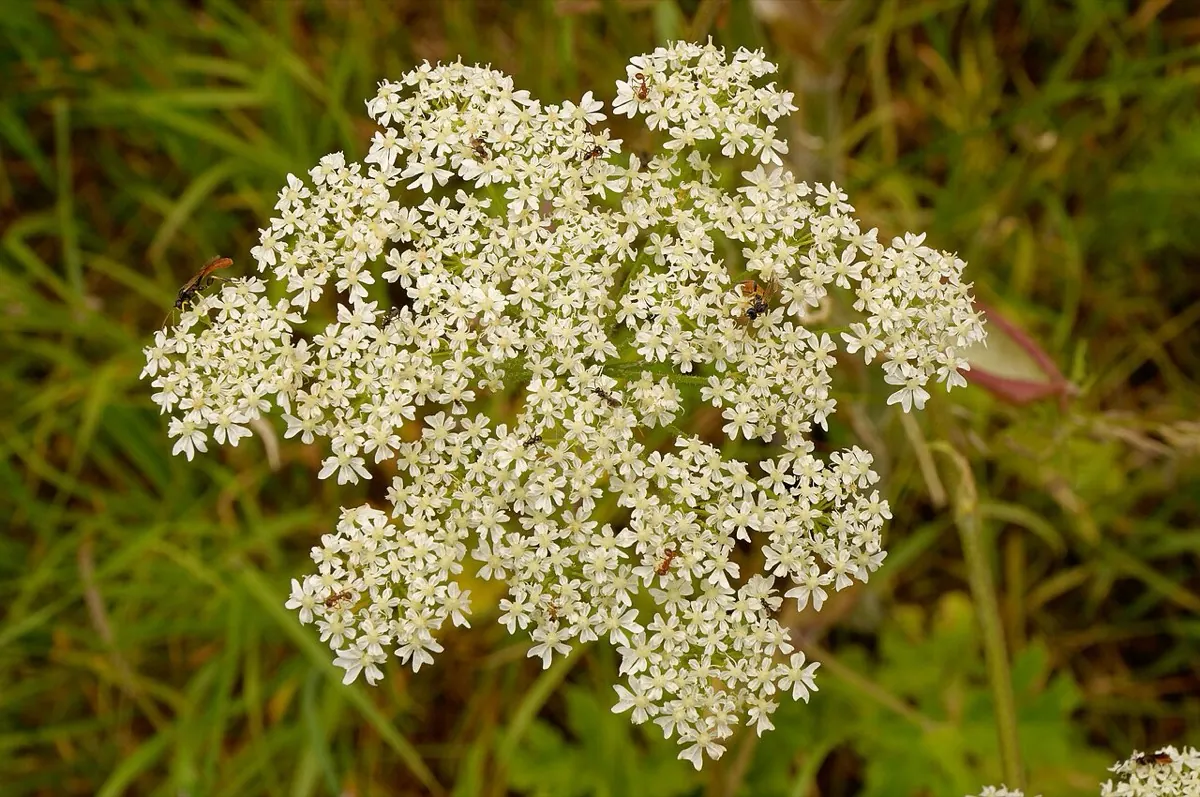
Photo: Pierre-Jacques DESPA, CC BY-SA 4.0, Wikimedia Commons

Common Hogweed
Heracleum sphondylium
PoisonousEaten by some foragers, but its sap burns skin in sunlight and it sits in the family that kills, so it is listed here as a caution, not a vegetable.
Confused with
Danger: Picking hemlock while looking for hogweed shoots is a fatal mistake. Hemlock causes creeping paralysis and death from breathing failure.
How to tell: Run your fingers up the stem. Common hogweed is bristly and rough. Hemlock is completely smooth and hairless with purple blotches. Hairy is hogweed, smooth and blotched is hemlock, and if the plant is smooth you stop there.
Danger: Far stronger phototoxic sap and far worse burns.
How to tell: Height and head size. Over 200 cm with an umbel wider than 40 cm is the giant. Do not touch it.
Leaves
Large, up to 60 cm, divided into three to five broad lobed and coarsely toothed leaflets, rough and bristly on both sides, especially beneath. Alternate, with a wide inflated sheath where the stalk meets the stem.
Flowers
White or pinkish-white flat umbels 10 to 25 cm across. The outer petals of the outer flowers are noticeably larger and unequal, giving a ragged edge to the head.
Stem
Hollow, strongly ridged, green and sometimes flushed purple at the nodes, covered in stiff bristly hairs. The hairs are the clearest separation from hemlock, which is perfectly hairless.
Smell or taste
Crushed leaves smell rank and slightly pig-like, which is where the name comes from. Do not use taste as a check.
Habitat
Hedgerows, roadsides, meadows, woodland edges, damp grassland. Very common across most of Europe, less common in southern Portugal.
Preparation
This guide does not give it as food. Even where young shoots are eaten traditionally, the sap is phototoxic, some people react badly to it, and the identification sits inside the most dangerous plant family in Europe. There is no preparation that removes the phototoxic risk to skin, and no preparation that undoes picking hemlock by mistake.
Traditional use
Young shoots and flower buds have been cooked as a spring vegetable in parts of northern and eastern Europe, and the plant was cut as pig fodder, which gave it its name. Treat that as history. Do not start with this plant.
Harvest rule
Treated here as a plant to know and avoid, not to gather. If you clear it, wear gloves and long sleeves, work out of bright sun, and wash tools and skin afterwards. Leave standing plants on field edges where they feed pollinators, take nothing from roadsides that are sprayed, and ask the landowner before cutting anything.
Branca-ursina, canarios (PT); cow parsnip, hogweed (EN)