 Human Skills
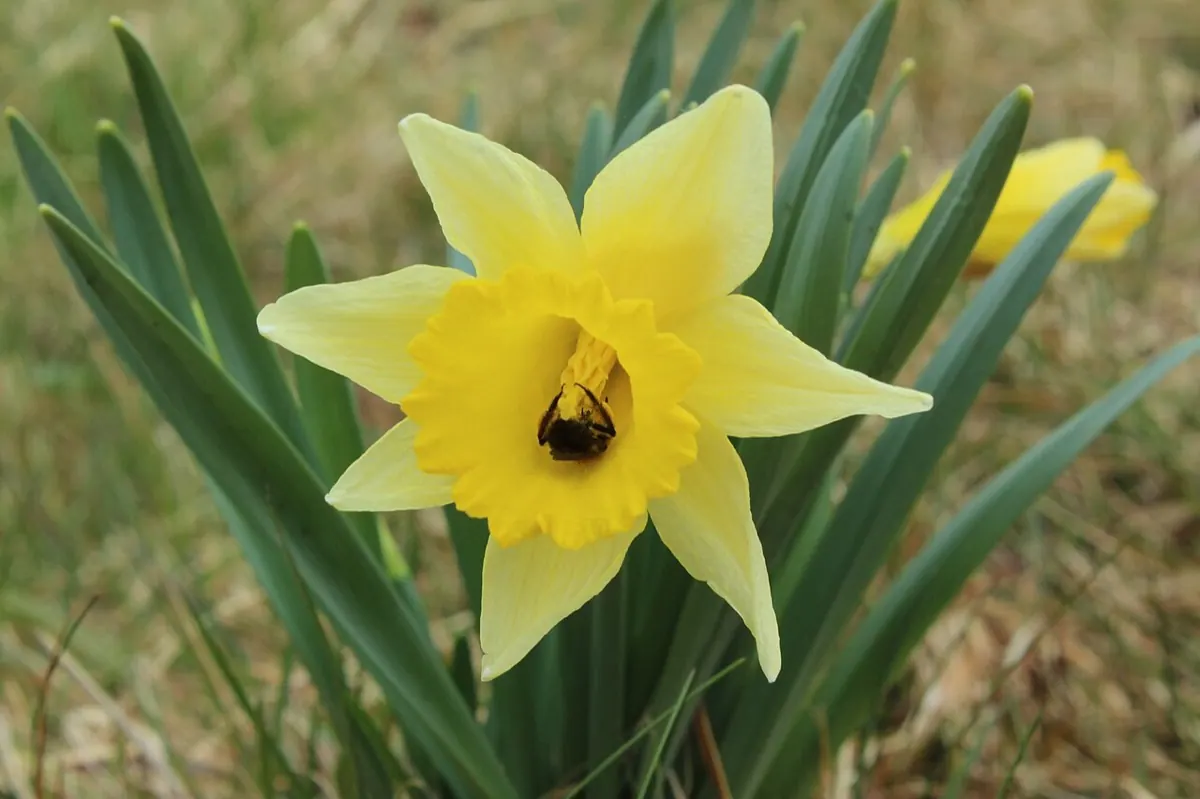
Photo: Morbus147, CC BY-SA 4.0, Wikimedia Commons

Daffodil
Narcissus species
PoisonousIts bulb sits in the ground looking exactly like an onion and causes violent vomiting, cramps and collapse.
Confused with
Danger: Lycorine and related alkaloids cause burning mouth, heavy salivation, violent vomiting, cramping diarrhoea, sweating, low blood pressure and sometimes heart rhythm problems. Whole families and school kitchens have been poisoned when daffodil bulbs were stored or planted beside onions.
How to tell: Cut the bulb in half and smell it. An onion smells like an onion and stings your eyes, and its layers are concentric rings that separate cleanly. A daffodil bulb smells of nothing, and its flesh is denser with a hard flat base plate. No onion smell means it is not an onion, whatever it looks like.
Danger: Daffodil leaves gathered among wild garlic cause the same violent vomiting, and the poisoning is often blamed on a bad meal instead of the plant.
How to tell: Smell each crushed leaf. Allium smells of garlic or onion every time. Daffodil leaves smell green and nothing more, are thicker, blue-green and blunt-ended, and come up in a bundle from one bulb.
Danger: Daffodil leaves pushing up through a herb bed in late winter get snipped into food.
How to tell: Chive leaves are hollow tubes, round in cross section. Daffodil leaves are flat and solid. Roll a leaf between your fingers: hollow tube means chive, flat strap means stop.
Leaves
Flat or slightly keeled strap-shaped leaves 20 to 50 cm long and 5 to 20 mm wide, blue-green or grey-green, blunt-tipped, rising in a bundle straight from the bulb with no stem. Solid, not tubular.
Flowers
One or several flowers per stalk, yellow, white or two-toned, with six spreading outer segments and a central trumpet or cup, emerging from a papery brown sheath. The bulb is a brown-skinned onion shape 3 to 6 cm across with white layered flesh.
Stem
A single hollow leafless flower stalk, round or slightly flattened, rising from the bulb.
Smell or taste
Many are sweetly scented in flower. Crucially, the bulb and leaves have no onion or garlic smell at all. Never taste any part.
Habitat
Gardens, orchards, verges, churchyards and naturalised on banks and meadows. Wild narcissus species are native in Portuguese mountains and grassland, and garden daffodils escape everywhere.
Preparation
No preparation makes it safe. Boiling, roasting and frying do not destroy the alkaloids, and cooked daffodil bulb in a stew is a recorded cause of mass poisoning. There is no way to make it food.
Traditional use
Narcissus alkaloids are studied in medicine, and galantamine, used for Alzheimer's disease, comes from snowdrop and narcissus species. That medicine is extracted, purified and dosed in a laboratory and a pharmacy. Home preparation of any kind is dangerous and pointless.
Harvest rule
Not a harvest plant. Gloves when lifting and dividing bulbs, and keep the bulbs in clearly marked containers well away from food. Many wild Narcissus species in Portugal and Spain are legally protected and must not be dug from the wild at all, so buy bulbs and leave wild populations alone. Never put bulbs or foliage where stock or poultry can reach them.
Narciso, junquilho (PT); daffodil, narcissus (EN)