 Human Skills
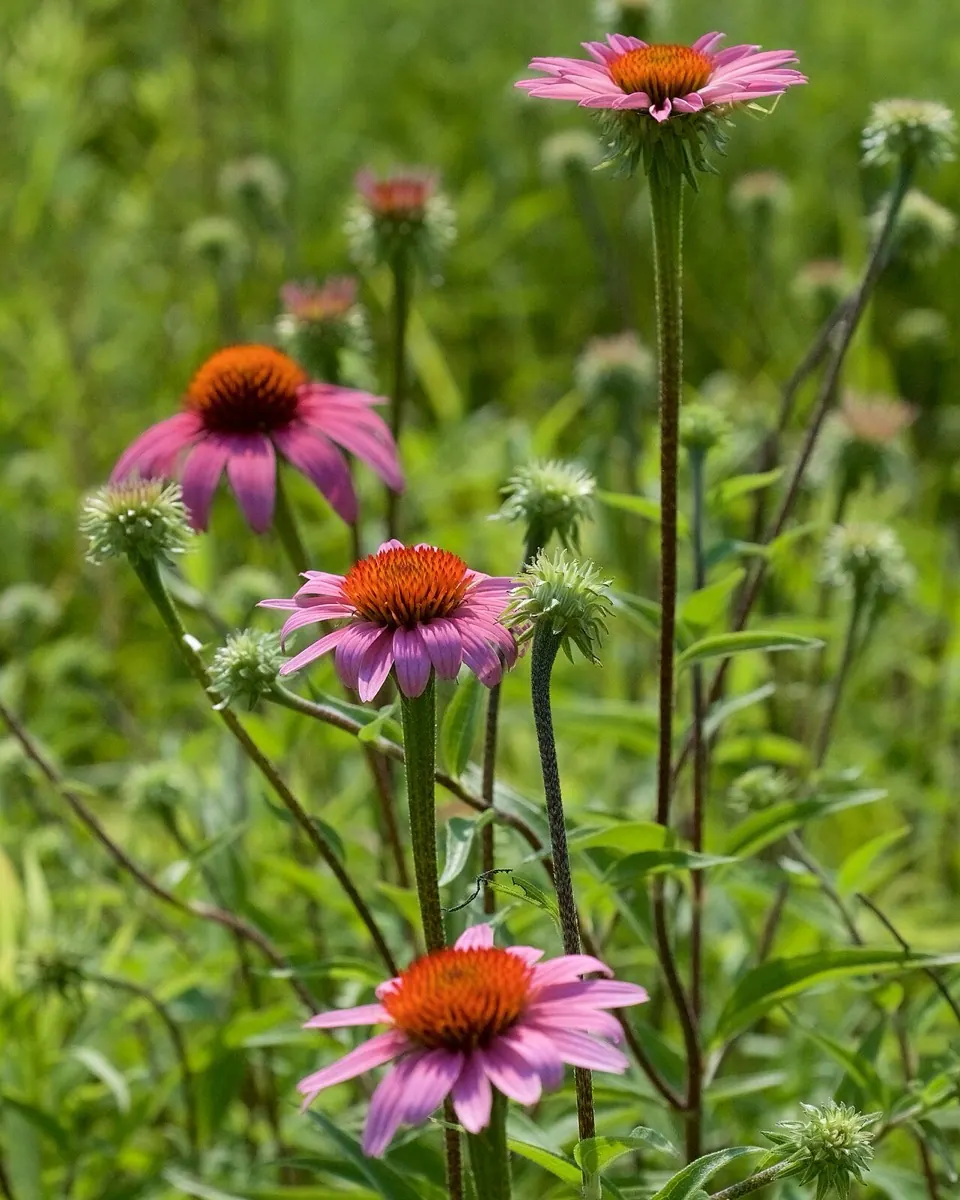
Photo: Eric Hunt, CC BY-SA 4.0, Wikimedia Commons

Echinacea (Purple Coneflower)
Echinacea purpurea
A North American prairie daisy with drooping purple rays and a spiky orange cone, now grown across Europe as the best-known cold-season herb.
Confused with
Danger: Not dangerous, but different in chemistry and in traditional use, and often substituted in commerce.
How to tell: E. angustifolia is shorter, under 60 cm, with narrow leaves and short pale rays. E. pallida has very long, thin, pale drooping rays. E. purpurea is the tall one with broad rough leaves and rich rose-purple rays.
Danger: Harmless but not the traditional herb.
How to tell: Rudbeckias have yellow or orange rays around a dark smooth cone. Echinacea purpurea has purple-pink rays around a spiny orange-brown cone.
Danger: Real danger. Ragworts contain pyrrolizidine alkaloids and cause cumulative, irreversible liver damage.
How to tell: Ragworts are yellow-flowered with many small heads in a branched cluster and ragged deeply cut leaves. Echinacea has a single large purple head per stem on a stiff rough stalk.
Leaves
Alternate, rough and sandpapery on both sides with coarse stiff hairs, dark green. Lower leaves broadly oval to lance-shaped, 10 to 20 cm long on long stalks, with three to five strong veins running from the base along the leaf and a coarsely toothed edge. Upper leaves smaller and stalkless.
Flowers
One large head per stem, 7 to 12 cm across. Twelve to twenty long strap-shaped rays in rose-purple or pink, which droop downwards away from the centre, around a raised dome of dark orange-brown, spiky, bristly disc florets. That spiny cone gives the plant its name, from the Greek for hedgehog.
Stem
Single or few, round, stiff, rough-hairy, solid, green sometimes flushed purple, mostly unbranched below the flower.
Smell or taste
Little smell from the flowers. The root has a faint sweet then sharply pungent quality. Do not use taste to identify: identify by the drooping purple rays and the spiny orange cone.
Habitat
Garden borders, herb beds, wildflower plantings and market gardens. Not a European native, so it is grown, not foraged. It does well in Portuguese gardens with sun and free-draining soil.
Preparation
The flowering tops are cut in the second or third year, at the point of full flowering, and the roots lifted in autumn of the third or fourth year, when the plant has enough root to give. Dry the flowering tops in a dark airy place for one to two weeks until brittle. Wash and split roots, then dry them slowly in a warm airy place until they snap; roots are dense and take two to four weeks. Store both in sealed, dark, labelled jars and use within a year. The two traditional forms are a tincture, made by steeping the fresh or dried plant in alcohol for several weeks and straining, and a decoction of the root, which means simmering, not steeping, because a hard woody root will not give up much in a teapot: the chopped root is covered with cold water, brought to a simmer and held there covered for fifteen to twenty minutes, then strained. This guide gives no dose. Echinacea is traditionally taken in defined short courses, and if you are going to use it, use a properly labelled pharmacy product and read it.
Traditional use
Echinacea comes from the Great Plains, where it was one of the most widely used plants of the Lakota and other peoples, applied to bites, stings, snakebite and sores and taken for sore throats. European and North American herbalists adopted it in the nineteenth century, and it became a standard household preparation in Germany in the twentieth. Today it is taken across Europe, in Portugal included, as the herb people reach for at the start of the cold season. That popularity is cultural history. Research on whether it shortens or prevents colds is mixed and much of it is unconvincing, and this guide makes no claim that it does anything. It will certainly not treat an infection.
Harvest rule
Grow your own. Echinacea is not wild in Europe, and in its native North American range several species are seriously depleted by wild digging, with E. angustifolia and E. tennesseensis of real conservation concern. Buying wild-harvested echinacea root perpetuates that. In your own garden, leave plants at least three years before lifting a root, divide clumps rather than destroying them, and leave the seed heads standing over winter for goldfinches.
Equinácea (PT); equinácea (ES)