 Human Skills
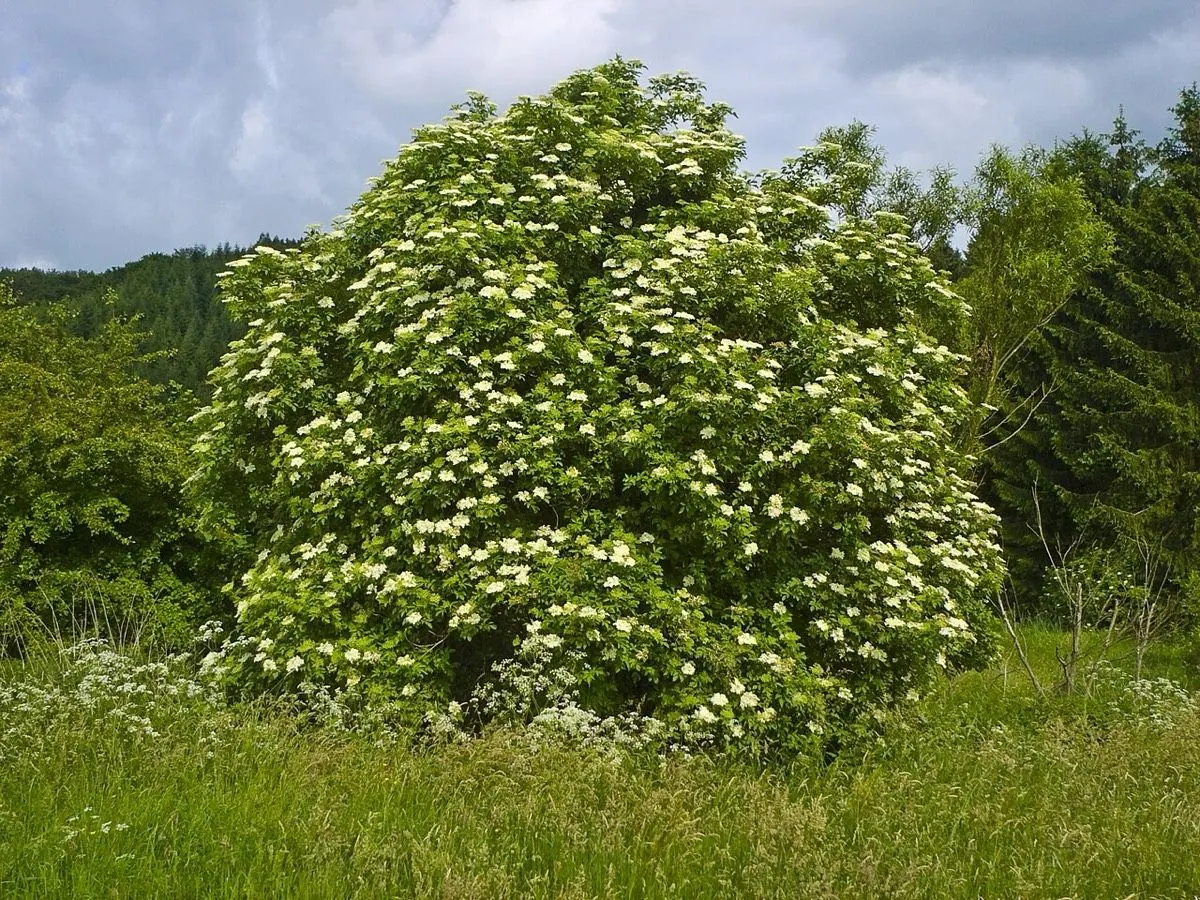
Photo: Willow, CC BY 2.5, Wikimedia Commons

Elderflower
Sambucus nigra
Great creamy plates of scented blossom on a corky-barked shrub, gathered across Europe in early summer, with a tree whose every other part is unsafe raw.
Confused with
Danger: Poisonous. It causes severe vomiting and diarrhoea, and its berries have poisoned people who mistook them for elderberries.
How to tell: Dwarf elder is a herbaceous plant that dies back to the ground every winter, rarely over 150 cm, with no woody corky bark at all, and its berries stand upright rather than hanging. It stinks unpleasantly when bruised. Elder is a woody shrub or tree with corky bark and drooping berry bunches.
Danger: Rowan is not deadly, but raw rowan berries cause sickness and the flowers are not elderflower.
How to tell: Rowan leaves are alternate, not opposite, with 11 to 19 leaflets, and its twigs have no wide white pith. Elder has opposite leaves, 5 to 7 leaflets and a thick white pith core in the twigs.
Danger: Hemlock is deadly and giant hogweed causes severe burns and blistering that scar for years when its sap meets sunlight.
How to tell: Both are non-woody plants with hollow stems rising from the ground, and their white flower heads are open lacy umbrellas on spokes. Elderflower grows on a woody shrub with corky bark. If it does not grow on wood, do not pick it as elderflower.
Leaves
Opposite pairs, pinnate, the whole leaf 10 to 30 cm long and made of five to seven leaflets arranged along a central stalk with one at the tip. Each leaflet 4 to 12 cm, oval with a pointed tip and a sharply saw-toothed edge, dull dark green.
Flowers
Flat-topped or slightly domed plates 10 to 25 cm across, made of hundreds of tiny creamy-white flowers each 5 mm with five petals, held out horizontally from the branch. The whole head faces upwards and outwards, and the flowers are followed by hanging bunches of small purple-black berries.
Stem
Older bark is grey-brown, deeply corky and furrowed with raised warty lenticels. Young twigs are green, smooth and snap easily to reveal a wide core of soft white pith, which is the reliable confirmation.
Smell or taste
Sweet, heavy, muscat-like and slightly cat-like up close on a warm day, a smell you learn in one season. Do not taste any part of this tree to identify it: the leaves, bark, roots, stems and raw berries all contain cyanogenic compounds and cause vomiting and diarrhoea.
Habitat
Hedgerows, woodland edges, stream banks, waste ground, old walls and nitrogen-rich soil near farms. Common across northern and central Portugal and throughout Europe.
Preparation
Pick whole flower heads on a dry, sunny morning when most florets are open and the scent is strongest, cutting the head at the stalk. Shake out the insects; do not wash the flowers, because washing removes the scented pollen the head is worth picking for. To dry, lay the heads face down on mesh or paper in a warm, dark, airy place for one to two weeks, then rub the tiny flowers off and discard every scrap of green stalk, which carries the sickening compounds. Store the dry flowers in a sealed dark jar for up to a year. Infusion: one to two teaspoons of dried flowers in a cup of hot water, covered for ten minutes, then strained. The flowers are also traditionally steeped cold with sugar, lemon and a little citric acid for a day to make cordial, which is then strained and bottled. Never eat the leaves, bark, stems or roots, and never eat raw berries. Elderberries must be fully ripe and thoroughly cooked before they are used at all.
Traditional use
Sabugueiro is one of the old household trees of Europe, planted by the door and treated with a superstitious respect. A hot infusion of the flowers has traditionally been drunk during feverish colds and blocked-up heads across Portugal and the rest of the continent, often with a little honey, and a cooled infusion was used as a skin wash. The cordial is the summer drink of half of northern Europe. This is recorded custom and kitchen tradition, not a treatment for flu or anything else.
Harvest rule
Take no more than one flower head in four from any tree, and leave plenty, because every head you pick is a bunch of berries that birds will not get in autumn. Cut with scissors rather than tearing branches, which are brittle and break badly. Never cut down or strip a whole elder. Ask the landowner's permission, since most hedgerow elders belong to someone, and check local rules, which vary by country and restrict collecting in national parks and protected areas.
Flor de sabugueiro (PT); flor de saúco (ES)