 Human Skills
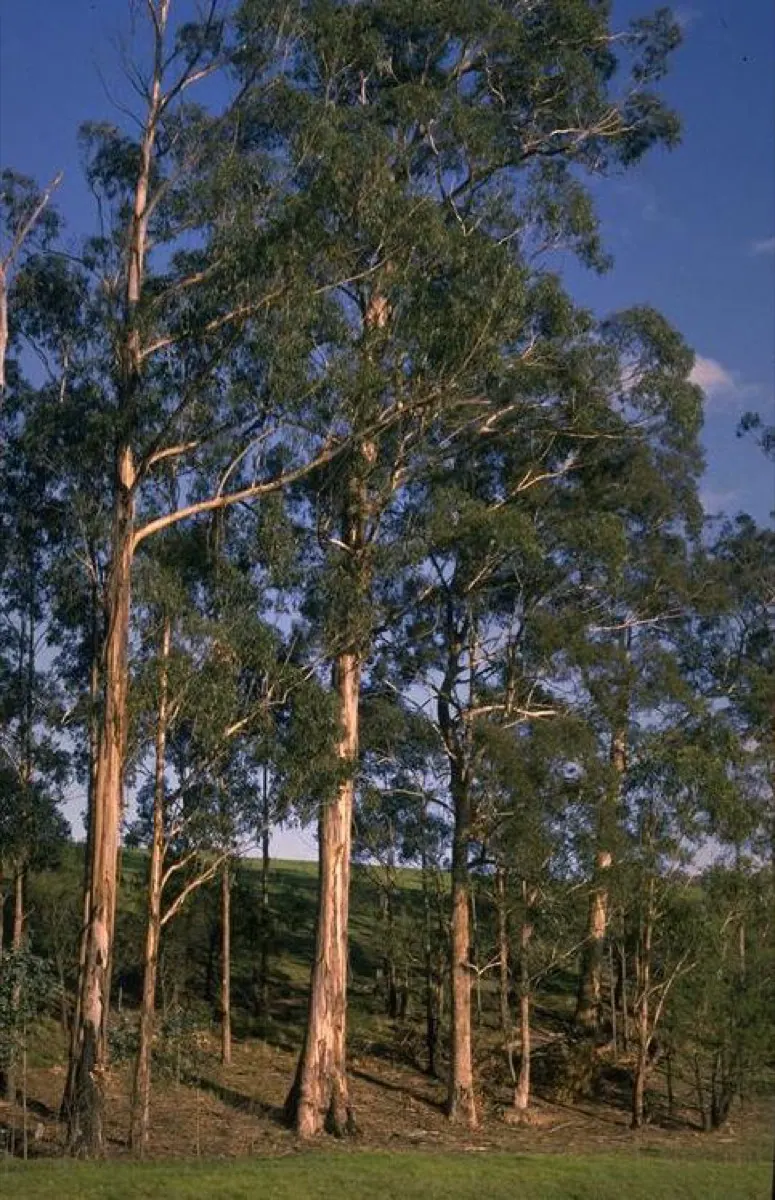
Photo: Ian Brooker and David Kleinig, CC BY 3.0 au, Wikimedia Commons

Eucalyptus
Eucalyptus globulus
The blue gum that covers much of Portugal, whose leaves give the sharp camphor steam of every winter kitchen and whose oil must never be swallowed.
Confused with
Danger: Their oil composition differs, and some species are much higher in irritant compounds than blue gum.
How to tell: E. globulus has the large warty four-ribbed bud cap, the big top-shaped ridged fruit and strongly blue-waxy juvenile leaves. Other species have smaller fruits and different bark. All share the camphor smell, so identifying the genus is easy and the species is not.
Danger: Bay is a kitchen herb, not dangerous, but cherry laurel, which looks similar, is toxic and releases cyanide compounds when its leaves are crushed.
How to tell: Smell decides it. Eucalyptus smells sharply of camphor and medicine. Bay smells warm and savoury; cherry laurel smells of bitter almonds or marzipan, which is a warning sign, not an invitation.
Leaves
Two completely different forms on the same tree, which is the identifying feature. Juvenile leaves, on young shoots and stump regrowth, are opposite, stalkless, heart-shaped to oval, 6 to 15 cm, and coated in a waxy blue-white bloom. Adult leaves are alternate, hanging vertically on a twisted stalk, narrow and sickle-shaped, 10 to 30 cm long and 2 to 3 cm wide, thick, leathery and glossy dark green on both sides.
Flowers
Creamy white, 3 to 4 cm across, made almost entirely of a brush of stamens with no visible petals. The bud is capped by a warty, blue-white, four-ribbed lid that is pushed off when the flowers open. The woody fruit is a hard, top-shaped, blue-grey capsule 1.5 to 3 cm wide with four ridges. Mostly flowers in the Portuguese winter.
Stem
Trunk with smooth bark in patches of grey, cream, blue and orange-brown that peels off in long ribbons and hangs in strips, leaving the rough fibrous bark only at the base. Young twigs are four-angled and often blue-waxy.
Smell or taste
A crushed leaf releases an unmistakable sharp, cold, camphor-and-medicine smell that clears the nose. It is the smell of the whole Portuguese interior on a hot day. Do not taste any part, and never swallow the oil.
Habitat
Vast plantations for pulp, plus roadsides, riverbanks and abandoned land throughout Portugal. Native to Tasmania and southeastern Australia; in Iberia it is an introduced and heavily debated tree.
Preparation
Adult leaves are picked at any time of year, from a low branch or from fallen fresh material, and dried flat in a warm airy shaded place for one to two weeks; they go stiff and leathery rather than crumbly. Store in a sealed dark jar. Steam inhalation is the traditional household use: a small handful of fresh or dried leaves in a bowl of very hot water, the face held well above the bowl with a towel over the head and eyes closed, breathing for a few minutes. Keep a safe distance from the surface, put the bowl where it cannot be knocked over, and never let a child lean over a bowl of scalding water. Leaves are also hung in the shower, added to a hot bath, or burned outdoors as a fragrant smoke. Eucalyptus essential oil is a separate, concentrated product. Do not attempt to distil it at home, do not add it to a child's inhalation bowl, and do not take it internally in any amount.
Traditional use
Eucalipto is stitched into Portuguese winters. Leaves have traditionally been boiled on the stove so the steam filled the room during a cold, added to hot water for an inhalation over a blocked head, and hung in the bathroom. The wood, the honey and the pulp industry built on it are part of the modern Portuguese landscape, for better and worse, and it is worth saying that these plantations are also a major factor in the country's wildfire problem. This is household custom. It is not a treatment for any respiratory illness, and steam does not cure a cold.
Harvest rule
Eucalyptus is superabundant in Portugal and nobody needs to damage a tree for a handful of leaves: take fresh fallen branches after wind, or clip low regrowth. Plantations are private commercial property, so ask before entering or cutting, and stay out of areas closed for fire risk. Never break branches off roadside or municipal trees. Check local rules, which vary by country, and remember that in Portugal eucalyptus planting itself is legally restricted in places because of fire and water concerns.
Eucalipto (PT); eucalipto (ES)