 Human Skills
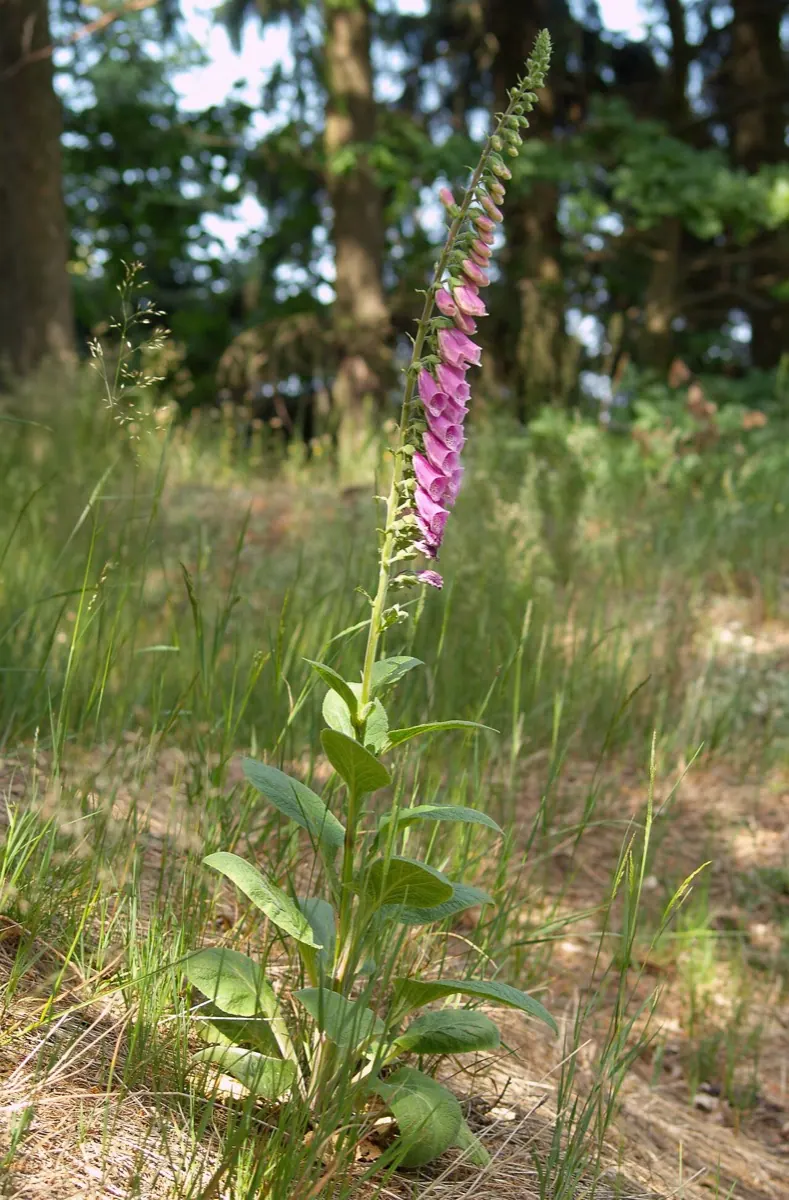
Photo: Jörg Hempel, CC BY-SA 3.0 de, Wikimedia Commons

Foxglove
Digitalis purpurea
PoisonousStops or wrecks the rhythm of your heart, and the dose that helps and the dose that kills are almost the same.
Confused with
Danger: Foxglove leaves brewed as comfrey tea have killed people. Digitalis glycosides cause nausea and vomiting, yellow or haloed vision, confusion, then a dangerously slow or chaotic heartbeat and cardiac arrest.
How to tell: Run the leaf between your fingers and look at the edge. Comfrey leaves are bristly, almost prickly, with a plain untoothed edge, and the leaf runs down onto the stem as a winged ridge. Foxglove leaves are soft and felty with a finely toothed edge and no wings on the stem. Toothed and soft means stop.
Danger: Mullein is a common folk remedy for coughs, so people gather the wrong felty rosette and brew a heart poison.
How to tell: Mullein leaves are thick, pale grey-white and woolly on both sides, like felt slippers, and the leaf base runs down the stem. Foxglove is greener, thinner, only grey-downy beneath, toothed, and does not run down the stem. If in any doubt, wait for the flower spike: mullein is a dense yellow candle, foxglove is a one-sided row of spotted bells.
Danger: Both are gathered for food or tea and both make similar large soft rosettes. The mistake is the same fatal heart poisoning.
How to tell: Borage is stiffly bristly and smells faintly of cucumber. Burdock leaves are huge, heart-shaped with a hollow stalk and white-woolly beneath. Foxglove is felty, oval, finely toothed and wrinkled with sunken veins. Never gather any large rosette leaf from acid woodland until you have seen that plant in flower.
Leaves
Soft, greyish-green, oval to lance-shaped, 10 to 35 cm long, with a wrinkled net of sunken veins and a finely round-toothed edge. Densely covered in soft grey down, especially underneath, which makes them feel like felt. In a rosette at the base, then alternate up the stem, getting smaller.
Flowers
Unmistakable: a one-sided spike of nodding tubular bells 4 to 5 cm long, pink-purple or sometimes white, with dark crimson spots ringed in white inside the throat. Nothing edible in Europe looks like this.
Stem
Single, usually unbranched, round, softly hairy, green often flushed purple at the base. Not hollow, not ridged, not square.
Smell or taste
Almost no smell when crushed, or a faint green smell. Never taste any part, not even a leaf tip.
Habitat
Acid soils: woodland clearings, felled plantations, heath, hedge banks, granite walls, roadside cuttings and mountain slopes. Abundant in northern and central Portugal, Galicia, the UK and Ireland.
Preparation
No preparation makes foxglove safe. Drying concentrates the glycosides rather than destroying them, and boiling puts them in the water. Water in a vase that held foxglove flowers is poisonous. Never use it in tea, tincture, soup or animal feed.
Traditional use
Foxglove is the source of digitalis, and William Withering's work on dropsy in 1785 turned it into a real heart medicine. Modern digoxin still comes from the genus. That is exactly why it must never be prepared at home: the amount of glycoside in a leaf varies with plant, age, season and drying, the gap between a helping dose and a lethal one is tiny, and hospital patients on digoxin have blood levels measured. The medicines made from this plant are produced, assayed and dosed under laboratory control. Attempting either at home is lethal.
Harvest rule
Do not harvest it. It is a superb pollinator plant, so leaving it standing in a hedge bank is fine, but pull it out of any bed you gather greens from, out of paddocks and out of poultry runs. Gloves on, pull the whole rosette, bag it, never feed it to stock and never compost it into a salad bed. Keep children and pets away from cut plants and from the water of any vase it has stood in.
Dedaleira, abeloura, erva-dedal (PT); foxglove (EN)