 Human Skills
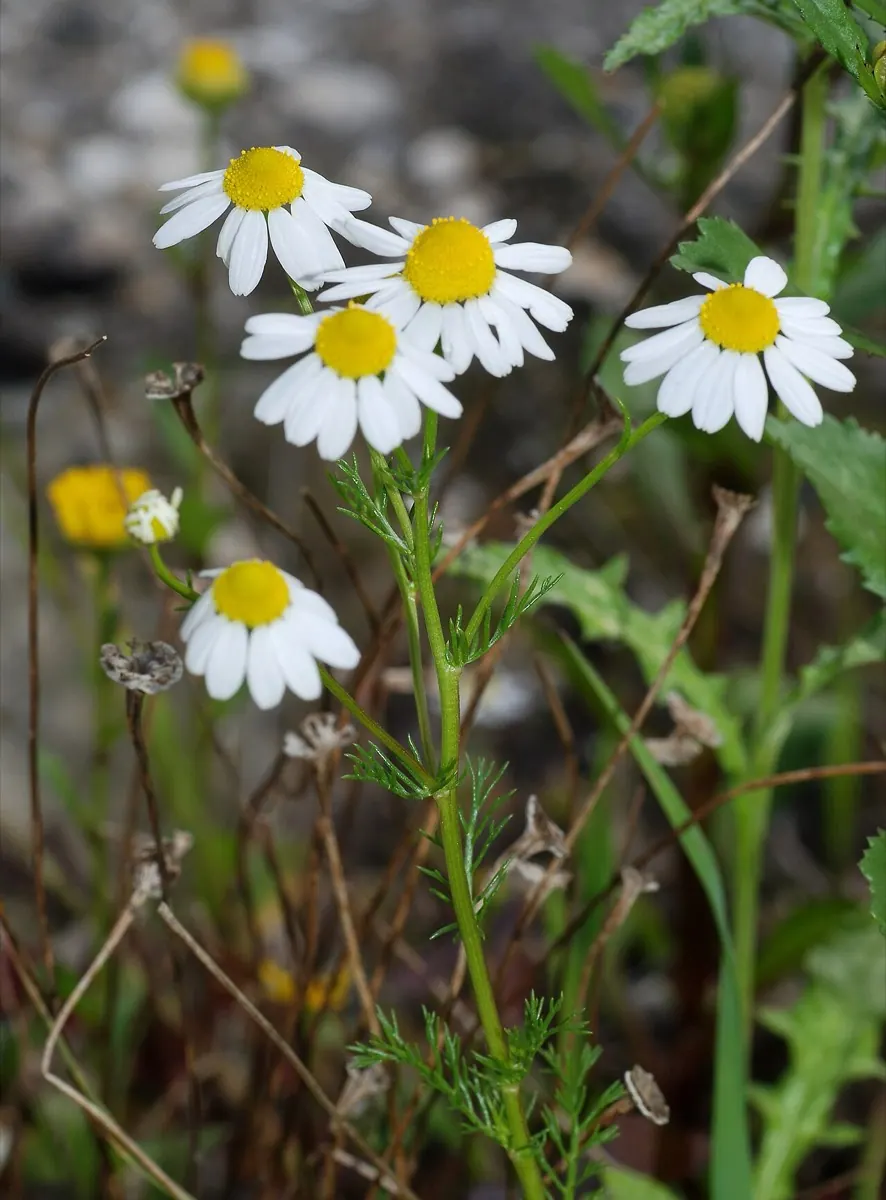
Photo: Alvesgaspar, CC BY-SA 3.0, Wikimedia Commons

Chamomile (German)
Matricaria chamomilla
The small white daisy whose hollow, domed yellow centre and apple smell make the evening tea of half of Europe.
Confused with
Danger: Not deadly, but genuinely unpleasant: it causes blistering and rashes on skin that handles it, and it makes a foul, irritating tea that can burn the mouth.
How to tell: Smell it, then cut the centre. Stinking mayweed smells sharply acrid and rancid, nothing like apples, and its yellow centre cone is solid all the way through when sliced. German chamomile smells of apples and its cone is hollow.
Danger: Harmless but useless, and it will quietly convince you that chamomile tea does nothing.
How to tell: It has almost no smell when crushed and a solid, flatter yellow centre. Its flower heads are larger, 2.5 to 4 cm. German chamomile smells of apples and has a hollow raised cone.
Danger: Not dangerous, but different plants with different strength and different traditional uses.
How to tell: Both have a solid centre. Roman chamomile is a low creeping mat that smells strongly aromatic and slightly bitter rather than apple-sweet. Only German chamomile has the hollow cone on an upright branching stem.
Leaves
Alternate, 2 to 6 cm long, divided twice or three times into thread-fine segments under 1 mm wide, bright light green and hairless, so the foliage looks wispy and almost transparent against the light.
Flowers
Heads 1.5 to 2.5 cm across on slender stalks. Ten to twenty white rays that bend sharply downwards as the flower ages, around a yellow centre that rises into a distinct cone. Cut that cone in half lengthways with a thumbnail and it is hollow inside. That hollow cone is the single best confirmation.
Stem
Round, smooth, hairless, finely grooved, solid but soft enough to snap easily, much branched, without any purple blotching.
Smell or taste
Crushed flowers smell sweetly of apples and hay, clean and warm, with no sourness. Once identified with certainty by every feature above, the tea itself is famously mild and slightly bitter-sweet, but never taste an unknown plant to decide what it is.
Habitat
Cultivated ground, fallow fields, cereal edges, waste ground, sandy verges and gardens. Widespread in Portugal, especially in the Alentejo and the centre, and across Europe.
Preparation
Pick the flower heads only, on a dry morning after the dew has gone and when the white rays are still horizontal rather than fully bent back. Spread them in a single layer on a tray or fine mesh in a warm, dark, airy place, out of direct sun, for about one to two weeks until they are papery and crumble under light pressure. Store in a sealed glass jar in the dark and use within twelve months, because the aroma is the active part and it fades. Infusion: about one heaped teaspoon of dried flowers, roughly one to two grams, in a cup of hot water just off the boil, covered for five to ten minutes, then strained. Keep it covered, or the aromatic oil floats away with the steam. A cooled, strained infusion has also traditionally been used as a wash for tired skin, and the warm strained infusion soaked into a cloth as a compress.
Traditional use
Chamomile is the household calming tea of Europe, and in Portugal camomila sits in almost every kitchen cupboard. It has traditionally been drunk in the evening to settle a restless mind before bed, after a heavy meal for a windy or uneasy stomach, and given as a warm, mild drink to someone who is out of sorts. A cooled infusion has a long folk history as a gentle wash for irritated skin and for tired eyes, though anything involving the eyes needs sterile care and a pharmacist's advice rather than a kitchen jar. This is what people have done for centuries. It is not a treatment for insomnia, anxiety or any digestive illness.
Harvest rule
Pick heads by pinching the stalk just below the flower, leaving plenty of unopened buds so the stand seeds itself for next year. Never strip a patch bare, and never uproot the plant. Avoid field edges that may have been sprayed, and avoid roadsides and dog-walked verges. Ask the landowner before picking on private ground, and check local rules, which vary by country and are usually strict inside national parks and protected areas.
Camomila, macela (PT); manzanilla (ES)