 Human Skills
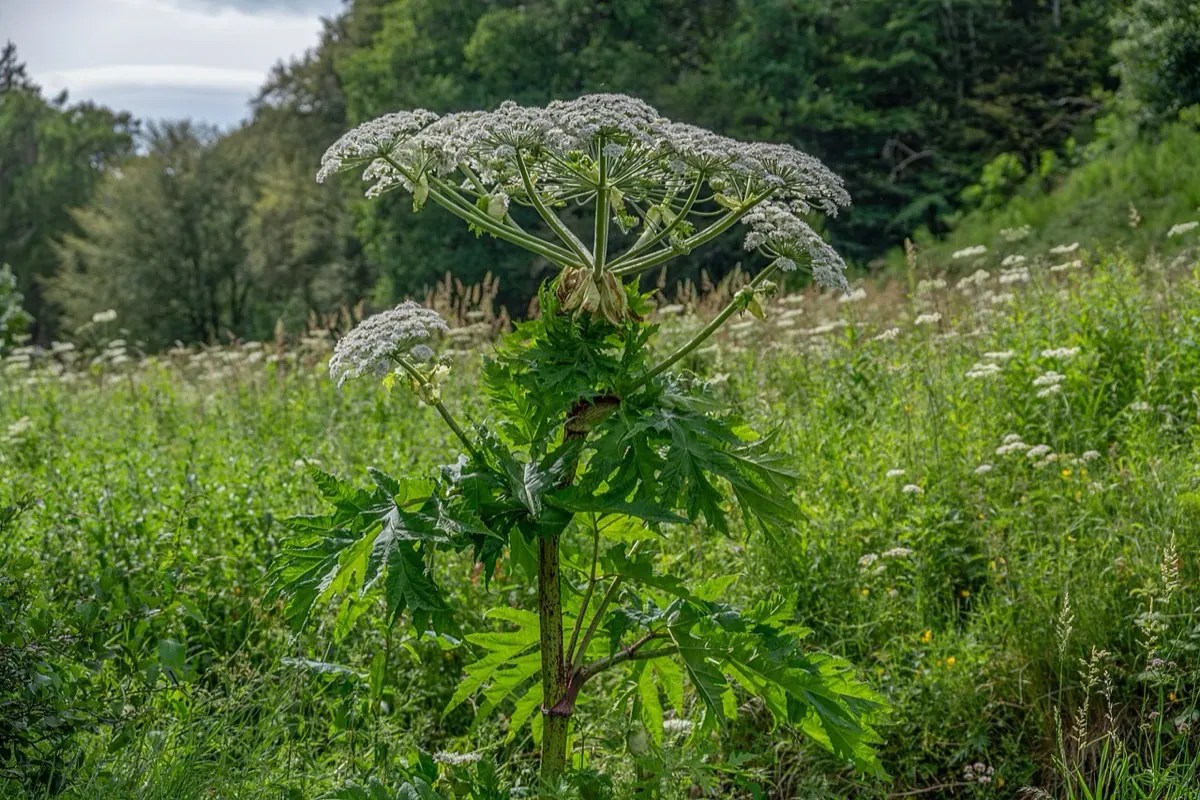
Photo: Lucas Kendall, CC BY-SA 4.0, Wikimedia Commons

Giant Hogweed
Heracleum mantegazzianum
PoisonousIts sap plus sunlight burns your skin like acid, and the scars can flare in the sun for years.
Confused with
Danger: Common hogweed shoots are eaten in some traditions, but its sap is also phototoxic and mistaking the giant for it means handling far more of a far stronger sap.
How to tell: Size settles it. Common hogweed rarely passes 200 cm and its umbels are under 25 cm across. If the plant is taller than you and the flower head is wider than a dinner plate, it is giant hogweed. Do not touch it.
Danger: People gather angelica stems and get severe phototoxic burns from the wrong plant.
How to tell: Angelica has smooth, often purple, hairless stems and rounded, domed flower heads. Giant hogweed stems are bristly with purple blotches and its head is flat and vast.
Leaves
Enormous, up to 150 cm long and almost as wide, deeply cut into jagged pointed lobes with sharp irregular teeth. Dark green, alternate, with stiff bristles on the underside and on the leaf stalk.
Flowers
Huge flat white umbels 40 to 80 cm across, the largest umbel you will ever see, on a single main head with smaller heads below.
Stem
Hollow, 5 to 10 cm thick, ridged, green with strong dark purple-red blotches and covered in coarse white bristles, densest at the base of each leaf stalk.
Smell or taste
Crushed foliage has a harsh, rank, slightly aromatic smell. Never taste it, and never put the stem to your mouth.
Habitat
Riverbanks, canal and stream sides, damp waste ground, railway lines and roadsides. Introduced and invasive across northern and central Europe, present in northern Portugal and Galicia, and spreading along watercourses.
Preparation
There is no preparation. Do not eat any part and do not use the hollow stems for anything, including pea-shooters, straws, telescopes or craft. Children have been badly burned playing with cut stems.
Traditional use
Introduced to Europe in the 19th century as an ornamental garden curiosity. It has no safe food or remedy use and is now a notifiable invasive weed in several countries.
Harvest rule
Only controlled removal. Full waterproof cover, gloves taped to sleeves, face shield and eye protection, and work on a dull day or in the evening, never in bright sun. Cut the root crown 10 to 15 cm below ground rather than strimming. Never burn it. Bag the material as controlled waste. In the UK, Ireland and several EU states it is a listed invasive species with legal duties on control and on not causing its spread, and in some places planting or allowing it to spread is an offence. Check your national and local rules, and report new stands to the authority that keeps the invasive species register.
Erva-gigante, branca-ursina-gigante (PT); giant hogweed (EN)