 Human Skills
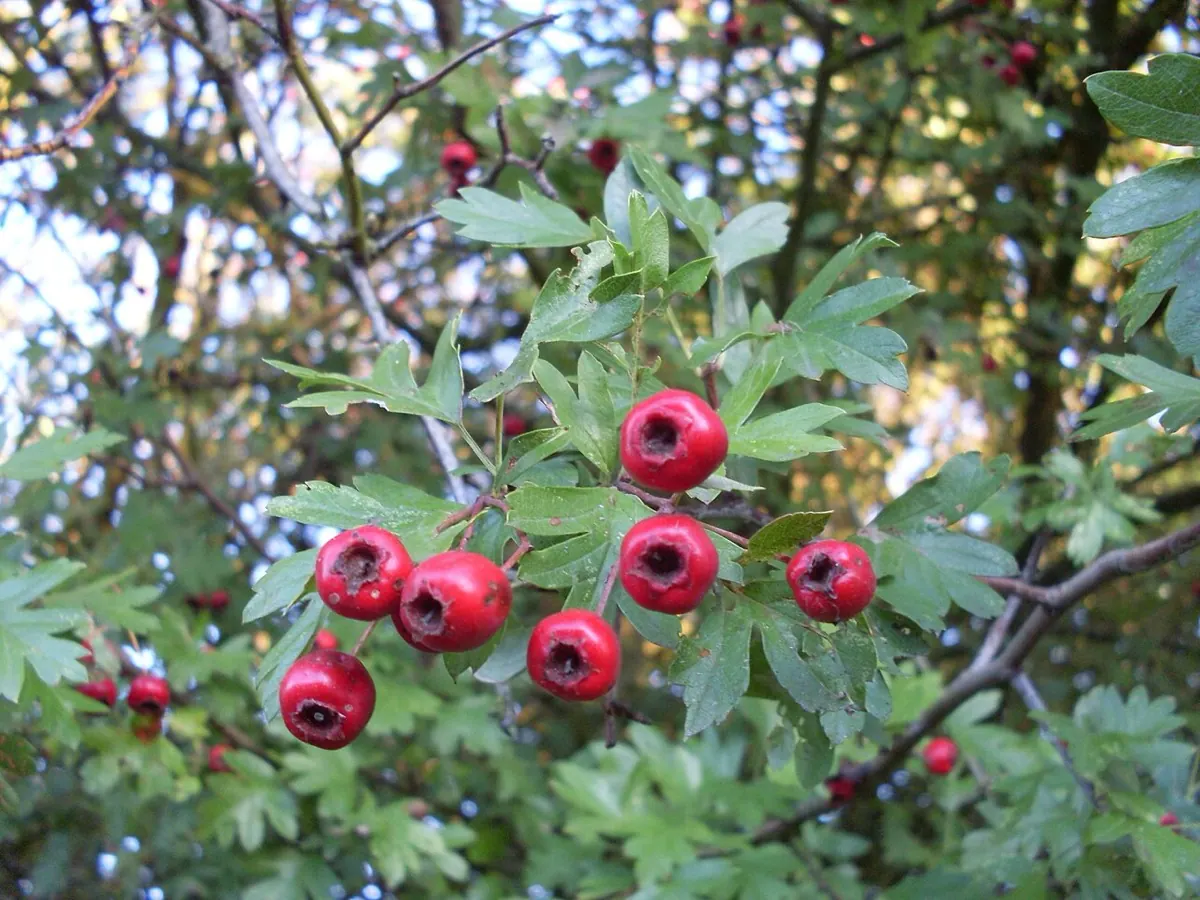
Photo: Elstro, CC BY 3.0, Wikimedia Commons

Hawthorn
Crataegus monogyna
EdibleThe white hedge blossom of May and the red haws of autumn, from a thorny tree whose leaves are cut into deep finger-like lobes.
Confused with
Danger: None for the fruit, which is edible though brutally astringent, but the kernels inside the stones of all Prunus species contain cyanogenic compounds and must never be crushed and eaten.
How to tell: Blackthorn flowers appear before the leaves on black bare twigs, its leaves are plain oval and untoothed rather than deeply lobed, and its fruit is a blue-black plum with a bloom and a single large stone. Hawthorn flowers come with the leaves and its fruit is red.
Danger: Raw berries cause stomach upset; both need cooking.
How to tell: Rowan leaves are pinnate with many paired leaflets and rowan has no thorns at all. Hawthorn has thorns and lobed simple leaves.
Danger: None. Used identically.
How to tell: Shallower leaf lobes and two or three styles and stones per fruit rather than one. Same uses.
Leaves
Alternate, 2-6 cm, cut into 3 to 7 deep lobes that reach more than halfway to the midrib, giving a hand-like outline with a few teeth near the tips. Glossy dark green above, paler beneath, hairless or with small tufts in the vein angles.
Flowers
Dense flat clusters of five-petalled white flowers 8-15 mm across, with pink-tipped stamens, in April and May, smothering the tree. The smell is heavy, sweet and with an odd musty, almost fishy edge that people either love or find unpleasant.
Stem
Twigs grey-brown with straight, stiff, sharp thorns 1-2.5 cm growing directly from the branches, not hooked. Older bark is grey-brown, cracked into small rectangular plates.
Smell or taste
Crushed leaves smell faintly green and nutty. The flower smell is heavy and slightly rank. Young leaves are confirmed safe and taste mild and nutty, which is why country children called them bread and cheese. The haw flesh is dry, mealy and mildly sweet.
Habitat
Hedges, field boundaries, scrub, woodland edges, mountain slopes, old walls. Common in northern and central Portugal, in the hills of the Alentejo and throughout temperate Europe.
Edible parts
Young spring leaves, flower petals, and ripe haws. Never the seeds inside the haws.
Preparation
Young leaves are picked in March and April when they are still soft and bright, and eaten raw in salad or in a sandwich. Once the leaves go leathery they are no use. Flowers are picked in full bloom on a dry day, stripped from the stalk, and used fresh in a cordial or dried for tea. Dry them in shade for 2 to 3 days. Haws ripen in autumn and are mostly stone. Do not chew the stones, which are hard, cyanogenic like other rose-family seeds, and unpleasant. The reliable preparation is a ketchup or a jelly, both of which strain the stones out. For haw ketchup, simmer 1 kg of destalked haws in 500 ml of water and 500 ml of cider vinegar for 30 minutes until soft, then push the pulp through a sieve, discarding the stones and skins. Add 300 g of sugar, 1 teaspoon of salt and pepper to taste, and simmer 10 more minutes. Bottle hot and refrigerate. For a leaf and flower infusion, use 1 to 2 teaspoons of dried flowering tops per 250 ml of water just off the boil, covered for 10 minutes.
Traditional use
Hawthorn flower, leaf and berry preparations have a long European tradition of use for the heart and circulation, and it remains one of the best-known folk heart herbs. That tradition is exactly why it must be treated carefully: a plant with a real effect on the heart is not a casual daily tea for anyone already being treated for a heart condition.
Harvest rule
Take flowers sparingly, since every cluster taken is haws lost, and haws are a major winter food for thrushes, blackbirds and fieldfares. Never cut branches or break thorny growth, and never take from a laid or managed farm hedge without asking, because hedges are farm infrastructure and damaging one is a real offence in several countries. In many parts of Europe mature hedgerow trees are legally protected. Foraging law varies by country: in Portugal ask on private and enclosed land, and check ICNF rules inside protected areas.
Pilriteiro, escalheiro, espinheiro-alvar (PT), majuelo, espino albar (ES), aubepine (FR)