 Human Skills
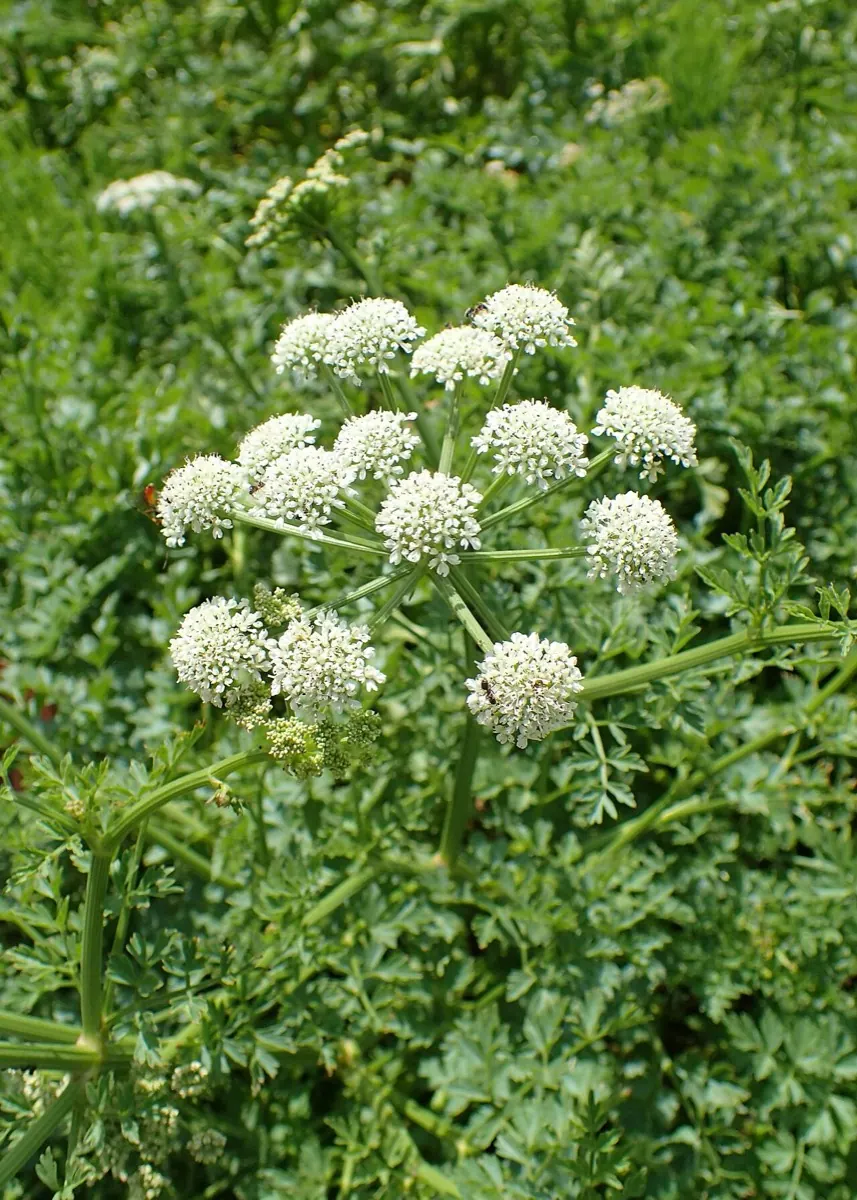
Photo: Krzysztof Ziarnek, Kenraiz, CC BY-SA 4.0, Wikimedia Commons

Hemlock Water-dropwort
Oenanthe crocata
PoisonousThe most common cause of fatal plant poisoning in Portugal and the UK, and its roots look and smell like a vegetable.
Confused with
Danger: Oenanthotoxin causes violent convulsions within an hour, often with a fixed grimace on the face, then death from repeated seizures and breathing failure. A single root tuber has killed adults. Deaths happen most years in Portugal and the UK.
How to tell: Look at the root, which is the part that kills. Hemlock water-dropwort has a bunch of pale swollen finger-like tubers and its cut flesh weeps a yellow juice that browns in the air. Nothing edible in a ditch does that. Simplest rule: never dig roots from wet ground.
Danger: The same convulsive poisoning. People gather it for soup stock thinking they have fennel or lovage.
How to tell: Smell test again. Fennel is aniseed all the way through, and its leaves are thread-fine, like dill. Hemlock water-dropwort smells of parsley or celery and has broad flat toothed leaflets. Fennel also grows on dry ground, this grows in water.
Danger: Leaf-for-leaf the resemblance to parsley is close, and the poisoning is the same: seizures, then death.
How to tell: Habitat is the reliable field check. Parsley and wild carrot grow on dry or well-drained ground. If a parsley-like plant is growing in or beside standing or running water, walk away from it. Wild carrot is also hairy, this plant is completely hairless.
Leaves
Bright glossy green, triangular in outline, up to 30 cm, divided two or three times. The end leaflets are broad, wedge-shaped and coarsely toothed, looking much like flat-leaf parsley or celery leaves. Alternate, with sheathing bases.
Flowers
White umbels 5 to 10 cm across, denser and more domed than hemlock, with several narrow bracts under each small umbel.
Stem
Stout, hollow, hairless, deeply grooved and ridged, green and never purple-blotched. Cut root and stem tissue oozes a yellow juice that turns orange-brown in air. The roots are a cluster of pale finger-like or carrot-like tubers, the dead man's fingers.
Smell or taste
Crushed leaves smell of parsley or celery, which is exactly why it kills people. The cut root smells sweet and carrot-like. A pleasant smell here means nothing. Never taste any part.
Habitat
Wet ground: stream and river banks, ditches, irrigation channels, marshes, pond edges, damp meadows and roadside drains. Extremely common in northern and central Portugal, Galicia, the UK and Ireland, usually with its feet in water or wet mud.
Preparation
Nothing makes it safe. Boiling, prolonged cooking, drying and soaking do not destroy oenanthotoxin. Water that has had the crushed roots in it has poisoned livestock. Do not use it as a soup herb, a stock flavouring or animal feed.
Traditional use
No safe traditional use. It has been used as a fish and rat poison, and floodwater exposing its roots in pasture has caused mass livestock deaths. Treat every historical reference as a warning, not a recipe.
Harvest rule
Only ever remove it. Gloves, long sleeves, dig the whole tuber cluster out, bag it and dispose of it as waste. Never burn it and never leave dug tubers lying in a field where stock can reach them. Keep children and dogs away from freshly cleared ditches. Check local rules before clearing vegetation on watercourses, as many regions protect riverbanks.
Embude, rabaca-brava, cicuta-aquatica (PT); dead man's fingers (EN)