 Human Skills
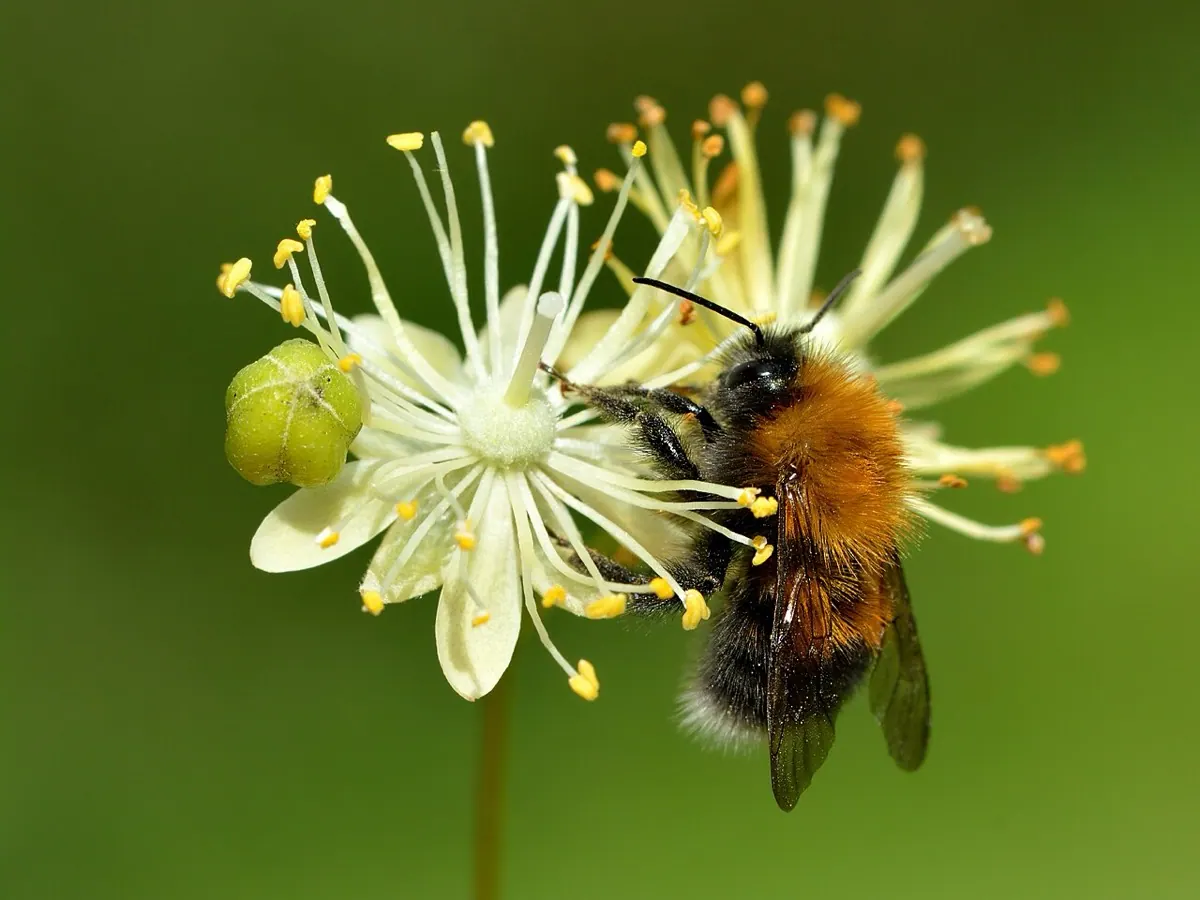
Photo: Ivar Leidus, CC BY-SA 4.0, Wikimedia Commons

Linden (Lime Flower)
Tilia cordata and Tilia platyphyllos
The honey-scented summer blossom of the lime tree, each cluster hanging from a pale papery wing, and the classic evening tea of Portuguese and French households.
Confused with
Danger: Not the traditional tea, and not to be brewed.
How to tell: Only lime hangs its flower clusters from a long pale papery strap-shaped bract. No other European tree does this. Judas tree has round leaves with a smooth edge and pink pea flowers straight from the branch; catalpa has huge leaves in threes and large white trumpet flowers.
Danger: Not dangerous. Same genus, used the same way, though the common hybrid lime is regarded as inferior.
How to tell: All Tilia share the papery bract, so the genus is safe to confirm even when the species is not. The common hybrid drips honeydew and is often covered in aphids and sticky black mould; those trees are best left alone.
Leaves
Alternate, heart-shaped with a distinctly lopsided base where one side meets the stalk lower than the other, 4 to 12 cm long, with a finely saw-toothed edge and a drawn-out point. Small-leaved lime has tufts of rusty-orange hairs in the vein angles on the underside; large-leaved lime is softly hairy all over beneath.
Flowers
Small, pale yellow-cream, five-petalled, 1 cm across, hanging in clusters of five to ten on a stalk that is fused along its length to a narrow, pale, papery, strap-shaped bract 3 to 8 cm long. That pale wing-like bract is unique and is the confirming feature.
Stem
Twigs are slim, reddish-brown, zigzagging slightly, with alternate buds. Mature bark is grey and shallowly ridged, and the trunk often sprouts a dense thicket of suckers at its base, which is a good way to spot a lime from a distance.
Smell or taste
Intensely sweet and honeyed on a warm July evening, noticeable from many metres away, and loud with bees. Do not taste to identify; identify by the lopsided heart leaf and the papery bract.
Habitat
Town avenues, parks, squares, churchyards, old estates, mixed woodland and hedgerows. Widely planted throughout Portugal and native across much of Europe.
Preparation
Pick the flower clusters with their pale bract attached, on a dry morning when most flowers in the cluster are open and before any have browned, which is a window of only a week or two. Both the flowers and the bract go into the tea. Dry them in a single layer on mesh or paper in a warm, dark, airy room for one to two weeks until the bracts are crisp and the flowers crumble. Sunlight browns them and destroys the scent. Store in a sealed dark jar out of light; the aroma fades noticeably after about a year. Infusion: one to two teaspoons of the dried flowers and bracts in a cup of hot water, covered for five to ten minutes, then strained. Keep it covered or the scent goes with the steam. Never use flowers from a tree that is dripping honeydew and coated in sooty mould, and avoid trees on busy roads, which collect exhaust and dust.
Traditional use
Chá de tília is a fixture of the Portuguese and Mediterranean evening, drunk to wind down at the end of the day and given to a restless child by grandmothers throughout the region, and it is the tilleul of every French household. A hot infusion has traditionally been taken during feverish colds to bring on a sweat, and the cooled tea was used as a mild skin wash. Household custom recorded as history, not a treatment for insomnia, anxiety or fever.
Harvest rule
Pick from low branches or from the suckers at the base rather than breaking limbs, and take only a small share of the blossom on any one tree, because lime flowers are one of the most important nectar sources of midsummer and hives depend on them. Never cut branches from town or park trees, which are usually municipal property, and ask before picking on private land. Check local rules, which vary by country and generally prohibit taking material from protected trees and from inside national parks.
Tília, flor de tília (PT); tilo (ES)