 Human Skills
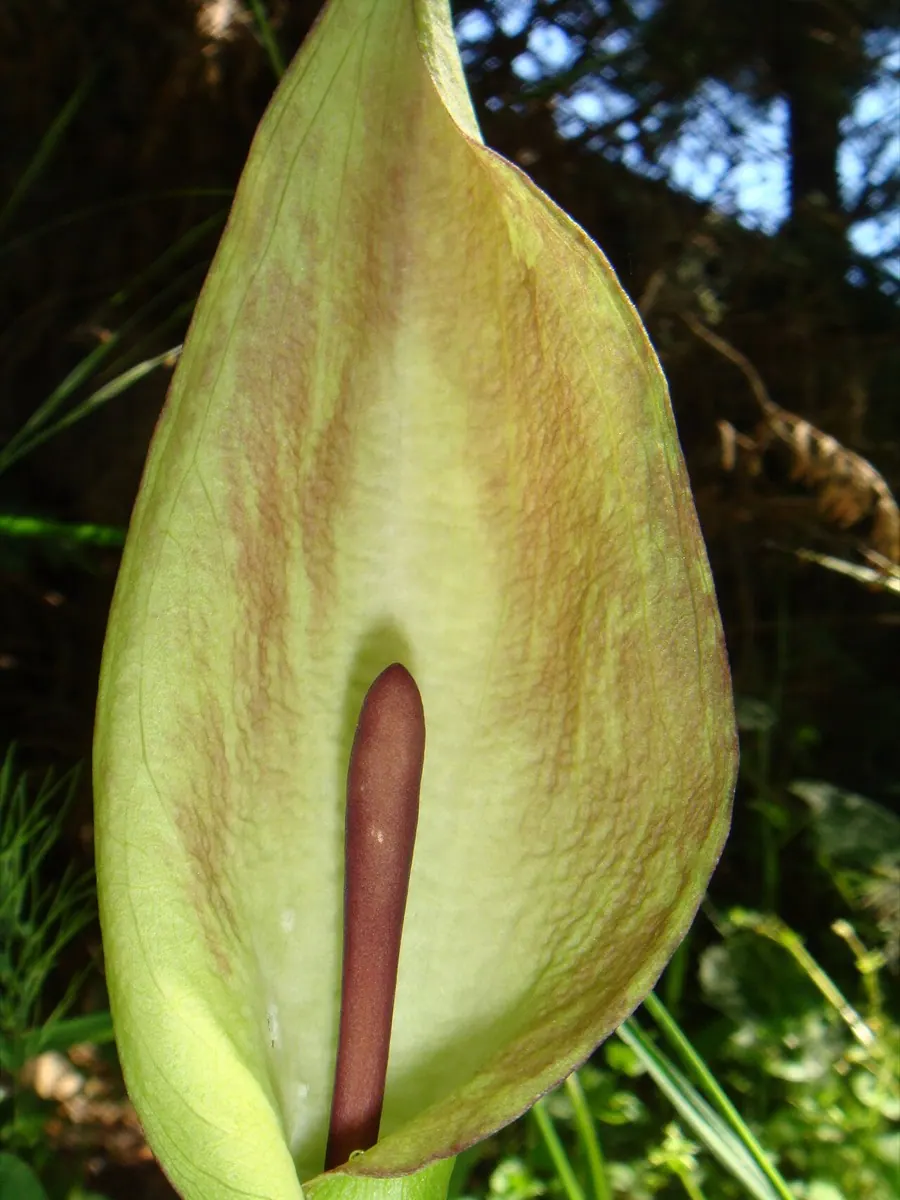
Photo: Francesco Scelsa, CC BY-SA 4.0, Wikimedia Commons

Lords-and-ladies
Arum maculatum and Arum italicum
PoisonousThousands of microscopic needles fire into your mouth and throat and it swells shut.
Confused with
Danger: Calcium oxalate needles cause instant intense burning of the lips, mouth, tongue and throat, drooling, swelling and difficulty swallowing or breathing. Airway swelling in a small child can be life-threatening. The berries cause severe gut pain.
How to tell: Crush the leaf between your fingers and smell your fingers. Wild garlic smells unmistakably of garlic, every leaf, every time. Arum smells of nothing. Then look at the shape: wild garlic leaves are plain ovals tapering into the stalk, Arum leaves have two backward-pointing lobes like arrow flights at the base. No garlic smell means put it down.
Danger: Sorrel has almost the same arrow-shaped leaf outline, so the mistake is very easy in spring. The result is the same burning mouth and swollen throat.
How to tell: Sorrel leaves are thin, soft, matt and slightly fleshy with backward lobes that point straight down and outward, and the plant grows in open grassland. Arum leaves are thick, stiff and glossy with rounded lobes, and grow in shade from a single stalk out of bare soil. If it is glossy and shade-grown, leave it.
Danger: Adding a couple of Arum leaves to a pan of greens burns the mouth of everyone who eats it. Cooking does not soften the crystals.
How to tell: Never gather mixed greens by handful in woodland. Pick leaf by leaf, smell each one, and check every base for backward lobes.
Leaves
Glossy dark green, arrow-shaped or spear-shaped with two backward-pointing lobes at the base, 10 to 25 cm long, on a long stalk rising straight from the ground. Arum italicum has bold creamy-white veins. Leaves appear in autumn and winter and stand alone, never in pairs along a stem.
Flowers
A pale green hood 15 to 25 cm tall wrapped around a purple or yellowish club. Later the hood dies and leaves a naked spike of tightly packed berries that ripen from green to bright orange-red, standing alone in summer grass.
Stem
No true leafy stem. Everything rises from an underground tuber on separate stalks.
Smell or taste
Crushed leaves have a faint dull green smell and no garlic smell at all. Do not put any part in your mouth, not even to test it, because the burning starts immediately.
Habitat
Shady woodland, hedge banks, ditches, old walls, damp gardens and church yards. Common in northern and central Portugal and across western Europe, often growing in the same shady ground as wild garlic.
Preparation
There is no home preparation that makes it safe. Boiling, frying and drying do not destroy the oxalate needles, and the raphides survive cooking. Historical accounts of roasting the tubers for starch involved long processes that still poisoned people. Do not attempt it.
Traditional use
The tubers were once roasted and ground into a starch called portland sago and used for stiffening ruffs. That process caused frequent poisonings and has been abandoned. No home use.
Harvest rule
Do not harvest it. Remove the berry spikes from gardens and paths where small children play, wearing gloves and bagging them. Elsewhere it is a native woodland plant and is best left, since the real protection is knowing it on sight. Do not dig wild woodland floors, and check local rules before clearing native flora.
Jarro, jarro-dos-campos, candeias (PT); cuckoo pint, wild arum (EN)