 Human Skills
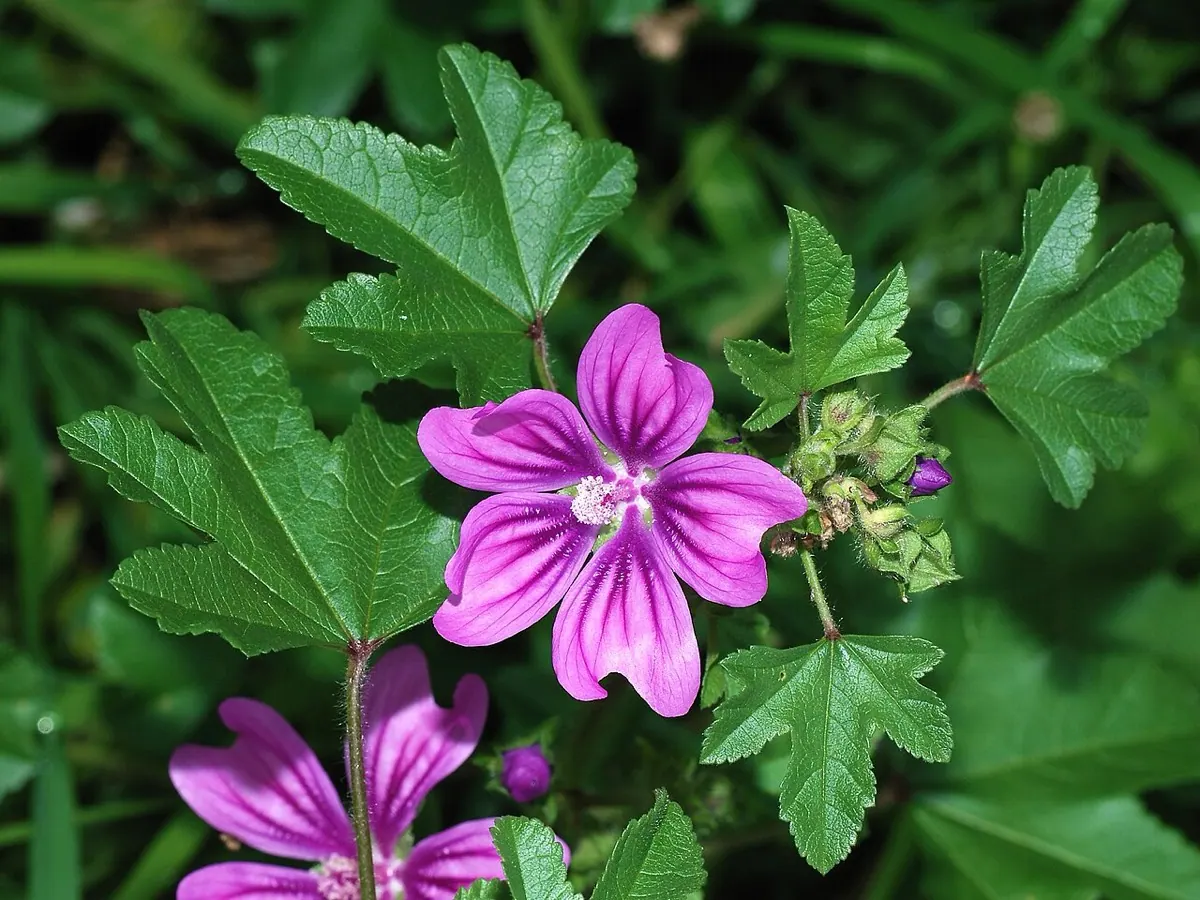
Photo: Alvesgaspar, CC BY-SA 3.0, Wikimedia Commons

Common Mallow
Malva sylvestris
EdibleA soft, mild green with slimy sap that thickens soup, and its little green seed discs are the cheeses of country childhoods.
Confused with
Danger: None. All are edible and used in the same way.
How to tell: Smaller pale flowers, or greyer downy leaves in the case of marsh mallow. The joined stamen column and the disc-shaped fruit identify the family, and the whole family is safe.
Danger: Not a poisoning risk in a mouthful, but it is aromatic and bitter and unpleasant in bulk.
How to tell: Ground ivy has opposite leaves on a square creeping stem and smells strongly aromatic when crushed. Mallow leaves are alternate on a round hairy stem and have almost no smell.
Danger: None. Same family, same edibility.
How to tell: Larger and coarser. Harmless confusion.
Leaves
Alternate, long-stalked, 3-10 cm across, round to kidney-shaped in outline with 5 or 7 shallow rounded lobes and crinkled toothed edges, like a small crumpled geranium leaf. Softly hairy on both surfaces, with veins radiating out from where the stalk joins the blade. Older leaves often show a purple spot at the base of the stalk.
Flowers
5 petals, 2.5-4 cm across, bright pinkish-mauve with three or four dark purple veins running along each petal, and each petal notched at the tip. The stamens are joined into a central column, which is the mallow-family signature. Flowers sit in small groups at the leaf joints from May to September.
Stem
Round or slightly angled, tough and stringy, covered in coarse spreading hairs, solid, often reddish at the base. Breaking one reveals strong fibres rather than a clean snap.
Smell or taste
No real smell when crushed, just a slightly soapy greenness. Confirmed safe once identified; the leaf tastes mild and bland with a slippery texture, and the young seed discs taste nutty.
Habitat
Roadsides, waste ground, field edges, farmyards, coastal banks, rubble. One of the commonest weeds in Portugal and across the Mediterranean.
Edible parts
Young leaves, flowers, and the immature green seed discs.
Preparation
Pick young tender leaves, since old ones are hairy and tough. Chopped small they go raw into a salad, but their real value is cooked: the mucilage thickens a broth the way okra does. Add 200 g of chopped leaves to a litre of soup for the last 10 minutes and it comes out silky. The traditional Mediterranean use is a simple greens dish: boil 500 g of leaves 5 minutes, drain, squeeze, then finish in olive oil with garlic for 3 minutes. Egyptian molokhia and many Levantine mallow dishes follow the same idea. Immature green seed discs, picked while still soft and pale, are eaten raw by the handful or pickled in a boiled brine. Flowers go raw into salads or make a blue-mauve tea that turns pink with lemon. For the traditional soothing infusion, steep 1 to 2 teaspoons of dried leaf or flower in 250 ml of water for 10 minutes, or use a cold infusion left 4 hours, which extracts more mucilage and less tannin. Dry the leaves flat in shade for 3 to 4 days.
Traditional use
Mallow is one of the great Mediterranean domestic remedies, traditionally taken as a warm infusion to soothe sore throats and irritated coughs and used as a warm compress or a mouth rinse for inflamed gums. Its Portuguese reputation as a gentle cure-all is why malva grows beside so many old farmhouses.
Harvest rule
Mallow is abundant and fast-growing, so picking leaves does no harm, but do not uproot it and leave the flowering plants, which are valuable late-season bee forage. Because it grows on verges and disturbed ground it is the plant most likely to have been sprayed or sat in traffic dust, so pick well back from roads and from anywhere a strimmer or a herbicide has been. Foraging law varies by country; in Portugal ask on private or enclosed land and check ICNF rules inside protected areas.
Malva, malva-silvestre (PT), malva (ES), grande mauve (FR)