 Human Skills
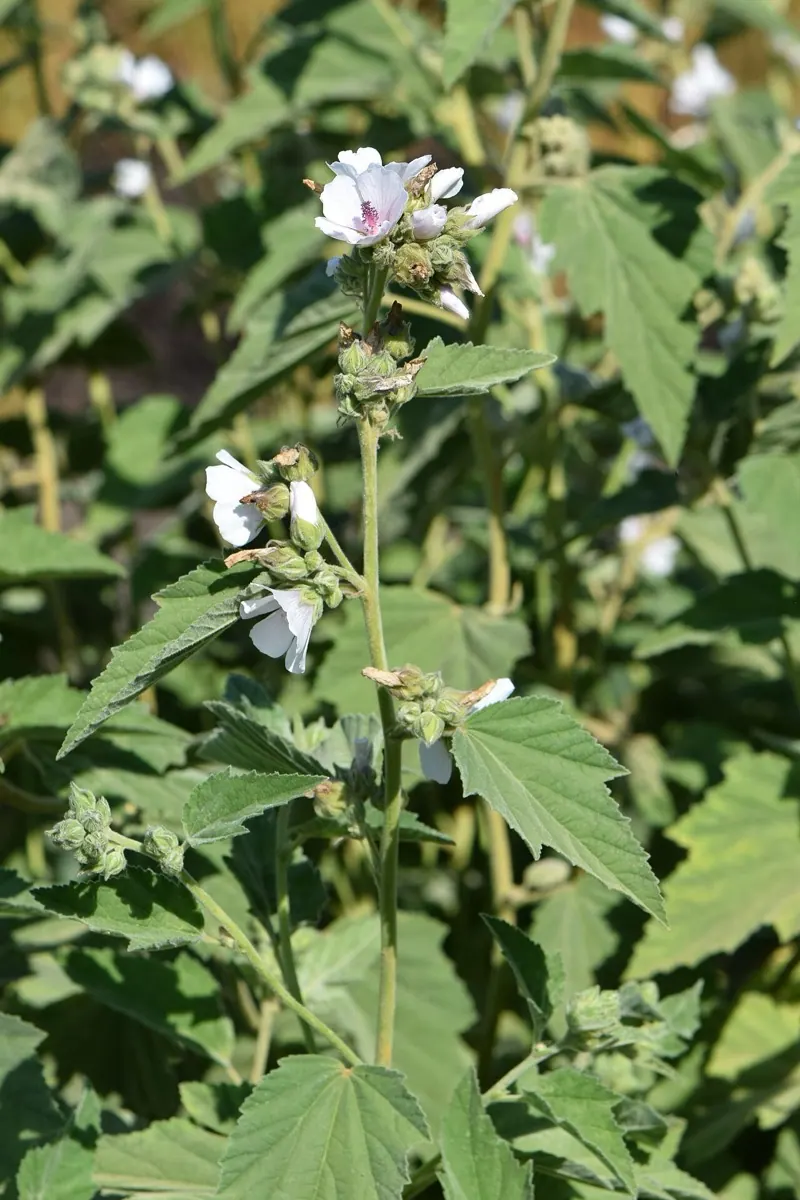
Photo: Krzysztof Ziarnek, Kenraiz, CC BY-SA 4.0, Wikimedia Commons

Marshmallow
Althaea officinalis
EdibleA velvety grey mallow of damp salty ground whose root releases a thick, slippery gel in cold water.
Confused with
Danger: None. They are non-toxic relatives with the same slippery quality, weaker in the root and used the same way in folk practice.
How to tell: Common mallow is greener, nearly hairless or roughly hairy rather than softly velvety, with bright mauve flowers boldly striped with dark purple lines. Marshmallow is uniformly grey-velvety with pale unstriped pink flowers.
Danger: Not dangerous, but coarser and not the traditional root.
How to tell: Hollyhock is far taller, often over 2 m, with a single tall spike of very large flowers over 6 cm. Tree mallow is woody at the base. Marshmallow is a soft grey herb under 150 cm.
Danger: Not a traditional remedy plant and an invasive agricultural weed in parts of Iberia.
How to tell: Velvetleaf has enormous, undivided, heart-shaped velvety leaves up to 20 cm with a long drawn-out point, and small plain yellow flowers. Marshmallow has smaller lobed leaves and pale pink flowers.
Leaves
Alternate, 3 to 10 cm, roughly triangular to heart-shaped with three to five shallow lobes and a toothed edge, thick, and covered on both sides in dense soft velvety grey-white hairs so the whole plant looks dusty. The veins fan out from the base of the leaf.
Flowers
Pale pink to almost white, five petals, 2.5 to 4 cm across, with a notch at the tip of each petal and a central column of fused stamens typical of the mallow family. They sit in small clusters in the leaf joints, and the fruit is a flat ring of segments like a tiny cheese wheel.
Stem
Round, stout, softly velvety-hairy all over, solid, pale grey-green, usually unbranched below and branching near the top.
Smell or taste
Almost no smell. The root, when scraped, is white, fibrous and immediately slimy to the touch: that slipperiness is the identifying feature and the whole point of the plant. Mallows are confirmed non-toxic, but never taste an unknown plant.
Habitat
Brackish and damp ground: salt marsh edges, estuary banks, ditches, coastal grazing and riverbanks. In Portugal it is a plant of estuaries and damp coastal ground, and it is much less common than the everyday common mallow.
Edible parts
Young leaves and flowers, as a minor cooked green; root as a traditional preparation.
Preparation
Roots are lifted in autumn from second-year or older plants, washed hard, peeled, sliced thin and dried slowly in a warm, dry, airy place, or in an oven on its lowest setting with the door ajar, until the pieces snap rather than bend. Root that is not fully dry will mould in the jar. Store the dried slices in a sealed dark jar for up to a year. Cold infusion is the traditional and correct method, because the slippery substance is drawn out by cold water and damaged by heat: a heaped teaspoon of dried chopped root is left in a cup of cold water for four to eight hours or overnight, stirred occasionally, then strained. The result is faintly sweet and noticeably thick. Leaves and flowers can be infused in hot water in the ordinary way, for ten minutes, covered. A poultice for external folk use is made by mixing powdered dried root with a little warm water into a paste and spreading it on a clean cloth.
Traditional use
Malvaísco is the old European plant for anything that felt raw and dry. Its cold root infusion has traditionally been sipped for a scratchy dry throat and a dry cough, and taken for a sour, uneasy stomach, across Portugal, Spain and the rest of Europe. Root paste was applied to chapped skin, and the softened root was given to teething babies to chew in an age with no idea of choking hazards, which is exactly the sort of tradition to record and not to repeat. The original marshmallow sweet was made from this root. History and custom, not a treatment.
Harvest rule
Digging the root kills the plant, so this is the one to grow rather than to forage. Marshmallow is uncommon and declining in much of its European range, it grows in salt marsh and estuary habitats that are frequently protected under Natura 2000, and digging there is usually illegal as well as damaging. Never dig on protected land, never take from a small stand, get the landowner's written permission for any digging, and check local rules, which differ by country. If you want the root, plant it in a damp corner and lift it in its third year.
Malvaísco, alteia (PT); malvavisco, altea (ES)