 Human Skills
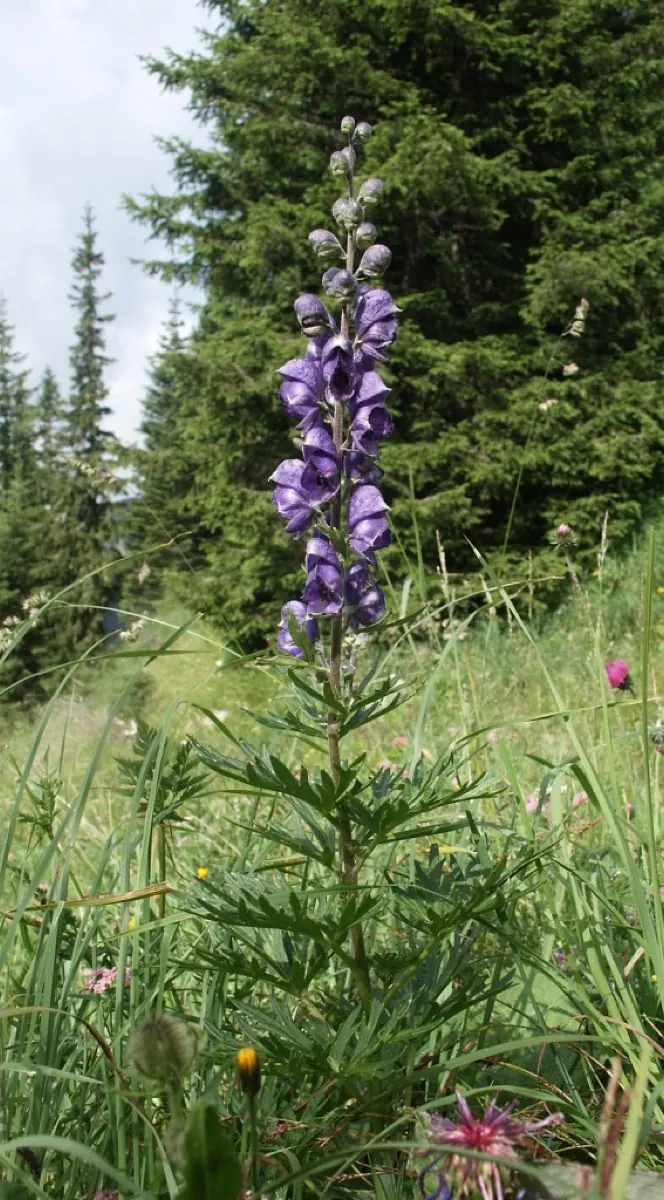
Photo: Bernd Haynold, CC BY-SA 2.5, Wikimedia Commons

Monkshood
Aconitum napellus and related species
PoisonousThe most poisonous plant in Europe: it can kill through the skin of your hands, and a mouthful of root kills within hours.
Confused with
Danger: Aconitine causes tingling and numbness of the mouth and hands within minutes, then burning, vomiting, muscle weakness, a chaotic heartbeat and death from cardiac arrest, often within two to six hours. There is no antidote and very small amounts kill.
How to tell: Before flowering, the leaf is the check. Monkshood leaves are thick, stiff, glossy and cut all the way to the leaf stalk into narrow spiky segments, growing from a stout unbranched stem in wet shade. Cow parsley and celery-family leaves are soft, matt, and their segments sit on little stalks of their own, and they smell strongly when crushed. Monkshood smells of nothing. A glossy, deeply divided, scentless leaf in wet shade is one you do not touch.
Danger: The tubers have been dug and grated as horseradish. That mistake has killed whole households. The root is the most concentrated part of the plant.
How to tell: Horseradish root is a single long pale tapering root that smells violently of mustard the moment you cut it and makes your eyes stream. Monkshood roots are a pair of short dark brown tubers with no smell at all. No mustard blast means it is not horseradish. Better still, never dig roots from wet shady ground.
Danger: Gardeners weeding borders handle monkshood foliage and roots bare-handed. Aconitine is absorbed through skin and through cuts, and there are recorded deaths of gardeners who never ate any of it.
How to tell: Do not rely on telling them apart by leaf. Treat every deeply cut leaf on a tall blue-flowered border plant as monkshood and wear gloves.
Leaves
Dark glossy green, rounded in outline, 5 to 15 cm across, cut almost to the base into five to seven wedge-shaped lobes which are themselves deeply cut into narrow toothed segments, giving a spiky star. Alternate, on long stalks lower down.
Flowers
Unmistakable when in flower: a tall spike of deep blue-purple flowers 2 to 4 cm, each with the top sepal arched over the rest like a monk's hood or a helmet. Nothing edible in Europe has that hood.
Stem
Stout, upright, round, green, usually unbranched below the flower spike, slightly hairy near the top. Not hollow. The root is a pair of dark brown tubers like small dahlia or parsnip roots, and the root is the deadliest part.
Smell or taste
Almost no smell. Never taste any part. Even a tiny amount on the lips causes tingling and numbness, and that tingling is already a poisoning.
Habitat
Damp shady ground: mountain streams, wet woodland, shaded meadows, ditches, and very widely as a garden border plant. Native in the mountains of northern Portugal and Spain and grown in gardens everywhere.
Preparation
There is no preparation that makes it safe. Cooking, boiling, drying, soaking and fermenting do not remove aconitine. Processed aconite roots exist in some Asian herbal traditions, and poisonings and deaths from them are reported every year even from professionally processed material. Never attempt anything with this plant.
Traditional use
Used historically as an arrow and bait poison for wolves, which gave it the name wolfsbane, and in tiny homeopathic and herbal preparations for pain and fever. Those preparations have killed people repeatedly. Any medicine derived from aconitine is made under strict laboratory control, and home extraction or dosing is lethal.
Harvest rule
Never harvested for anything. Removal only: waterproof gloves taped to long sleeves, eye protection, dig the whole tuber cluster, double-bag it and dispose of it as hazardous garden waste rather than composting it. Never burn it near people and never leave tubers on the surface of a field. Wild Aconitum in Iberian mountains may be legally protected and rare, so leave wild populations alone and simply learn the plant rather than clearing it.
Acronito, capuz-de-monge, matalobos (PT); wolfsbane, aconite (EN)