 Human Skills
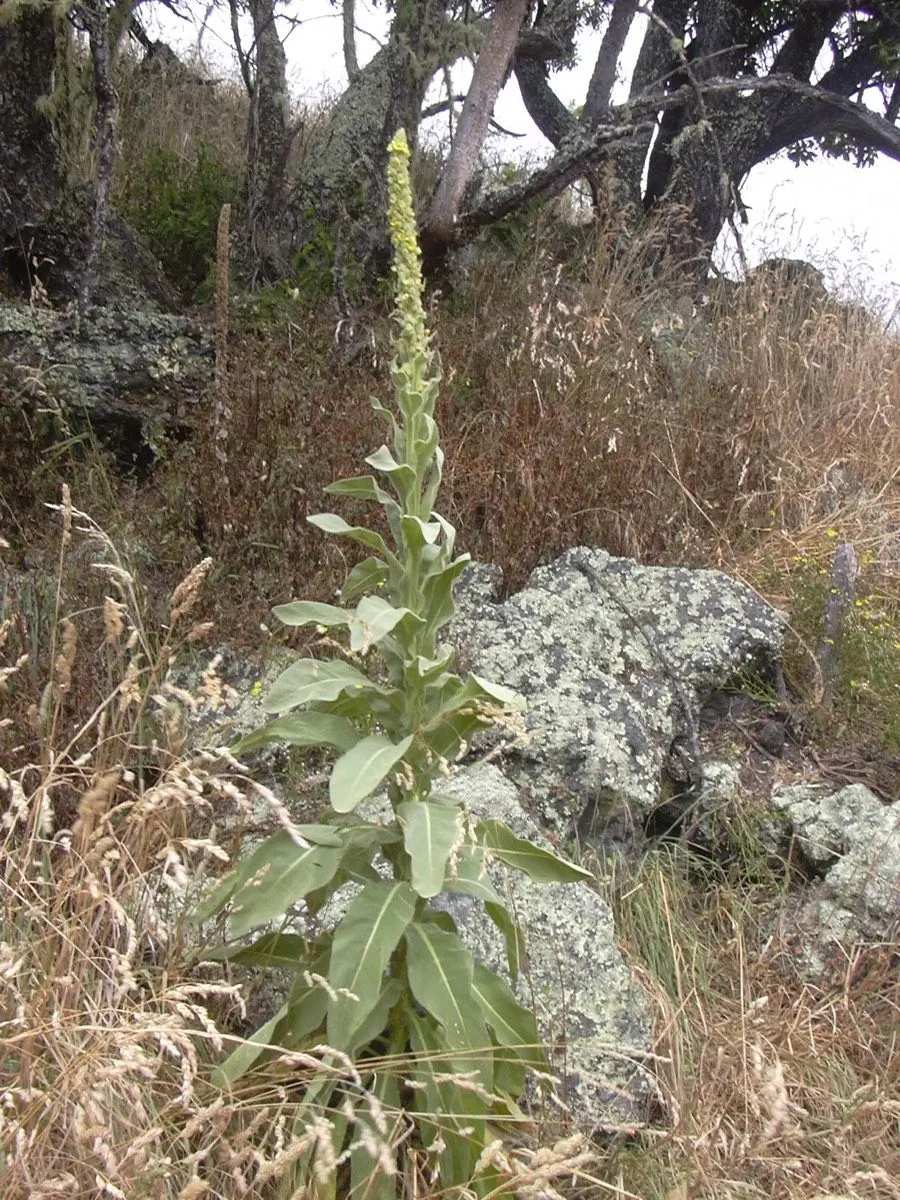
Photo: Forest & Kim Starr, CC BY 3.0, Wikimedia Commons

Mullein
Verbascum thapsus
A tall yellow candle of a plant covered in thick grey felt, the old chest herb and lamp wick of rural Europe.
Confused with
Danger: Deadly. Foxglove contains cardiac glycosides that disturb the heart rhythm, and people have died from drinking tea made from mistaken leaves.
How to tell: Foxglove leaves are thinner, softer grey-green, clearly toothed along the edge, with a deeply net-veined and wrinkled surface, and they sit on a long distinct leaf stalk. Mullein leaves are thick, felted like flannel on both sides, smooth-edged or barely scalloped, and have no true stalk: the base runs down onto the stem as a wing. If the leaf has a stalk and a toothed edge, do not touch it.
Danger: Not deadly on contact, but comfrey must never be taken internally because of liver-damaging pyrrolizidine alkaloids.
How to tell: Comfrey leaves are dark green with coarse bristly hairs that prickle rather than a soft pale felt, and it carries hanging bell-shaped purple or cream flowers, never a yellow spike. Mullein is pale grey and soft as flannel.
Danger: Used similarly in folk practice but variable, and some carry irritant hairs and saponins in greater amounts.
How to tell: V. thapsus is the one with the thick unbranched stem, dense pale felt everywhere, and leaf bases running down the stem as wings. Other species are often branched, greener, or hairless on the upper leaf surface.
Leaves
Alternate, very large, 15 to 50 cm long, oval to oblong, thick and soft, and covered on both sides in dense pale grey-white woolly felt so they feel like flannel. The leaf base runs down the stem as a raised wing below each leaf, which is the confirming feature. Edges are smooth or slightly scalloped.
Flowers
Bright yellow, five rounded petals, 1.5 to 3 cm across, stalkless and packed densely into a long spike up to 50 cm at the top of the stem, opening a few at a time in no particular order. The stamens are covered in white or yellow hairs.
Stem
Single, stout, up to 3 cm thick, densely white-woolly, unbranched or branching only near the top, stiff, and clearly winged where the leaf bases run down it. It stands through the winter as a dry brown skeleton.
Smell or taste
Almost no smell; a faint honey scent from the open flowers. Do not taste. Identify it by the huge felted leaves, the winged stem and the yellow candle spike.
Habitat
Dry, disturbed, sunny, stony ground: roadsides, gravel, quarry edges, abandoned fields, fire sites and riverbanks. Widespread in Portugal and across Europe.
Preparation
Pick the yellow flowers individually as they open, over several weeks, since only a few open each day, and pick leaves from the first-year rosette in dry weather. Dry the flowers in a single layer on paper in a warm, dark, airy place for about a week, until crisp, keeping them out of sunlight so they stay yellow rather than browning. Leaves need longer, one to two weeks on mesh so air reaches both sides; their felt holds moisture and they mould easily. Store both in sealed dark jars for up to a year. Infusion: one to two teaspoons of dried flowers, or a teaspoon of crumbled dried leaf, in a cup of hot water, covered ten minutes. Straining is not optional here: the tiny hairs on the leaves and flowers irritate the throat badly, so pour the tea through a coffee filter or a double layer of muslin, not a wide kitchen sieve. The dry stalk soaked in fat has been used as a torch, and the dry felted leaves as tinder and as improvised lamp wicks, which is where the name candlewick plant comes from.
Traditional use
Verbasco has been the chest herb of rural southern Europe for centuries, traditionally drunk as a strained hot infusion during a dry, tiring cough and a raw throat, often sweetened with honey. Flowers steeped in olive oil have a long folk history as a warmed ear oil, though nothing should ever be put in an ear that might have a perforated eardrum, and ear pain belongs with a doctor. The felted leaf has served as emergency toilet paper, tinder, insole padding and lamp wick across the continent. All of this is recorded custom, not a treatment for any respiratory condition.
Harvest rule
Take flowers a few at a time from several plants and leave the spike standing, because a single mullein produces the seed for a whole future colony and the dry stems shelter insects over winter. Leave first-year rosettes alone unless the stand is large. Never uproot. Avoid roadsides and contaminated ground, since mullein colonises exactly those places. Ask permission on private land and check local rules, which vary by country and are strict in protected areas.
Verbasco, barbasco, orelha-de-burro (PT); gordolobo (ES)