 Human Skills
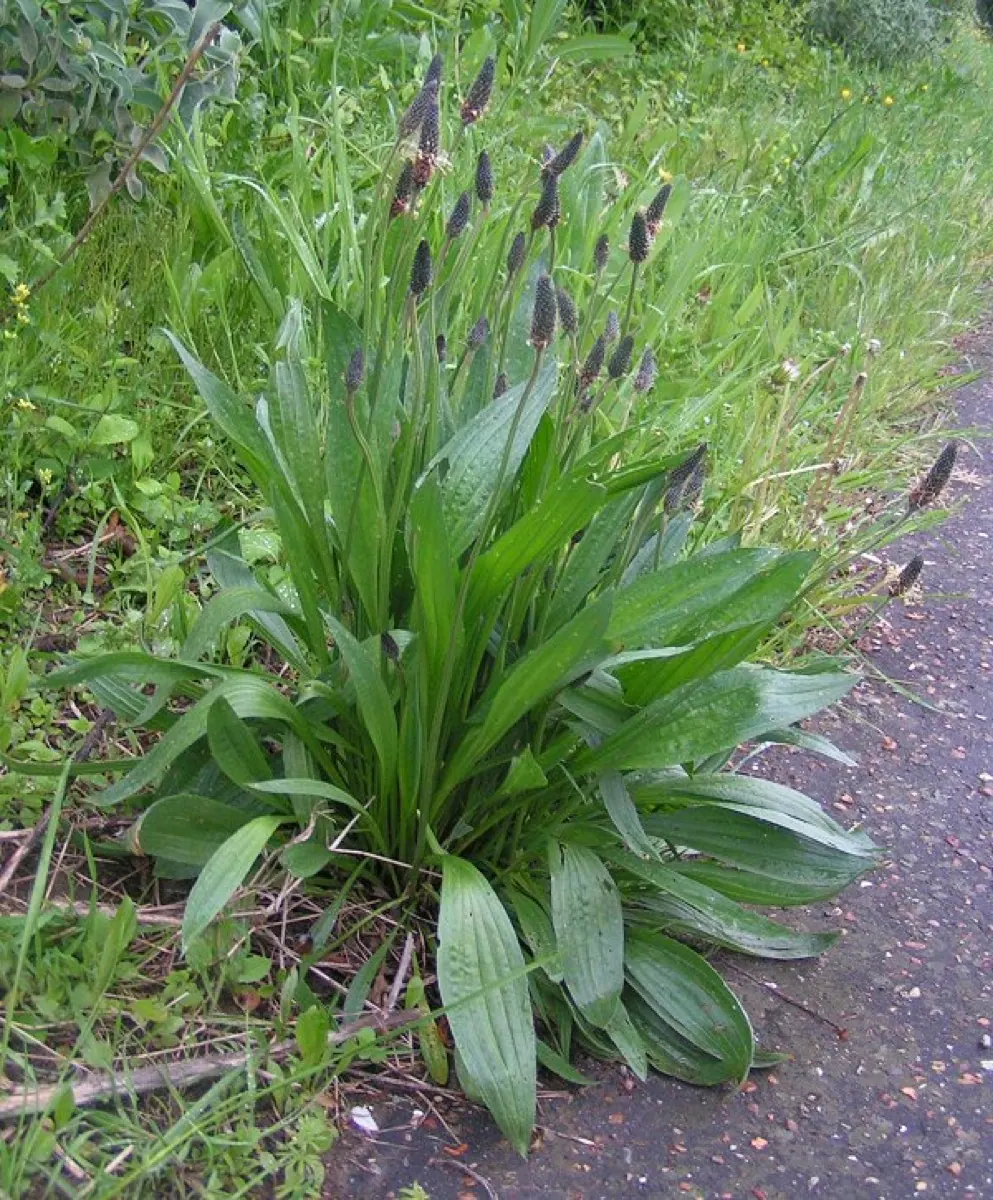
Photo: sannse, CC BY-SA 3.0, Wikimedia Commons

Ribwort Plantain
Plantago lanceolata
The narrow, strongly ribbed rosette leaf of every European path edge, carried for centuries as the bite and sting plant.
Confused with
Danger: None. It is closely related and used in exactly the same way in folk practice; it is a separate entry in the edible plants section of this site.
How to tell: Greater plantain has broad oval leaves 5 to 15 cm wide on long stalks, with a long slim green flower spike. Ribwort has narrow lance-shaped leaves and a short dark flower head.
Danger: Orchids are protected by law almost everywhere in Europe. Lords-and-ladies is seriously toxic: chewing it causes immediate intense burning and swelling of the mouth and throat, which can obstruct breathing.
How to tell: Lords-and-ladies leaves are broad arrowheads with two backward-pointing lobes at the base, on long stalks, with a branching net of veins, and they grow in shade. Ribwort leaves are narrow, lobeless, and have straight parallel ribs with no net. Never pull an unopened rosette in shady woodland and assume it is plantain.
Leaves
All from a basal rosette, no stem leaves at all. Narrow and lance-shaped, 10 to 30 cm long and only 1 to 3 cm wide, tapering at both ends, with three to five strong parallel ribs running the whole length of the leaf. Tear one slowly and tough white threads stretch between the halves. Edge nearly smooth, surface slightly hairy.
Flowers
A short, dense, dark brown-black cylinder or egg shape 1 to 4 cm long at the top of the bare stalk, with a ring of creamy-white stamens standing out around it that moves slowly up the head as it opens. Unmistakable once seen.
Stem
There is no leafy stem. The flower stalk is leafless, deeply grooved with five or more furrows you can feel, wiry, tough and slightly hairy.
Smell or taste
Faintly green and grassy when crushed, with no strong scent. This is a confirmed non-toxic plant, but identify it by the parallel ribs, the leafless grooved stalk and the dark flower head, never by taste.
Habitat
Lawns, paths, trampled ground, pasture, roadside verges, dunes and dry grassland. One of the most common plants in Portugal and Europe, and it thrives on being walked on.
Preparation
The traditional field use needs no preparation at all: a clean fresh leaf is crushed or chewed by the user into a rough green mass and pressed onto a nettle sting or insect bite, held in place for a few minutes. This is folk practice, done with your own leaf on your own skin, on intact skin only, and not something to do with plant material from a roadside or a dog-walked verge. To dry: pick clean leaves in dry weather, lay them singly on mesh in a warm airy dark place for about a week until brittle, and store in a sealed jar for up to a year. Infusion: a teaspoon of dried leaf in a cup of hot water, covered ten minutes, strained. A cooled, strained infusion has traditionally been used as a skin wash or a gargle. A poultice is made by pouring a little hot water over dried leaf, letting it swell, cooling it to comfortable skin temperature, and laying it on under a clean cloth.
Traditional use
Tanchagem is the plant European children have been shown for generations when they walk into nettles: grab a plantain leaf, crush it, rub it on. It has been applied to insect bites, stings, small grazes and blisters across Portugal and the rest of Europe, and an infusion of the leaf was traditionally drunk for a dry, tickly cough and gargled for a rough throat. Its seed husks are the same family as the psyllium sold today for bulk fibre. This is folk practice, recorded as such. It is not a treatment, and it does nothing for a serious wound.
Harvest rule
Pick individual leaves from the outside of the rosette, leaving the growing centre and the roots, and it will regrow within days. It is abundant and resilient, so there is no sustainability problem, but still take only what you need and leave flowering heads for the birds and insects. Ask the landowner's permission on private ground and check local collecting rules, which vary by country and are stricter inside protected areas.
Tanchagem-menor, língua-de-ovelha (PT); llantén menor (ES)