 Human Skills
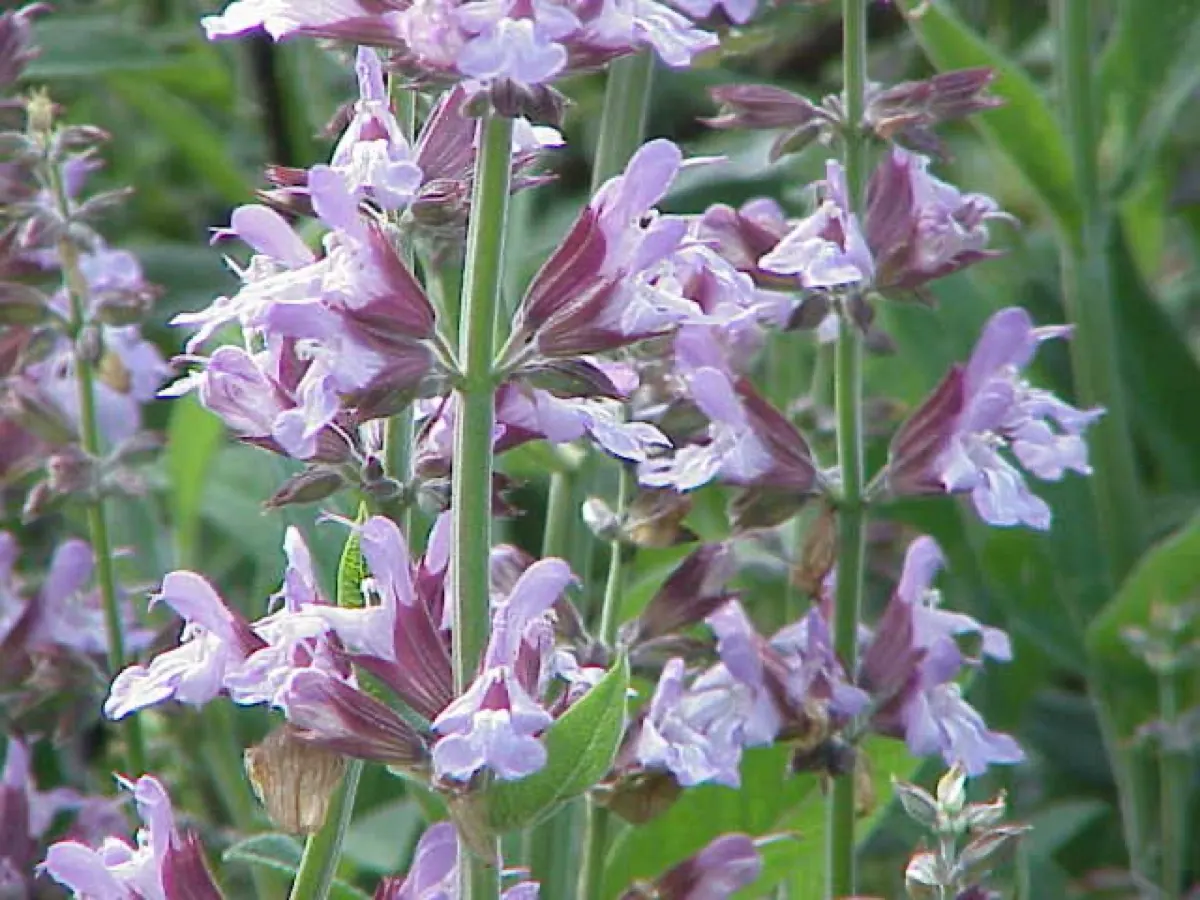
Photo: Kurt Stüber [1], CC BY-SA 3.0, Wikimedia Commons

Sage
Salvia officinalis
EdibleA grey-green woody shrub of the Mediterranean whose pebbled, velvety leaf has been the European gargle herb for a thousand years.
Confused with
Danger: Ornamental salvias vary from harmless to psychoactive and are not culinary plants.
How to tell: Common sage has thick, grey, white-felted, finely pebbled leaves on a woody base. Ornamental salvias are usually greener, thinner-leaved, softer and grown for showy flowers, and they lack the warm camphor smell of true sage.
Danger: Harmless but useless as a herb.
How to tell: Lamb's ear is far woollier, thickly white-furry on both sides like felt, with no aromatic smell at all when rubbed. Sage smells powerfully of camphor.
Leaves
Opposite, oblong to lance-shaped, 3 to 10 cm long and 1 to 3 cm wide, grey-green, thick, and covered in fine white felt so they feel like soft suede. The surface is finely pebbled or quilted between a raised net of veins, and the edge is very finely round-toothed.
Flowers
Two-lipped violet-blue flowers, sometimes pink or white, 2 to 3 cm long, in widely spaced whorls up a spike at the tip of the shoots. The upper lip is hooded and the lower lip is broad, the classic mint-family shape.
Stem
Square when young and green, becoming round, woody, grey and shredding-barked at the base. Whole plant is white-woolly on the new growth.
Smell or taste
Strong, warm, camphor-like and slightly peppery when a leaf is rubbed, instantly recognisable and unlike anything else in a Portuguese garden. Sage is a confirmed culinary plant, and the leaf tastes savoury and resinous, but never use taste as identification.
Habitat
Dry sunny slopes, garden borders, rocky limestone ground and herb gardens. Native to the northern Mediterranean and widely grown all over Portugal, where it thrives in poor dry soil.
Edible parts
Leaves, as a culinary herb.
Preparation
Cut shoots before flowering, in the morning after dew has dried. Hang small bundles in a dark airy room for one to two weeks, or strip and dry the leaves flat, until they are brittle. Sage dries very well and keeps its strength for a year or more in a sealed dark jar. Infusion for a traditional gargle: a teaspoon of dried leaf in a cup of hot water, covered ten minutes, strained, and allowed to cool to comfortably warm before gargling and spitting out. As a kitchen herb, whole leaves are fried briefly in oil or butter, or added to slow-cooked beans and pork. Sage essential oil and strong sage extracts are a separate matter: they contain thujone, they are not safe to make or dose at home, and this guide gives no doses for them.
Traditional use
Sage was so valued in medieval Europe that the old saying asked why anyone with sage in the garden should die. Across Portugal and the Mediterranean, a warm sage infusion has traditionally been gargled for a raw, sore throat and a hoarse voice, and used as a mouth rinse for sore gums. It has an old reputation as a herb for the sweats of midlife and as a drying, cooling herb in folk practice, and cooks have always used it with fatty meat and beans. History and kitchen custom, not medicine. A sore throat with high fever, difficulty swallowing or breathing, or one that lasts more than a few days, needs a doctor.
Harvest rule
Cut shoots with scissors, never more than a third of the bush at once, and never into the old bare wood, which will not resprout. Do not uproot. Sage is easy to grow from a cutting, so plant your own rather than cutting wild Mediterranean stands, some of which are locally protected. Ask the landowner's permission and check local rules, which vary by country and are strict in protected areas.
Salva, salva-comum (PT); salvia (ES)