 Human Skills
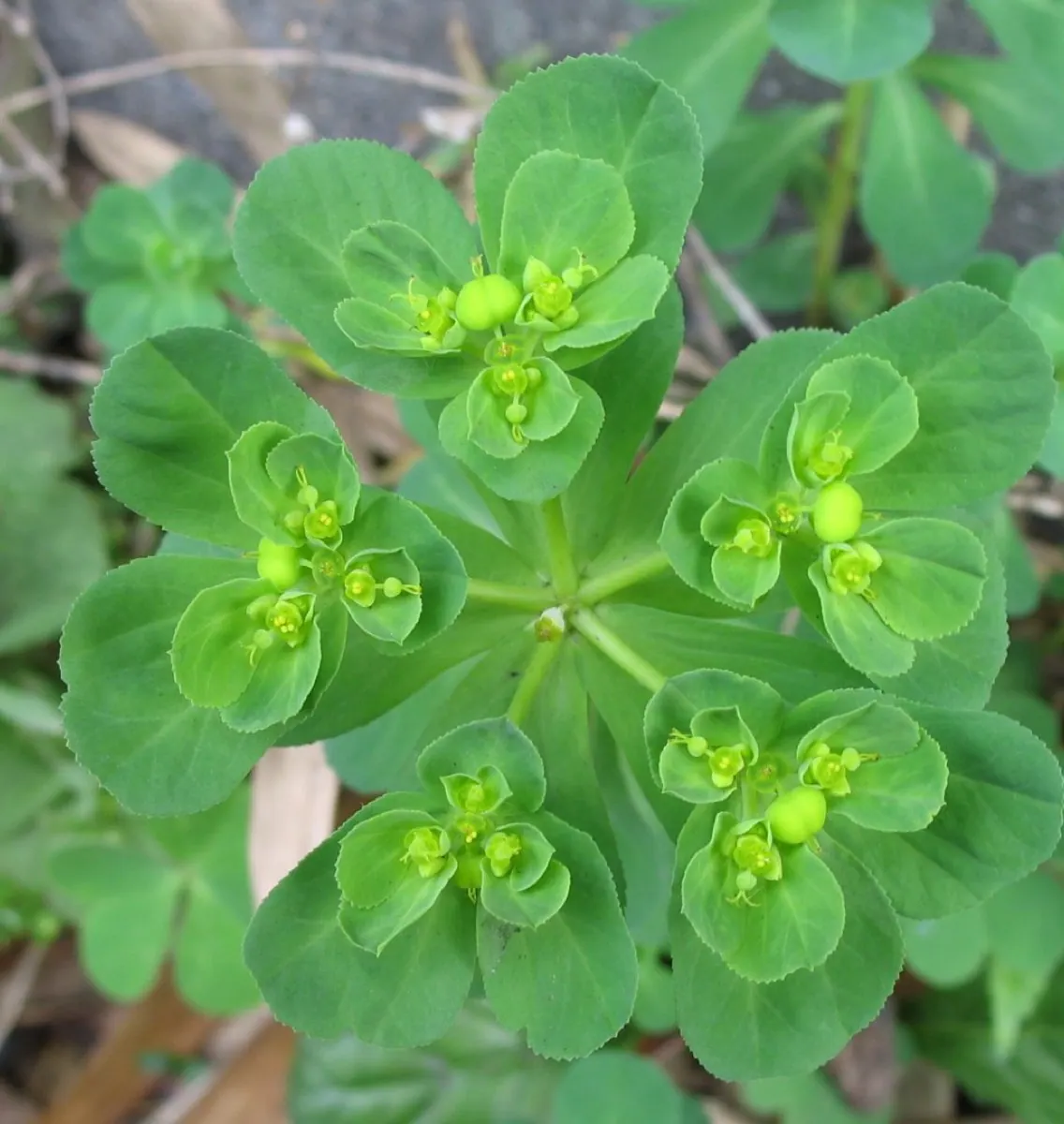
Photo: Sphl, CC BY-SA 3.0, Wikimedia Commons

Spurge
Euphorbia species
PoisonousBreak any part of it and it bleeds a milky latex that burns skin and can blind you.
Confused with
Danger: Euphorbia latex causes intense burning of the mouth, throat and gut, vomiting and diarrhoea. On skin it causes redness and blistering, and in the eye it causes severe pain, swelling and sometimes lasting damage or temporary blindness.
How to tell: Look at the leaf arrangement and the flower. Dandelion and sow thistle have all their leaves in a rosette or clasping the stem, with clear toothed dandelion-type leaves and a proper yellow daisy flower. Spurges have leaves crowded up a stiff upright stem and green cup-like flower structures with no petals. Milky sap plus green petalless flowers means do not touch.
Danger: Fleshy spurges look very like purslane in dry ground, and the burning is immediate.
How to tell: Snap the stem. Purslane sap is clear and watery. Every spurge bleeds thick white latex within a second or two. Clear sap, look further. White milk, stop.
Leaves
Very variable between species, but typically narrow, untoothed or finely toothed, often blue-green or grey-green, arranged alternately or in dense whorls up the stem, crowded towards the top. Some are fleshy and cactus-like.
Flowers
Never showy petals. Small green, yellow-green, or maroon-centred cup structures with crescent-shaped glands around the rim, grouped in a flat or umbrella-shaped head, often with leaf-like bracts of the same colour beneath. Poinsettia is the same genus.
Stem
Green to reddish, often stout and unbranched below the flower head, sometimes woody at the base. The single defining feature is the sap: cut or snap any stem or leaf and a thick white milky latex runs out immediately. That is the identification.
Smell or taste
Sap smells faintly acrid. Never taste anything, and do not let the latex near your mouth.
Habitat
Everywhere. Garden beds, dry hillsides, dunes, walls, cultivated soil, roadsides and waste ground throughout Portugal and Europe. There are hundreds of species and all of them have the latex.
Preparation
No preparation makes any spurge safe. Cooking, drying and soaking do not destroy the diterpene esters in the latex. Do not use it as a green, a tea, a wart treatment on skin or a fish poison.
Traditional use
Spurge latex has been used traditionally to burn off warts and corns, and as a purgative, and several species were used to stun fish. Those uses caused burns, eye injuries and severe poisoning. The latex is also a known tumour promoter. Do not repeat any of it at home.
Harvest rule
Not harvested. To clear it, wear waterproof gloves, long sleeves and eye protection, cut rather than strim, and wash tools and clothes afterwards. Never burn large amounts, since the smoke irritates eyes and airways. Some native Euphorbia species are protected in dune and cliff habitats, so check local rules before clearing on the coast, and leave wild stands that are not in anyone's way.
Leiteira, trovisco-macho, euforbia, maleiteira (PT); spurge (EN)