 Human Skills
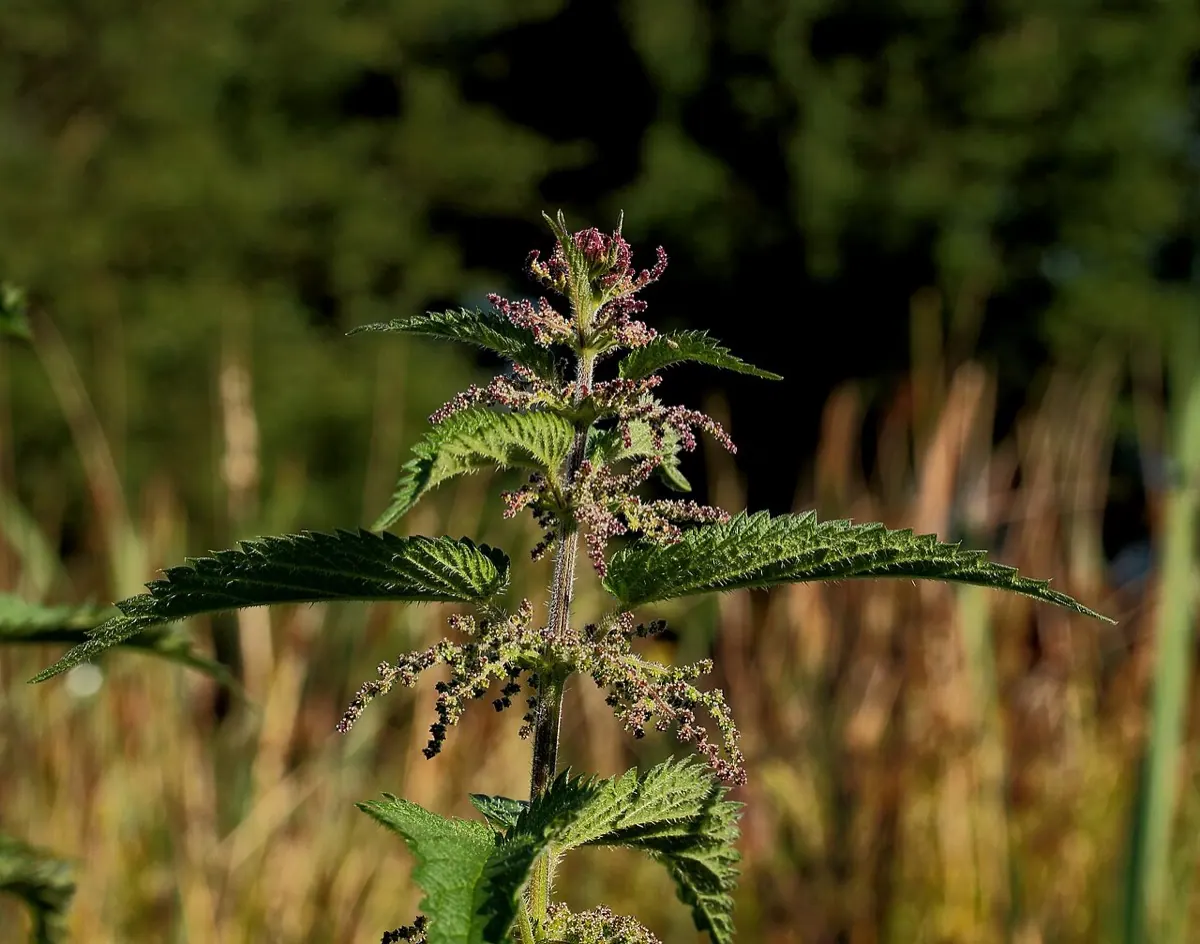
Photo: Dominicus Johannes Bergsma, CC BY-SA 4.0, Wikimedia Commons

Stinging Nettle
Urtica dioica
EdibleThe plant that stings you is one of the best wild greens in Europe, and heat removes the sting completely.
Confused with
Danger: Harmless. It is also edible, so this mistake costs you nothing.
How to tell: Dead-nettle has no stinging hairs at all and carries large hooded white flowers 2 cm long at the leaf joints. Real nettle flowers are tiny green strings.
Danger: Not deadly, but foul-tasting and it will ruin a pot of greens.
How to tell: Crush a leaf with a gloved hand: black horehound stinks strongly and unpleasantly, musty and rank. Nettle smells green and clean.
Danger: None. It is edible in the same way and stings harder for its size.
How to tell: Small nettle is an annual under 50 cm with shorter, more deeply cut leaves and male and female flowers on the same plant. Treat it identically.
Leaves
Opposite pairs, each pair set at a right angle to the pair below. Blades 4-15 cm, heart-shaped base, pointed tip, strongly and evenly toothed all round. Both surfaces carry stiff stinging hairs, densest on the underside and along the veins.
Flowers
Tiny, green to greenish-white, with no petals worth the name, hanging in loose branched catkin-like strings from the leaf joints. Male and female flowers are usually on separate plants. Wind pollinated, so never showy.
Stem
Square in cross-section, upright, unbranched or lightly branched, grooved on the faces, covered in stinging hairs. Not hollow, not blotched.
Smell or taste
Crushed leaves smell green, faintly of cucumber and wet hay, with no onion, no aniseed and no mousy note. Do not handle bare-handed to test: the sting is the identification, not the taste. Once cooked it is confirmed safe and tastes like a deep, mineral spinach.
Habitat
Nitrogen-rich disturbed ground: field edges, old farmyards, compost heaps, riverbanks, ruined walls, shaded ditches. In Portugal it is common in the north and centre, and in the south it hides in damp shade and irrigated ground rather than open dry hillsides.
Edible parts
Young tops: the top four to six leaves of a shoot under about 30 cm, or the regrowth after cutting. Seeds in late summer. Stop eating the leaves once the plant flowers.
Preparation
Pick with gloves into a bag, never into a bare hand. Wash in cold water, then drop into a large pot of boiling water for 1 to 2 minutes and drain. That fully destroys the stinging hairs. From 500 g of fresh tops you get roughly 120-150 g of cooked greens, which is one generous side dish. For a tea, use 2 to 3 teaspoons of dried leaf, or a small handful of fresh leaf, to 250 ml of water just off the boil, covered for 8 to 10 minutes. Dry leaves in a single layer in shade with moving air for 3 to 5 days until they crumble, then store in a sealed jar away from light. For soup, sweat an onion and a potato, add 1 litre of stock, simmer 15 minutes, add 300 g of washed tops, simmer 5 minutes more and blend. Nettle seeds are gathered in August and September, rubbed from the strings, dried and sprinkled on food a teaspoon at a time.
Traditional use
Across rural Europe nettle was traditionally taken as a spring tonic tea after winter, and the leaf was used as a folk remedy for tiredness and for joint aches. The old practice of deliberately stinging arthritic joints is folk custom, not evidence. Nettle fibre was also historically spun into cloth and cord.
Harvest rule
Nettle is abundant and regrows hard, so cut tops with scissors and never pull the roots. Take no more than a third of any patch and leave the flowering plants, which feed the caterpillars of several butterflies. Foraging law varies by country: in Portugal, gathering small amounts of common plants for personal use on unenclosed land is generally tolerated, but the land belongs to somebody, so ask on farmland and enclosed land, and inside the Rede Natura 2000 sites and national and natural parks follow ICNF rules, which can restrict collection. Never gather on private land without permission.
Urtiga (PT), ortiga (ES), ortie (FR)