 Human Skills
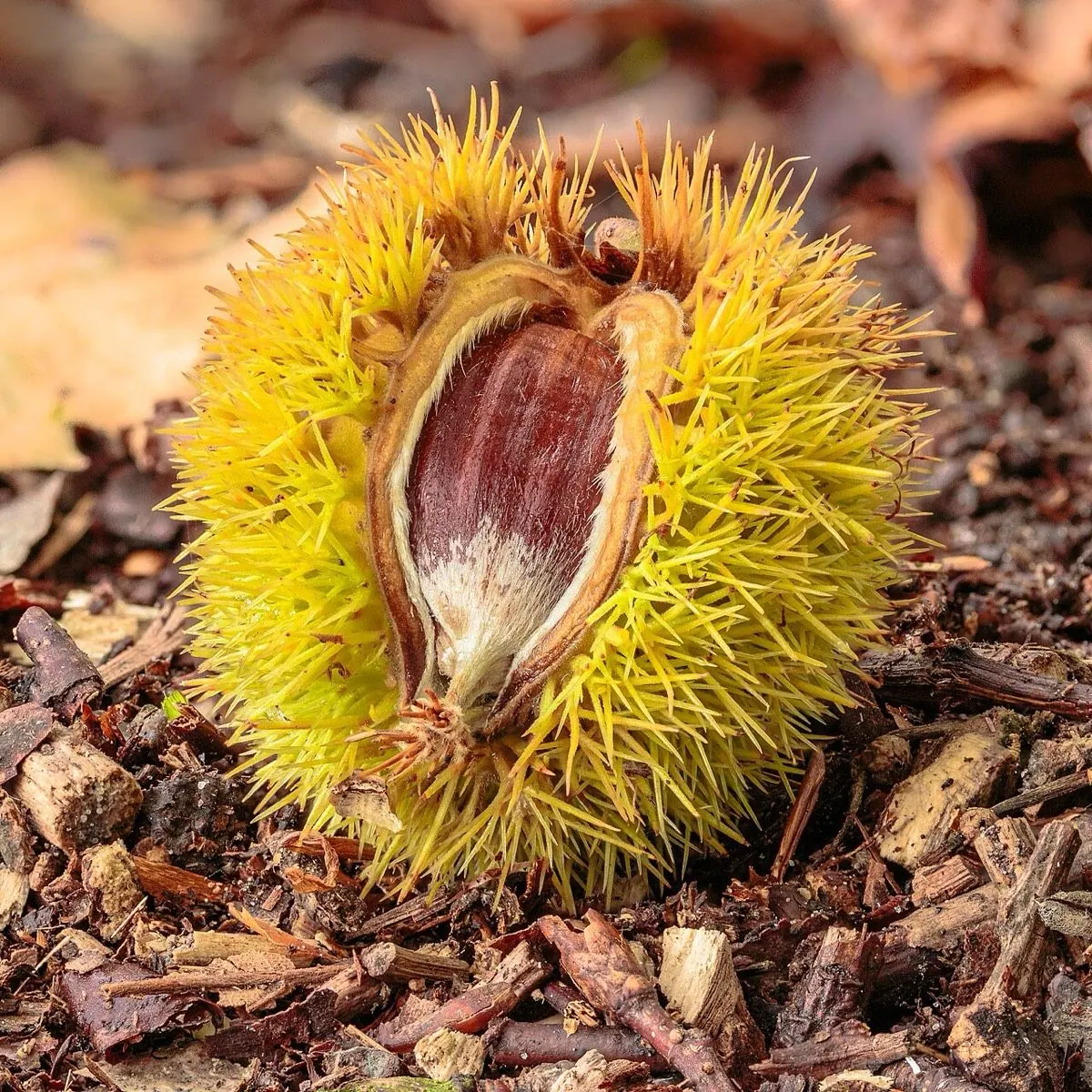
Photo: Dominicus Johannes Bergsma, CC BY-SA 4.0, Wikimedia Commons

Sweet Chestnut
Castanea sativa
EdibleThe one wild nut in Europe that is a genuine staple starch, and the only true chestnut has a spiny husk like a hedgehog holding two or three flat-sided nuts.
Confused with
Danger: Toxic. Contains aesculin. Causes vomiting, stomach pain, diarrhoea and, in quantity, dizziness and muscle weakness. Children are poisoned by conkers most years.
How to tell: Three checks. The husk: horse chestnut has a thick green case with a few short blunt widely-spaced spikes, while sweet chestnut has a dense hedgehog of long fine sharp spines you cannot hold bare-handed. The nut: a conker is one round nut with no point, while a sweet chestnut has a distinct pointed tip with a little tuft or tassel at the end and a flat side where it pressed against its neighbours, usually two or three per husk. The leaf: horse chestnut leaves are palmate, five to seven leaflets spreading from one point like a hand, while sweet chestnut leaves are single long toothed blades. If the nut is round with no tassel, it is a conker.
Danger: Not dangerous but inedible without leaching, and a waste of a cook pot if mixed in.
How to tell: Acorns have a scaly cap, no spiny husk, and a smooth oval body. Different tree entirely.
Leaves
Alternate, simple, large: 10-28 cm long and 4-9 cm wide, oblong-lance shaped, glossy dark green, with a strong midrib, straight parallel side veins running to the edge, and a bold row of large forward-pointing bristle-tipped teeth all round. Unmistakable once seen.
Flowers
Long creamy-yellow catkins 10-25 cm hanging in July, with a heavy sweet smell that many people find unpleasant. Female flowers sit at the base of the catkins and become the burrs.
Stem
Trunk bark smooth and grey when young, then deeply fissured with ridges that twist in a spiral around older trunks. Twigs stout, reddish-brown, with prominent buds.
Smell or taste
Crushed leaves smell faintly green and tannic. The flowering tree in July smells sweet and slightly rank at a distance. Cooked nuts are confirmed safe and taste sweet, floury and mild.
Habitat
Acid, well-drained soils in hill country: managed soutos in Tras-os-Montes and Beira Alta, mixed woodland, old orchard terraces. In Portugal, chestnut country is the north and the mountain interior, not the dry south.
Edible parts
The nuts, always cooked.
Preparation
Gather from the ground in October and November, taking the ones still in fresh husks where possible. Open the burr by standing on it with a boot and twisting; do not grab it. Sort immediately. Drop the nuts into a bucket of water and discard everything that floats, since floaters are hollow, dried out or grub-eaten. Chestnuts are wet and alive and they mould in days at room temperature, so either use them within a week, refrigerate in a paper bag for up to a month, or dry them. Never eat a raw chestnut in quantity: raw nuts are high in tannic acid, hard to digest and cause stomach upset. Cook them. To roast, cut a clear slit through the shell on the flat side of every single nut or it will explode, then roast at 200 C for 20 to 30 minutes, or 15 to 20 minutes in a pan over embers with constant shaking. Peel while hot, because both the hard shell and the bitter inner skin come away easily hot and impossibly once cold. To boil, slit and simmer 25 to 35 minutes, which is better if you want a puree. For flour, the traditional method, peel the nuts and dry them slowly at 50 C for 24 to 48 hours until they snap, then mill. Chestnut flour keeps 6 months in a sealed jar and makes bread, porridge and cakes. 1 kg of fresh nuts gives roughly 450 g of peeled nuts and about 250 g of flour.
Traditional use
For centuries the bread tree of mountain Portugal, Galicia, Corsica and the Apennines, where chestnut flour fed people through winter before maize and potatoes arrived. There is no significant folk-medicine use worth reporting beyond a leaf infusion once used for coughs.
Harvest rule
Assume every chestnut tree in Portugal belongs to somebody. The soutos of Tras-os-Montes and Beira are working orchards, the crop is a real income, and gathering without permission is theft, not foraging. Ask, and expect a reasonable landowner to say yes to a bagful. Leave plenty for wild boar, jays and squirrels, which are also the trees replanting mechanism. Do not beat or shake branches; take what is on the ground. Foraging law varies by country; inside ICNF protected areas check the rules, and in the chestnut regions respect the local custom, which often reserves the crop until the owner has gathered it.
Castanheiro, castanha (PT), castano (ES), chataignier (FR)