 Human Skills
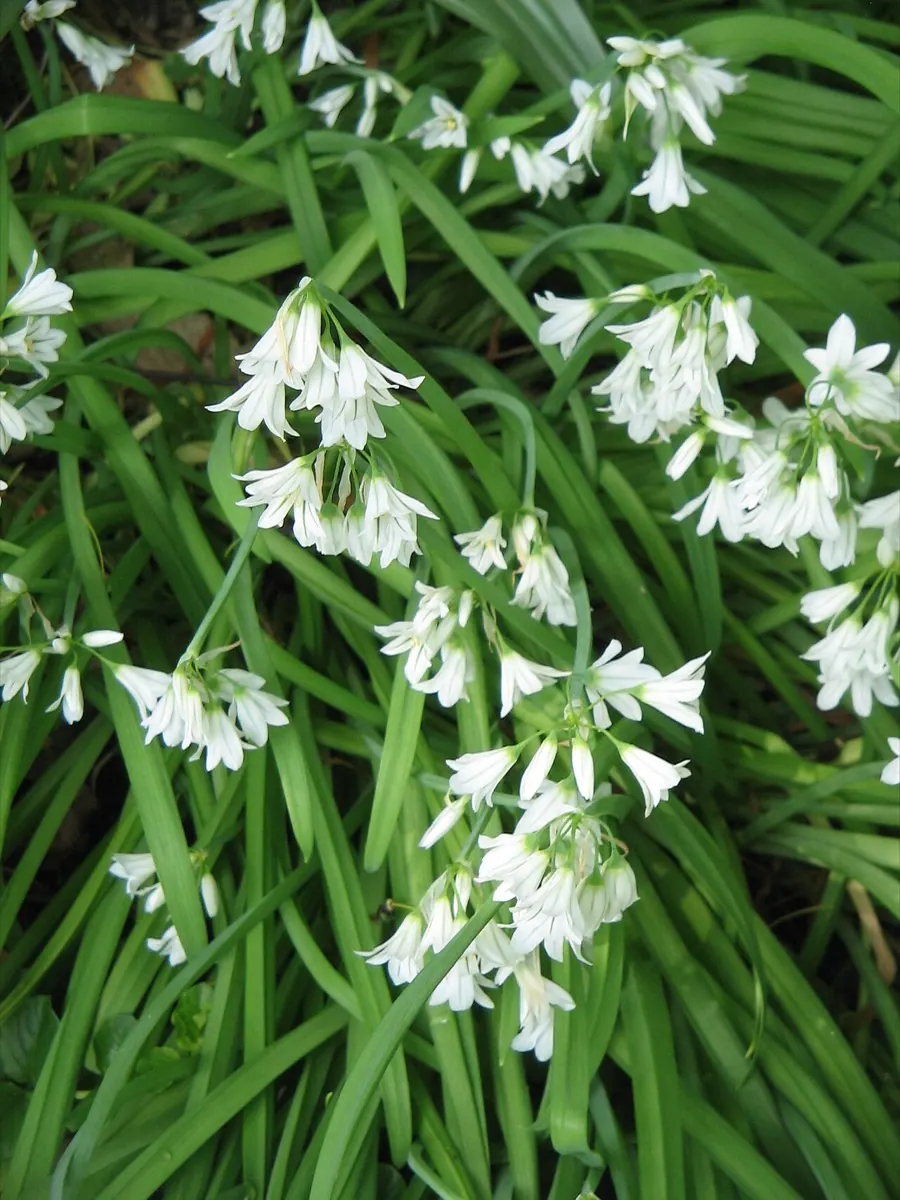
Photo: Meneerke bloem, CC BY-SA 3.0, Wikimedia Commons

Three-Cornered Leek
Allium triquetrum
EdibleThe abundant Portuguese wild onion, settled by a flower stalk that is sharply triangular in cross-section and a strong garlic smell.
Confused with
Danger: Deadly. Colchicine and cardiac glycosides respectively. Both kill, and both have strap-like green leaves at ground level that a careless grab-and-cut harvest can include.
How to tell: Neither smells of garlic when crushed, and neither has a keeled leaf or a triangular flower stalk. Crush and smell every leaf you pick, on clean fingers, and never cut a bunch blind. If in any doubt, wait for the triangular stalk with the green-striped white bells, which nothing toxic imitates.
Danger: Toxic. Alkaloids that cause vomiting, diarrhoea and, in quantity, heart and nervous effects. The bulbs are the worst part and they grow in the same shaded banks.
How to tell: No garlic smell. Snowflake flowers are bells with a green or yellow spot at the very tip of each petal, not a stripe down the middle, and snowdrop has three long outer petals and three short inner ones. Their leaves are flat and blunt-tipped, not keeled.
Danger: None. Also edible.
How to tell: Broad flat leaves with no keel, white star flowers in a flat-topped head. Both are used the same way.
Leaves
Two to four narrow strap leaves, 15-40 cm long and 5-20 mm wide, rising from a small white bulb. Each leaf is keeled, with a distinct raised ridge running along the underside so the cross-section is a shallow V. Bright green, hairless, with parallel lengthwise veins.
Flowers
Four to fifteen white bells hanging to one side of the top of the triangular stalk, each 10-18 mm long with six petals, and each petal carrying a distinct narrow green stripe down the middle. That green line is diagnostic.
Stem
The flower stalk is the giveaway: sharply three-angled, a clear triangle in cross-section with three edges you can feel by rolling it between finger and thumb. Smooth, leafless, unbranched.
Smell or taste
Crush a leaf and it smells strongly of onion and garlic. As with all wild alliums, the crush-and-smell test is the safety check and must be done leaf by leaf on clean fingers. Never taste to identify.
Habitat
Shaded damp banks, hedge bottoms, stream sides, old garden walls, roadside ditches, orchard edges. Extremely common through western and southern Portugal and much of the Mediterranean, where it is an aggressive spreader and in some countries is listed as an invasive species.
Edible parts
Leaves, flower stalks, flowers and the small bulbs, which are legitimate to take here because the plant is invasive.
Preparation
Cut leaves and stalks with scissors, crush-testing each. Use it as you would a spring onion: chopped raw over salad, potatoes, soup or eggs, or wilted for 2 minutes at the end of cooking. The flowers are good raw and make a striking garnish. The bulbs, dug in late winter when they are fattest, can be pickled: trim, blanch 1 minute, pack into a jar and cover with a boiled brine of 1 part vinegar to 1 part water with 30 g of salt and a teaspoon of sugar per litre. Refrigerate and use within a month. Like all alliums it does not dry well; the smell goes flat. Freeze it chopped in oil in an ice-cube tray, or salt it down at 15 g of salt per 100 g of chopped leaf. Do not keep garlic or onion preparations in oil at room temperature, since that is a botulism risk.
Traditional use
Used in the Mediterranean as a free kitchen onion rather than as a remedy. Where a folk-medicine role is claimed it is borrowed from cultivated garlic, and there is no separate tradition worth reporting.
Harvest rule
This is one of the very few wild plants you can harvest hard with a clear conscience, since it is invasive across Portugal, Spain and Britain and out-competes native ground flora. Even so, do not spread it: never move bulbs or dump trimmings in clean ground, because a single bulblet starts a colony. Foraging law varies by country: in Portugal it grows mostly on roadside and field margins that belong to somebody, so ask on private land, and inside ICNF protected areas check the local rules even for an invasive species.
Alho-bravo, cebolinho-bravo (PT), ajo de tres esquinas (ES), ail a trois angles (FR)