 Human Skills
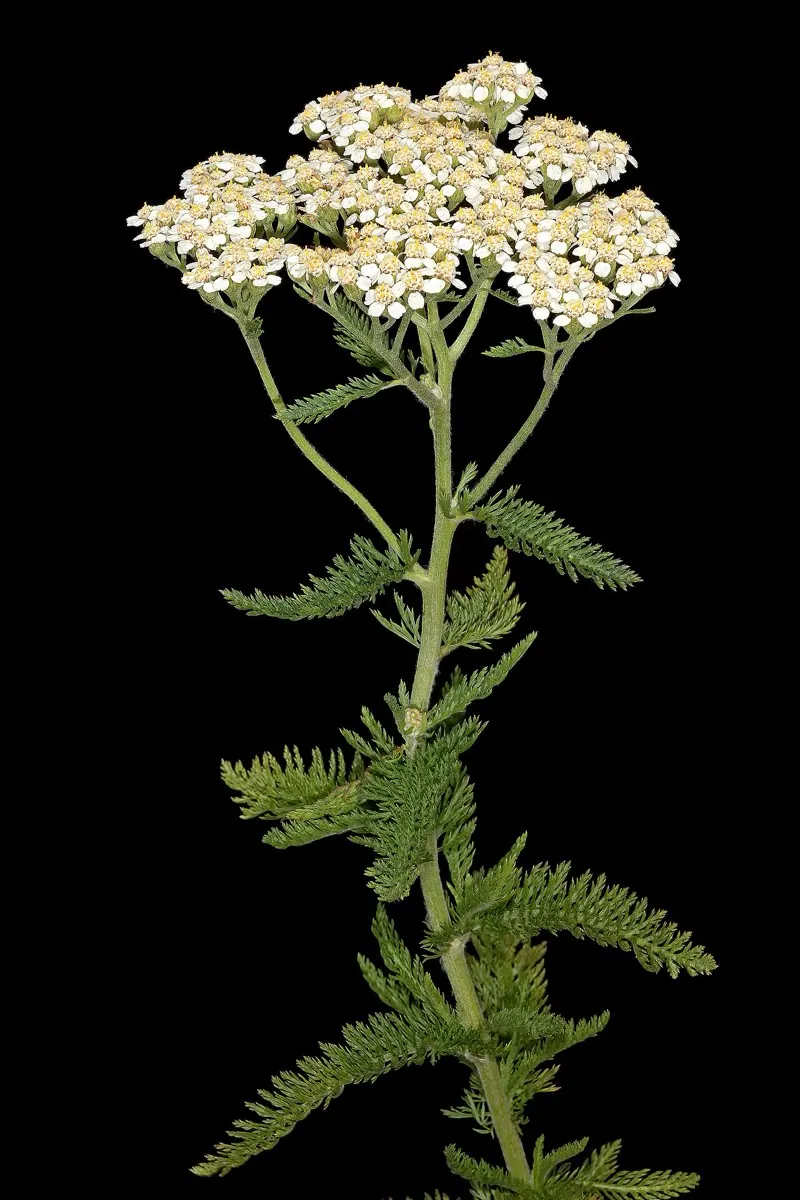
Photo: SAplants, CC BY-SA 4.0, Wikimedia Commons

Yarrow
Achillea millefolium
A tough roadside plant with feathery, almost fern-like leaves, carried in folk kits across Europe as the wound herb.
Confused with
Danger: Deadly. Coniine causes paralysis that spreads to the breathing muscles. A small amount of leaf can kill an adult, and there is no home remedy.
How to tell: Hemlock has a hollow stem with distinct purple-red blotches and a foul mousy smell when crushed; its flowers are an open lacy umbrella of tiny separate white flowers on spoke-like rays. Yarrow has a solid, woolly, unspotted stem, a sweet aromatic smell, and a dense flat cluster of tiny daisy heads with a cream centre, not an umbrella on spokes.
Danger: Deadly, and Portugal and Iberia have plenty of it along streams. The parsnip-like roots contain oenanthotoxin and cause violent convulsions within an hour.
How to tell: It grows in or beside water, is much bigger (up to 150 cm), has broad flat-lobed celery-like leaflets several cm wide, a thick grooved hollow stem, and a bundle of fleshy pale tubers at the base. Yarrow is a dry-ground plant with thread-fine leaf segments and no tubers.
Danger: Poisonous. Causes burning in the mouth and throat, vomiting and, in quantity, hemlock-like paralysis.
How to tell: It carries three long thread-like bracts that hang down beneath each small flower cluster like a tiny beard, a feature yarrow never has. Its leaves are flat and triangular in outline, not feathery plumes.
Danger: Not deadly, but a different plant with a different tradition, and it can be sharply irritating to the nose and mouth.
How to tell: Sneezewort has undivided, narrow, saw-edged leaves and far larger flower heads, 12 to 18 mm across, with long showy white rays. Yarrow's leaves are finely divided and its heads are tiny.
Leaves
Alternate, 5 to 15 cm long but only 1 to 3 cm wide, divided two or three times into very fine segments so the whole leaf looks feathery. Softly hairy, dark green, and the divisions are so fine that the leaf outline looks like a narrow plume rather than a normal leaf.
Flowers
A flat-topped cluster 3 to 10 cm wide made of many small daisy-like heads, each head only 4 to 6 mm across with four to six short white (sometimes dusky pink) outer rays around a cream centre. The cluster is dense and slightly domed, not a lacy open umbrella.
Stem
Single, round in cross section, solid (not hollow), tough and stringy, covered in soft woolly hairs, and never blotched or spotted with purple. It is ridged along its length and hard to snap cleanly.
Smell or taste
Crushed leaves smell strongly aromatic and sweetly medicinal, a little like chrysanthemum with a peppery edge. Do not taste anything to identify it, here or anywhere else: taste tells you nothing before poisoning already began.
Habitat
Field edges, roadsides, dry grassland, pasture, old lawns, coastal banks. Very common across mainland Portugal and the whole of Europe, from sea level to mountain pasture.
Preparation
Traditionally the whole flowering top is cut just as the flowers open, tied in small loose bundles and hung upside down in a dark, dry, airy room for one to two weeks until the stems snap rather than bend. The dried leaves and flowers are then stripped off, stored whole in a sealed jar away from light, and used within a year. Infusion is the usual form: about one teaspoon of dried flowering tops in a cup of just-boiled water, covered for five to ten minutes, then strained. Covering matters, because the aromatic oils leave with the steam. For external folk use the fresh leaf was simply crushed between clean fingers and pressed onto a small graze, or the dried herb was moistened with hot water, cooled to skin temperature and laid on as a poultice under a clean cloth.
Traditional use
Yarrow is one of the oldest recorded wound herbs in Europe. Its Latin name points at Achilles, and its Portuguese name erva-dos-carpinteiros, the carpenters' herb, records the same idea: it was the plant reached for when a tool slipped. Across rural Portugal, Spain and the rest of Europe the crushed leaf was traditionally pressed onto small cuts and grazes, and an infusion of the flowering tops was taken as a household tea during feverish colds and for digestive upsets. This is history, not a treatment plan. A wound that is deep, dirty, gaping, bleeding heavily, or made by an animal or a rusty tool is a job for proper cleaning, pressure and a clinician, never for a leaf.
Harvest rule
Take only the flowering tops, cutting with scissors and leaving the basal rosette and roots untouched so the plant returns. Never take more than one stem in ten from any patch, and leave whole stands alone where they are the only flowers feeding insects. Avoid roadsides, sprayed field margins and dog-walking routes. Get the landowner's permission before picking on private land, and check local rules first: collecting is restricted or banned in national parks and protected areas, and the rules differ between countries and even between municipalities.
Milefolio, mil-folhas, erva-dos-carpinteiros (PT); milenrama (ES)