 Human Skills
Why Salad Does Not Feed You
The staple four, and the hard problem of fat
5 minBeginnerUpdated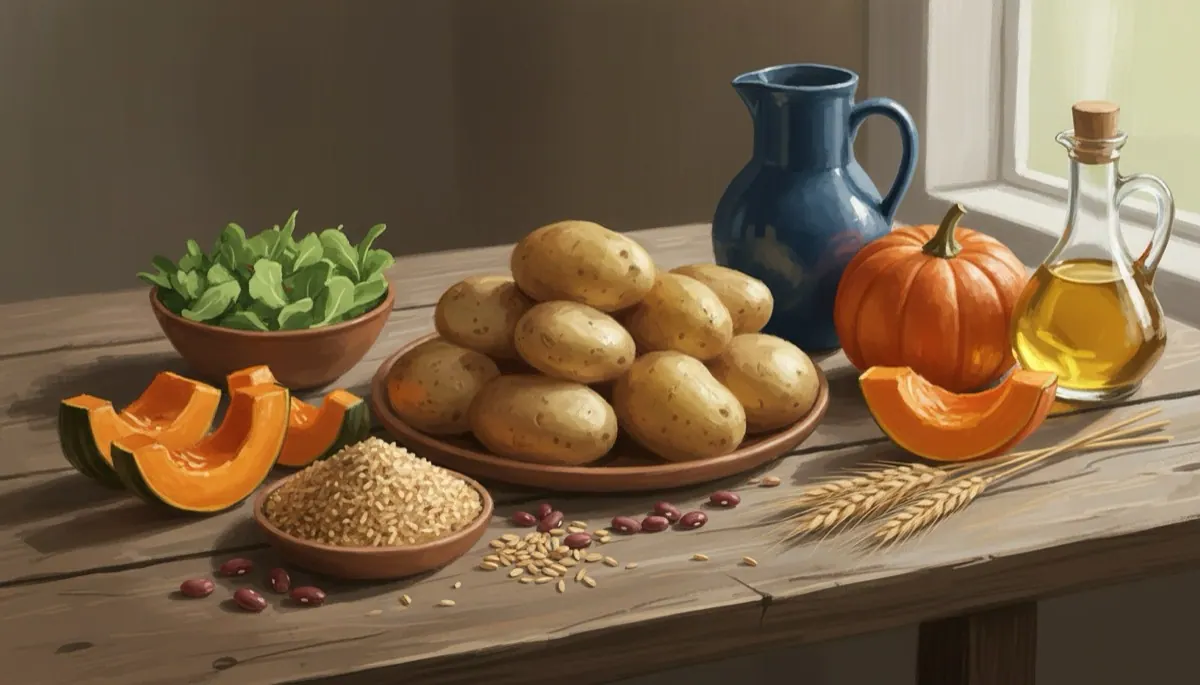
- Rank crops by calories per square metre, not by weight
- Name the four staples that carry a household
- Explain why fat is the hardest thing to grow at home
Weight lies, calories do not
A courgette plant can throw out 15 kg of fruit and feel like abundance. At 170 calories a kilogram that is about 2500 calories, which is a single day of food for one adult, from a plant that occupied three square metres for four months.
Cucumber is 96 percent water. Lettuce gives roughly 375 calories per square metre for a whole crop. Tomatoes are magnificent and give about 1400 calories per square metre, mostly as flavour.
This is not an argument against growing them. It is an argument for knowing which beds are feeding you and which are seasoning your food. Most beginner gardens are almost entirely seasoning, and then the gardener wonders why the shopping bill has not moved.
The staple four
Four groups do the actual work. Potatoes give roughly 2700 calories per square metre and need no processing beyond curing. Winter squash gives about 800 and stores on a shelf for six months with no work at all. Dry beans give about 850 per square metre and bring protein with them. Grains give around 1200 but demand threshing, winnowing and dry storage.
Between them these four cover carbohydrate, protein and long storage. Add onions and garlic so the food is worth eating, and a brassica bed so you have something green in January, and you have the skeleton of a real food plan.
Everything else in the garden is built on top of that skeleton, not instead of it.
Fat is the hard one
Fat is the most calorie dense food there is, about 9000 calories a kilogram, and it is the thing a garden is worst at producing. You cannot grow butter and you cannot grow cooking oil from a vegetable bed.
Sunflowers give perhaps 0.2 kg of seed per square metre, and pressing that into oil needs a press and a great deal of seed. Rapeseed and linseed have the same problem. Walnuts and almonds produce well but take five to ten years to come into bearing.
Olives are the practical answer in the south. A mature tree gives 15 to 40 kg of fruit, about 5 kg of olives make a litre of oil, and pressing happens at a shared local mill rather than at home.
How the old smallholdings solved it
A traditional Portuguese smallholding did not solve this with clever bed planning. It solved it with four things working together.
Olives gave the cooking fat and enough to trade. A pig, fed largely on kitchen waste, windfall fruit, acorns and surplus roots, converted things people could not eat into fat and preserved meat that lasted a year as chouriço, presunto and lard. Chestnuts and walnuts gave calories from ground that was too steep or poor for beds. Potatoes, maize, beans and cabbage filled the flat land.
Nothing in that system is a secret technique. It is a set of choices about which problems to solve with animals and trees rather than with vegetables.
Building a plan that actually feeds
A workable split for a plot aiming at real food is roughly 50 percent staples, 25 percent storage vegetables such as onions, carrots and cabbage, 15 percent summer fruiting crops, and 10 percent salad and herbs. Most gardens run those proportions almost exactly backwards.
Trees and fat sources sit outside that split, because they need permanent ground and years of patience. Get them planted in the first season even if the beds are still a mess.
Be honest that a garden alone will not give you oil, and probably not enough protein either. Buying olive oil and flour while growing everything else is not failure. It is how almost every successful smallholding in history has actually worked.
Check yourself
Potatoes give roughly 2700 calories per square metre, several times more than any salad or fruiting vegetable.
Potatoes, dry beans, grains and winter squash between them give carbohydrate, protein and long storage.
Sunflower gives about 0.2 kg of seed per square metre and needs a press, while nut and olive trees take five to ten years to bear.
Olives gave oil, a pig turned waste into fat and cured meat, nuts used poor ground, and potatoes filled the good land.
Try it for real: Re-balance one season of beds
- List every bed you planted last year and what was in it.
- Mark each as staple, storage vegetable, summer fruiting, or salad.
- Add up the area in each group as a percentage of the total.
- Move at least one salad or courgette bed into staples for next season.
- Order one nut or olive tree to plant this winter.
🛒 Gear for this skill
As an Amazon Associate I earn from qualifying purchases. It costs you nothing extra and keeps this site free.
Next lesson: Planning a Year of Eating →
Written and checked by the Human Skills team against the sources below. How we check our content
- FAO INFOODS Food Composition Tables
- John Jeavons, How to Grow More Vegetables
- RHS Grow Your Own
Related lessons
Crop Rotation and Planning a Year of Food
Move plant families, fill every gap, eat all year
How Much Land Feeds One Person
The honest arithmetic behind a number everyone gets wrong
Planning a Year of Eating
Work backwards from the kitchen, not forwards from the seed box
Getting the Harvest to Next Spring
Clamps, sand boxes, plaits and dry stores without a freezer