 Human Skills
Getting the Harvest to Next Spring
Clamps, sand boxes, plaits and dry stores without a freezer
6 minIntermediateUpdated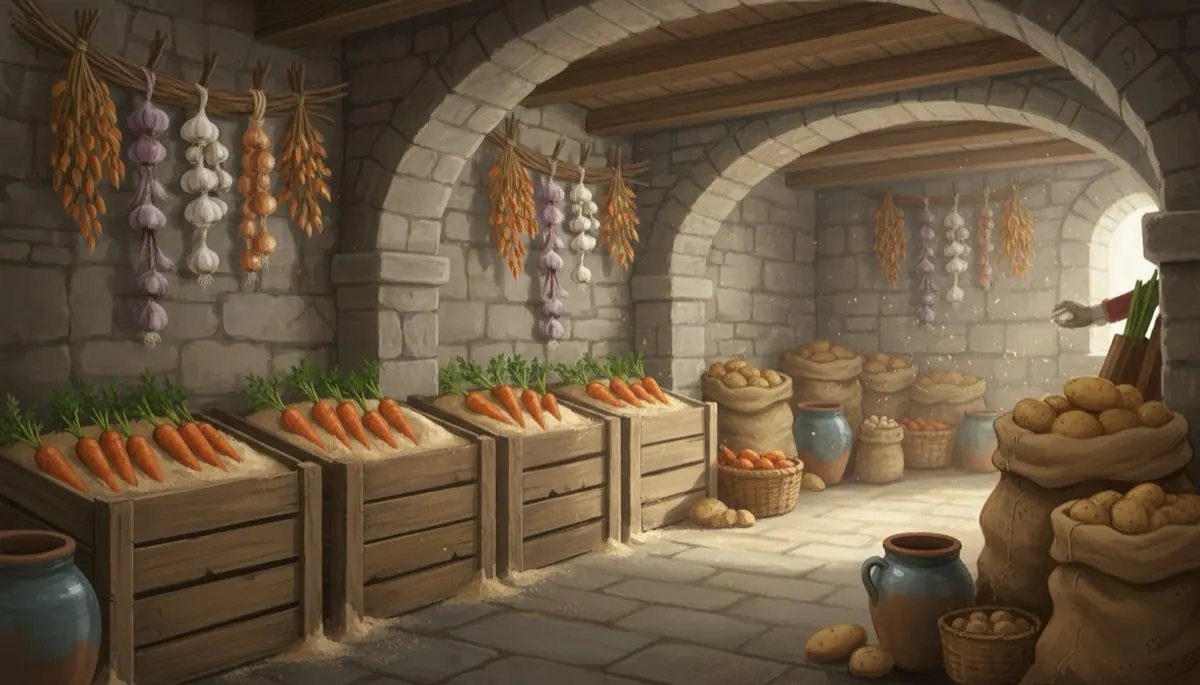
- Match each staple to the right storage conditions
- Build a clamp or a sand box for roots
- Predict how long each crop will really keep
Four conditions, not one shed
Crops do not want a single store, they want four. Cold and damp at 0 to 4 C with high humidity suits carrots, beetroot, parsnips and cabbage. Cool and dry at 4 to 10 C suits potatoes, which must also be in complete darkness or they green and become inedible. Warm and dry at 10 to 15 C suits onions, garlic and winter squash. Cold and dry suits dried beans and grain.
Putting onions in with the carrots ruins both, and storing potatoes next to apples makes the potatoes sprout, because ripening apples give off ethylene.
Before you build anything, walk your house and find the coldest corner, the driest shelf and the darkest cupboard. Most homes have all three already.
Clamps and sand boxes
A clamp is the traditional outdoor root store. Choose free draining ground, lay 15 cm of straw, pile the roots in a cone up to about 60 cm high, cover with another 20 cm of straw, then 15 cm of soil beaten smooth, leaving a wisp of straw at the top as a vent. It holds potatoes, carrots, beetroot and turnips through a frosty winter and costs nothing.
Indoors, a sand box does the same job. Layer roots in slightly damp sand in a wooden crate so that no two roots touch, tops trimmed to 2 cm, and keep it somewhere that stays under 5 C. Carrots and beetroot will hold five months this way with very little loss.
Hanging, plaiting and curing
Onions and garlic must be cured before storage: two to three weeks in a dry airy place until the necks are papery and rustle. Then plait them or hang them in nets somewhere dry and cool. Cured well, garlic holds nine months and onions seven.
Winter squash needs ten days in the sun or a warm room until the skin resists a thumbnail, then a shelf at 10 to 15 C. Do not wash it and always leave a few centimetres of stalk on.
Potatoes need curing too: two weeks at around 15 C in the dark to heal the skins, then move to 4 to 8 C in paper sacks or hessian, never plastic.
Drying, and what keeps longest
Drying is the oldest and least equipment hungry method. Beans and peas are dried on the plant, then finished indoors until a seed shatters rather than dents under a hammer. Tomatoes, figs, apples, peppers and herbs all dry well in Mediterranean sun or a very low oven.
Realistic home storage lives: dry beans and grain two years, garlic nine months, onions seven months, potatoes and parsnips five to six months, carrots and beetroot four to five, winter squash five to six, cabbage three months, and leeks and kale which simply stand in the ground until you want them.
Salad, courgette, cucumber and tomato do not store at all in their fresh state. Any plan that relies on them is a summer plan.
Check the store, do not trust it
Go through every store once a fortnight. Take out anything soft, sprouting or mouldy immediately, and take out the ones touching it too. Rot spreads by contact and by spores, and ten minutes a fortnight is the difference between a store that lasts to April and one that collapses in January.
Rub sprouts off potatoes as they appear, and keep light out completely. Green potatoes contain solanine and must never be eaten, no matter how much you cut away.
Keep a note on the door of what went in and when. By your second winter that note tells you exactly which varieties keep on your particular shelf.
Check yourself
Potatoes need 4 to 8 C, complete darkness and air. Light turns them green and warmth makes them sprout.
A clamp is roots piled on straw, covered with more straw and soil, with a small vent at the top.
Cured until the necks are papery and hung somewhere dry and cool, garlic holds about nine months.
Green potatoes contain solanine, which is toxic and is not removed by peeling or cooking.
Try it for real: Set up three real stores
- Measure the temperature of three places in your home or shed over a week.
- Assign each to roots, potatoes or onions based on what you measured.
- Build one sand box and fill it with undamaged carrots or beetroot.
- Cure and plait or net one crop of onions or garlic.
- Put a fortnightly check in your calendar until April.
🛒 Gear for this skill
As an Amazon Associate I earn from qualifying purchases. It costs you nothing extra and keeps this site free.
Next lesson: Protein and Fat on a Smallholding →
Written and checked by the Human Skills team against the sources below. How we check our content
- FAO Rural Structures in the Tropics, Crop Storage
- University of Minnesota Extension, Storing Garden Vegetables
- RHS Storing Fruit and Vegetables
Related lessons
Crop Rotation and Planning a Year of Food
Move plant families, fill every gap, eat all year
How Much Land Feeds One Person
The honest arithmetic behind a number everyone gets wrong
Why Salad Does Not Feed You
The staple four, and the hard problem of fat
Planning a Year of Eating
Work backwards from the kitchen, not forwards from the seed box