 Human Skills
Making a Household Supply Safe
Filter, disinfect, test, repeat
5 minIntermediateUpdated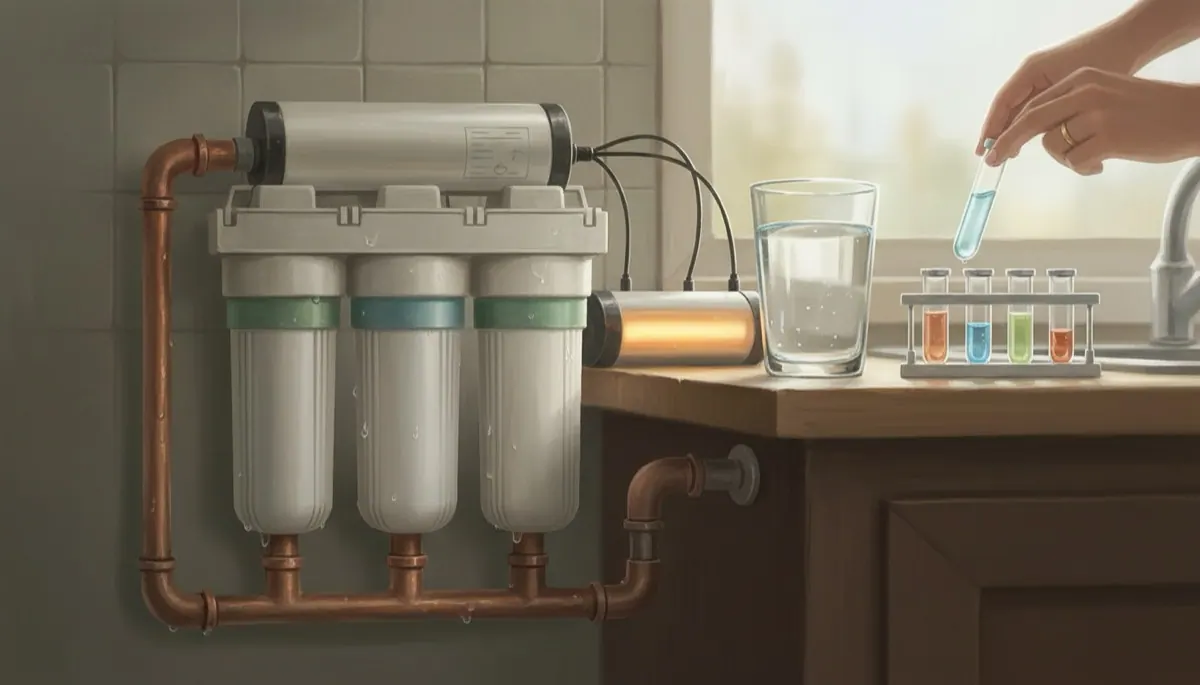
- Separate filtering, disinfecting and treating in your head
- Chlorinate a storage tank at a correct dose
- Build a testing routine you will actually keep
Three different jobs
Filtering removes particles and some organisms. Disinfecting kills what is left alive. Treating changes the chemistry, for example removing nitrate, iron or hardness. They are not interchangeable, and this is the mistake that makes people ill. A sediment filter makes cloudy water clear and does nothing to bacteria. Boiling kills bacteria and viruses and leaves nitrate and metals exactly where they were. Plan your household supply as a chain: settle and filter the solids first, then disinfect, then treat any specific chemical problem your lab test found, in that order.
Sand and ceramic filters
A slow sand filter is a tank of graded sand through which water trickles at a few hundred litres per square metre per hour. A biological layer forms on top over two or three weeks and removes most bacteria and protozoa remarkably well, but only while it is kept wet, fed slowly and never scoured. Ceramic candle filters with pores around 0.2 micrometres catch bacteria and cysts and are ideal at the tap; scrub them monthly and replace on schedule. Neither removes viruses reliably, and neither removes nitrate. Both need a disinfection step behind them for a drinking supply.
UV and chlorination
An ultraviolet lamp on the incoming pipe inactivates bacteria, viruses and protozoa as they pass, needs clear water and continuous electricity, and leaves no residual protection in the pipework. Chlorine is slower but stays in the water. For routine maintenance, household bleach at 5 percent free chlorine needs roughly 1 millilitre per 100 litres to reach about 0.5 mg per litre. Let it stand at least 30 minutes, then check that a free chlorine residual of 0.2 to 0.5 mg per litre remains at the far tap. Shock chlorination of a tank or well, after contamination or repairs, is far stronger: about 50 mg per litre, roughly 1 litre of 5 percent bleach per 1,000 litres. Leave it as long as the instructions say, then flush until the chlorine smell is faint. Do not drink it at shock strength. For emergency treatment of clear water, WHO gives two drops of 5 percent bleach per litre, stand 30 minutes.
What to test and how often
Test E. coli and total coliforms at least once a year, and always after heavy rain, flooding, a new pump, pipework changes or any illness in the house. Test nitrate annually where farmland sits uphill. Test metals and arsenic once at the start, then every three to five years unless the geology is known to be difficult. Keep every certificate in one folder with the date. A spring or well can be clean for years and then fail after heavy rain, because rain is exactly what pushes surface bacteria down into the aquifer. Past clean results are history, not a guarantee.
When something fails
A positive E. coli result means stop drinking it now. Boil at a rolling boil for one minute, three minutes above 2000 metres, for all drinking, teeth and food preparation. Then find the cause: a cracked well cap, a flooded chamber, an animal in the tank, a broken UV lamp, a back-siphoned hose. Fix the cause, shock-chlorinate the tank and the whole pipe run, flush it out and re-test. Do not accept a clean result from a single sample taken the same day; wait and take a second one. If a problem keeps returning, pay for a proper survey rather than treating the symptom forever.
Check yourself
Filtering removes particles, disinfection kills organisms, and treatment changes chemistry. Confusing them is how people get ill from clear water.
One minute at a rolling boil is enough, and three minutes above 2000 metres where water boils cooler.
A residual of about 0.2 to 0.5 mg per litre shows the dose was enough and keeps protecting the water in the pipework.
Heavy rain washes surface bacteria into springs and shallow wells. A source clean for years can fail within days of a storm.
Try it for real: Set up a water safety routine
- Draw your supply as a chain from source to tap and label each stage
- Identify which stage filters, which disinfects and which treats
- Buy a free-chlorine test kit and measure your current residual
- Book a laboratory test for E. coli, coliforms and nitrate
- Write the shock-chlorination dose for your tank volume on the tank lid
🛒 Gear for this skill
As an Amazon Associate I earn from qualifying purchases. It costs you nothing extra and keeps this site free.
Next lesson: Sizing a Real Off-Grid Solar System →
Written and checked by the Human Skills team against the sources below. How we check our content
- WHO Guidelines for Drinking-water Quality
- US EPA Ground Water and Drinking Water
- CDC Private Water Systems