 Human Skills
Sizing a Real Off-Grid Solar System
Watt-hours, winter sun and honest numbers
6 minAdvancedUpdated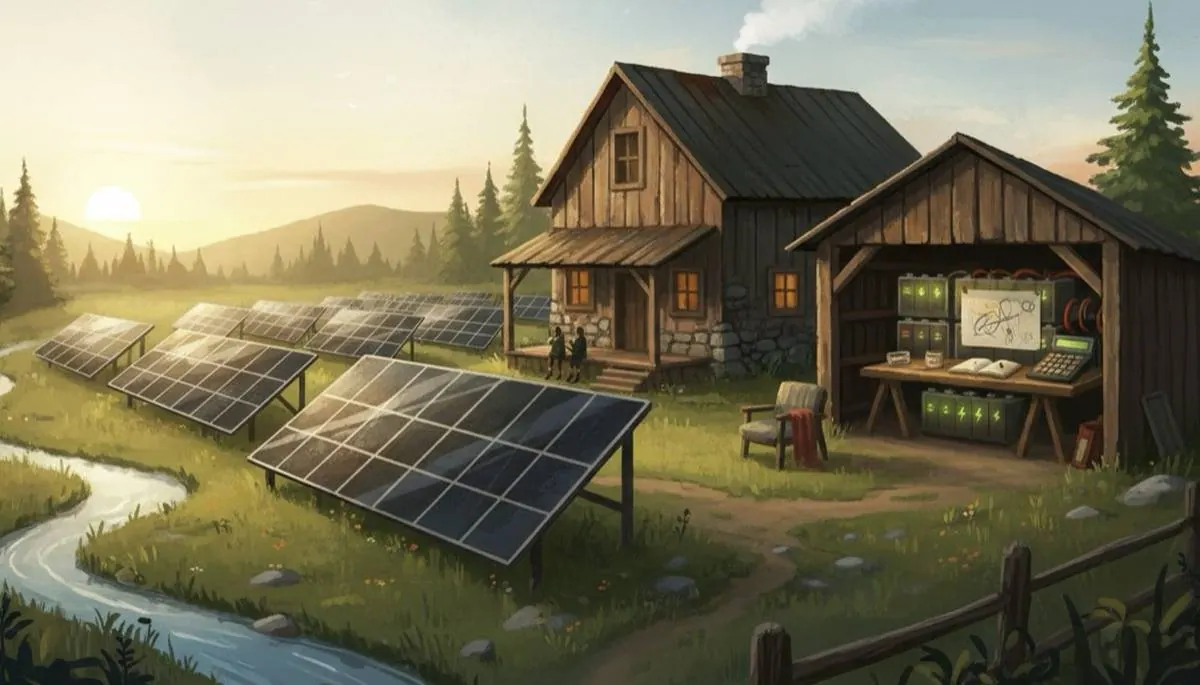
- Build a load list in watt-hours per day
- Size panels and battery for the winter design case
- See why a fridge and a well pump dominate the design
Start with a load list, not a panel
Write down every device, its watts, and the hours it runs per day, then multiply. A 10 watt LED for 5 hours is 50 watt-hours. A laptop is around 250 watt-hours a day. A modern A-rated fridge is 300 to 500 watt-hours a day and runs all year. A washing machine on a cold cycle is 300 to 600 watt-hours per load. Add it all up and you have your daily consumption. Most small off-grid homes land between 1.5 and 4 kilowatt-hours a day. Add 20 percent for losses in the inverter, wiring and battery round-trip. That number, not the roof area, drives the design.
Panels and battery do different things
Panels supply energy; the battery buys you time. Sizing one without the other gives you a system that either wastes sun or dies at 3 in the morning. As a rough rule, in a Mediterranean winter a fixed south-facing panel yields around 2 to 3 hours of full output per day, so a 400 watt panel returns roughly 0.8 to 1.2 kilowatt-hours on a good December day and far less under a week of cloud. To cover a 3 kilowatt-hour daily load through winter you are looking at 1.5 to 2.5 kilowatts of panel, several times what the summer figures would suggest.
Days of autonomy and battery chemistry
Autonomy is how many days the house runs with no sun at all. Two days is a realistic minimum, three is comfortable. A 3 kilowatt-hour daily load with two days of autonomy needs about 6 kilowatt-hours of usable storage. Lead-acid gives you only about half its rated capacity without damage, so that is a 12 kilowatt-hour bank, and it lasts perhaps 500 to 1200 cycles. Lithium iron phosphate gives 80 to 90 percent usable, tolerates deep cycling and typically lasts 3000 to 6000 cycles, which usually makes it cheaper per kilowatt-hour over ten years despite the higher sticker price.
Design for the worst week, not the average
Annual averages are useless off-grid because you cannot borrow December sun from July. Design against the worst realistic week: short days, low sun angle and cloud. Tilting a fixed array steeper, roughly your latitude plus 15 degrees, favours winter and sheds dust and rain. Accept that most systems need a backup, usually a small petrol or diesel generator run for a few hours on the worst days, and size it to charge the battery rather than to run the house. Planning the generator in from the start is far cheaper than doubling the array to chase five bad days a year.
The fridge and the pump run the design
Two loads usually dominate a small off-grid home: the fridge, because it runs every hour of every day, and the well pump, because it draws a big surge for short bursts. A deep-well pump starting at 1.5 kilowatts can demand three to five times that for a second, and an inverter that cannot deliver the surge simply trips. Fix it by pumping into a raised storage tank during sunny hours so the house feeds by gravity, and by choosing a modern high-efficiency fridge. Cutting those two loads well is worth more than another panel.
Check yourself
You cannot store July sun until December. Off-grid systems are sized on the worst week, usually with a generator for the extremes.
Daily load times days of autonomy gives usable storage. With lead-acid you then roughly double the rated bank because only half is usable.
Motors draw a large inrush current at startup. Either size the inverter for the surge, fit a soft starter, or pump to a gravity tank on sunny hours.
The fridge is modest in watts but runs every hour of every day, so it dominates annual consumption along with pumping.
Try it for real: Build your own load list and size the array
- List every device with its watts and daily hours and total the watt-hours
- Add 20 percent for system losses
- Multiply by two days for the usable battery capacity you need
- Divide the daily figure by 2.5 winter sun hours to estimate panel watts
- Identify your two biggest loads and write one way to cut each
🛒 Gear for this skill
As an Amazon Associate I earn from qualifying purchases. It costs you nothing extra and keeps this site free.
Next lesson: Heat and Cooking From Wood →
Written and checked by the Human Skills team against the sources below. How we check our content
- DGEG (Direcao-Geral de Energia e Geologia)
- International Energy Agency Photovoltaic Power Systems Programme
- US Department of Energy Solar Energy Technologies Office