Human Skills
CPR and Choking
Push hard, push fast, and clear a blocked airway
7 minIntermediateUpdated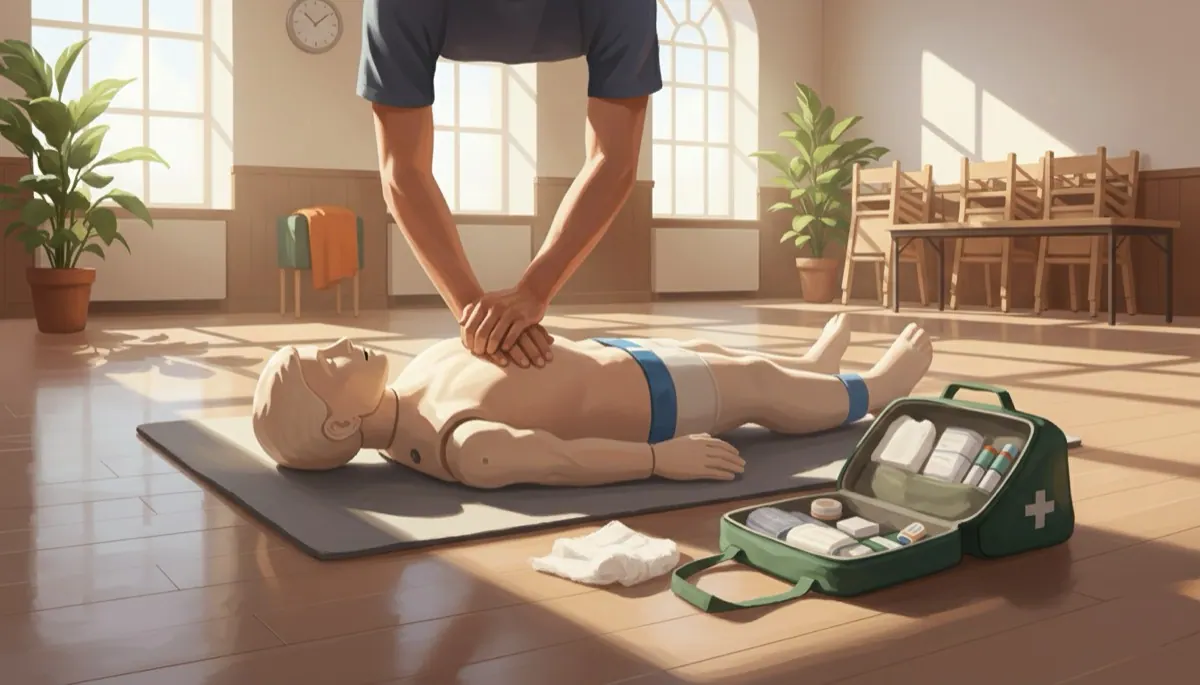
- Give adult chest compressions at the right rate, depth and position
- Know when to use hands-only CPR and how to use an AED
- Help a choking adult with back blows and abdominal thrusts
When the heart stops
If an adult is unresponsive and not breathing normally, their heart has probably stopped. Without help, the brain starts to die within minutes, and CPR is what buys time. Call your local emergency number (112 in Europe) first, put the phone on speaker, and ask someone to find an AED if there is any chance one is nearby. Then start compressions immediately. Do not worry about hurting them. A person in cardiac arrest is already as badly off as a person can be, and any CPR is far better than none.
Compressions: hard and fast
Kneel beside them. Place the heel of one hand in the centre of the chest, on the lower half of the breastbone, and the other hand on top with fingers interlocked. Keep your arms straight and shoulders directly over your hands. Push down 5 to 6 cm, then let the chest rise fully. Aim for 100 to 120 compressions a minute, roughly the beat of the song "Stayin' Alive". If you are trained, give 30 compressions then 2 rescue breaths, and repeat. If you are untrained or unwilling to give breaths, do hands-only CPR: continuous compressions without stopping. Swap with another person every two minutes if you can, because good compressions are exhausting.
Using an AED
An AED (automated external defibrillator) is a box that can restart a heart in the right rhythm. It is designed for the public, and it talks you through every step. Switch it on and follow the voice. Stick the pads to the bare chest exactly as the pictures show, one below the right collarbone and one on the left side below the armpit. When it says to stand clear, make sure nobody is touching the person. If it advises a shock, press the button. Then carry straight on with CPR until it tells you to stop. It only advises a shock when it detects a rhythm that needs one.
Choking adults, and why infants differ
If an adult can cough, encourage them to keep coughing. If they cannot cough, speak or breathe, act. Stand to the side, lean them forward and give up to 5 sharp back blows between the shoulder blades with the heel of your hand. If that fails, stand behind them, make a fist just above the belly button, grab it with your other hand and pull sharply in and up, up to 5 times. Alternate 5 back blows and 5 abdominal thrusts. If they become unresponsive, call for help and start CPR. Anyone who has had abdominal thrusts must see a doctor afterwards. Infants and small children need different techniques, and abdominal thrusts are never used on babies. A paediatric first-aid course teaches these properly.
Check yourself
5 to 6 cm pushes enough blood to the brain without excessive force.
100 to 120 a minute is the current European and international guidance.
Hands-only CPR is far better than nothing and is what dispatchers coach untrained people to do.
Back blows first, then up to 5 abdominal thrusts, and alternate.
Try it for real: Find the rhythm
- Play "Stayin' Alive" and press on a firm cushion in time for two minutes
- Notice how tiring it is, and plan who would swap with you
- Find the nearest public AED to your home or workplace
- Book a CPR course where you can practise on a training manikin
🛒 Gear for this skill
As an Amazon Associate I earn from qualifying purchases. It costs you nothing extra and keeps this site free.
Next lesson: Bleeding and Wounds →
Written and checked by the Human Skills team against the sources below. How we check our content
- European Resuscitation Council Guidelines 2021
- British Heart Foundation
- St John Ambulance