 Human Skills
Talking When the Phone Network Is Down
Radios, walkie-talkies and a family plan
6 minBeginnerUpdated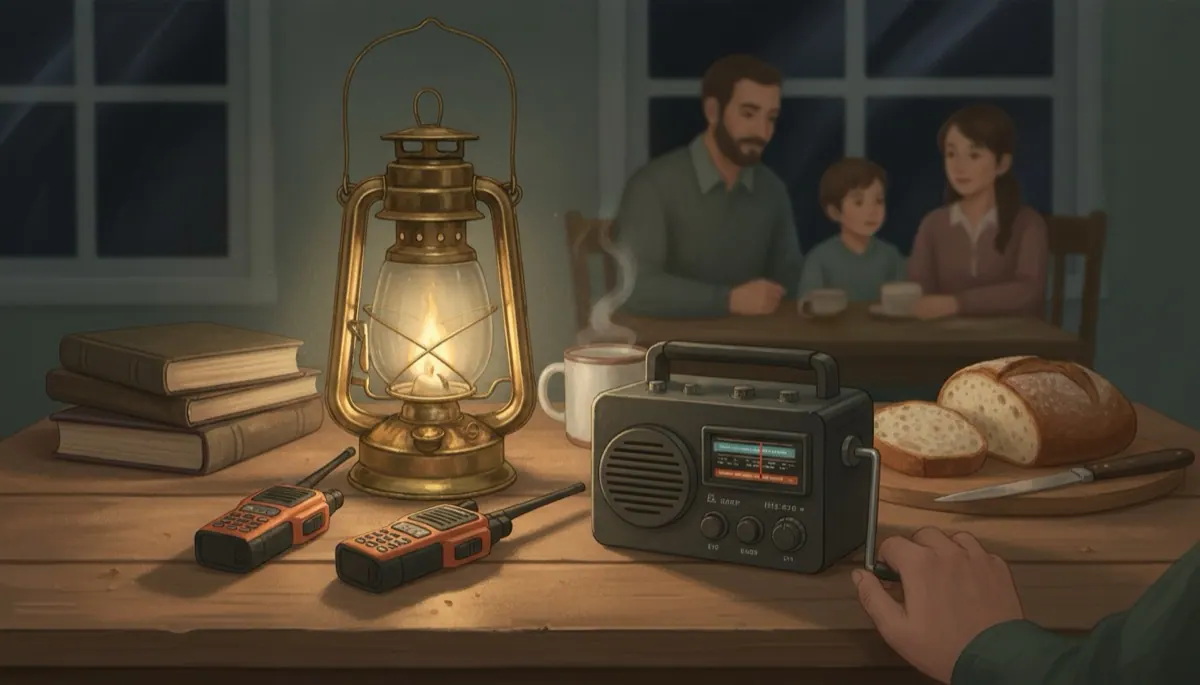
- Keep receiving official information with a battery or wind-up radio
- Use licence-free walkie-talkies with realistic expectations
- Make a family communication plan that works without phones
A radio for official news
In a big power cut, storm or disaster, mobile networks can fail or become overloaded within hours, and the internet goes with them. Ordinary FM and AM broadcast radio usually keeps working, because stations have backup power and their signals travel a long way. Keep a battery or wind-up radio at home, with spare batteries, and know the frequencies of your national public broadcaster and local stations. During the Iberian blackout of April 2025 many people in Portugal and Spain relied on exactly this. Listen at set times rather than all day to save power, and trust official sources over rumours.
Walkie-talkies: what they can really do
For talking within a family or a small neighbourhood, simple walkie-talkies work with no network at all. In Europe, PMR446 radios are licence-free and cheap; in the United States the equivalent is FRS. Ignore the range printed on the box, which assumes perfect conditions. In towns, among buildings, expect often 1 to 3 km. Between open hilltops with a clear line of sight you can get much more. Agree a channel, and a backup channel, in advance, and set check-in times, for example on the hour for five minutes, so radios can stay off between calls and save battery. Keep messages short and test the radios every few months.
When the phone still half works
A struggling network often fails for calls before it fails for text. Short text messages need very little capacity and are stored and retried, so a text can get through when a call will not. Keep messages brief and say where you are and whether you are safe. Save battery: lower the screen brightness, close apps, and switch the phone off between checks. Calls to the emergency number, 112 in Europe, may still connect on another operator's network even when your own has no service, so always try. Do not tie up the network with unnecessary calls.
A family plan and other options
Technology fails, so the most reliable tool is a plan agreed in advance. Choose a meeting point near home and one further away in case your area is evacuated. Pick an out-of-area contact, a relative in another region who everyone reports to, because long-distance lines may work when local ones are jammed. Write important numbers on paper and keep a copy in every bag and wallet, since few of us remember them. Amateur, or ham, radio can reach much further and has a long record in emergencies, but it requires a licence and some study. Finally, remember the simplest signals: a whistle, three blasts for help, and a torch or bright cloth to be seen.
Check yourself
FM and AM broadcasts reach you with no network and carry official instructions.
Buildings block signals. More range is possible between open hilltops, but plan for a few kilometres.
Texts need little capacity and are retried, so they often get through when calls do not.
Local networks jam first. A contact elsewhere links scattered family members.
Try it for real: Build your no-network kit
- Check you have a battery or wind-up radio and spare batteries, and note your local station frequencies
- Write key phone numbers on paper for every family member
- Agree a near and a far meeting point and an out-of-area contact
- If you have walkie-talkies, agree a channel and check-in times, then test them
🛒 Gear for this skill
As an Amazon Associate I earn from qualifying purchases. It costs you nothing extra and keeps this site free.
Written and checked by the Human Skills team against the sources below. How we check our content
- ANEPC (Autoridade Nacional de Emergência e Proteção Civil)
- ETSI and CEPT rules for PMR446
- US FEMA Ready.gov family communication plan
- International Amateur Radio Union emergency communications
Related lessons

Wildfire: Before, During, After
Clear the ground, leave early, know what to do if trapped

Carbon Monoxide: The Silent Killer
Where it comes from, how it feels and how to stop it

Getting Help With No Signal
Calls, satellites, whistles, lights and signs on the ground

Floods and River Crossings
Respect moving water, before, during and after