 Human Skills
Hooks, Sinkers, Floats and Your First Rig
Small parts, big difference
5 minBeginnerUpdated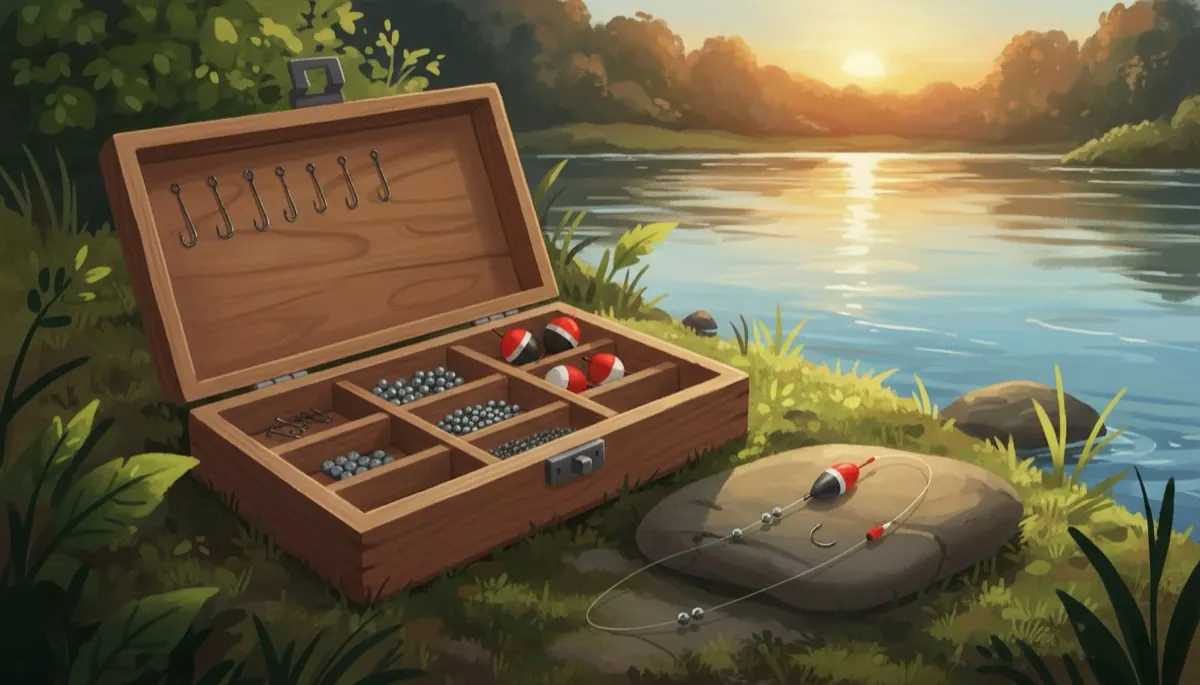
- Read hook sizes and pick one for small and medium fish
- Choose a sinker weight that holds bottom without killing the cast
- Assemble a simple float rig and a simple bottom rig
Hooks and their sizes
Hook sizes run backwards. Size 12 is tiny, size 6 is medium, size 1 is large. Above size 1 the scale flips to 1/0, 2/0, 3/0 and grows again. For most beginner fishing a size 8 to 4 hook is right: big enough for a worm, small enough for a 25 cm fish to swallow. Match the hook to the bait, not the fish you hope for. A hook should be sharp enough to catch on your fingernail when dragged lightly. Barbless hooks, or hooks with the barb pinched flat with pliers, come out of fish and fingers far more easily and are required in some waters. Circle hooks set themselves in the corner of the mouth and are the best choice if you plan to release fish.
Sinkers: just enough weight
A sinker (weight) gets the bait down and holds it there. Use the lightest one that does the job. Split shot are tiny beads pinched onto the line; use them to sink a float rig or drift a bait in a river. Egg or bullet sinkers slide on the line for bottom fishing in lakes. Pyramid or grip sinkers hold on the sea bed in waves and current. Start with 5 to 10 g in still water, 15 to 30 g in a moving river, 30 to 60 g in surf. Lead is banned or restricted in many countries because it poisons birds. Tungsten, steel or tin alternatives work just as well. Never bite split shot to close it; use pliers.
Floats: a bite you can see
A float suspends the bait at a chosen depth and tips, dips or vanishes when a fish bites. It is the most exciting way to learn because you watch every take. Small pencil or waggler floats suit calm lakes; round bobbers are easy but clumsy. Fix the float on the line with its rubber stops or a clip, then add just enough split shot below it so only the top 1 cm shows above water. Set the depth by sliding the float: start with the bait 30 cm off the bottom. If you get no bites in 15 minutes, change depth before you change bait. In wind, cast with the wind at your back and keep the rod tip low.
Rig 1: the simple float rig
Slide a float onto the main line and lock it with two rubber stops. Tie a size 8 hook to the end using an improved clinch knot (next lesson). Pinch two or three small split shot on the line 20 cm above the hook until the float sits low in the water. Set the hook depth 30 cm to 1 m below the float depending on the water. Bait with half a worm, a kernel of sweetcorn or a small piece of bread. Cast gently and let it settle. Watch the float. When it goes under or slides sideways, lift the rod firmly but not violently to set the hook. This rig catches perch, roach, bream, small bass and mullet almost anywhere.
Rig 2: the simple bottom rig
Slide an egg sinker of 10 to 20 g onto the main line, then a small plastic bead to protect the knot, then tie on a swivel. To the other eye of the swivel tie 40 to 60 cm of slightly lighter line with a size 6 to 4 hook at the end. The sinker holds bottom while the bait moves freely on the leader, so a fish feels no weight when it picks up the bait. Cast, let it sink until the line goes slack, wind in the slack, and rest the rod on a stand or your knee with the tip pointed slightly up. A bite is a tap-tap or a steady pull on the tip. Wait for a solid pull, then lift.
Check yourself
Sizes shrink toward 1, then the 0 scale grows: 2/0 is bigger than size 1, which is bigger than size 6.
A float weighted down to its tip shows the gentlest bites. Add split shot until only the top shows.
When you snag, the weakest point breaks. Making that point the hook link means you lose one hook, not sinker, swivel and 10 m of line.
Swans and other birds swallow lost lead shot as grit and die of poisoning. Tungsten, tin and steel sinkers avoid this.
Try it for real: Build both rigs at home
- Lay out hooks, split shot, a float, an egg sinker, a bead and a swivel on a table
- Tie the float rig with a size 8 hook and shot it in a glass of water until only the tip shows
- Tie the bottom rig with a 50 cm leader and a size 6 hook
- Photograph both, then take them apart and rebuild each in under 5 minutes
🛒 Gear for this skill
As an Amazon Associate I earn from qualifying purchases. It costs you nothing extra and keeps this site free.
Next lesson: Passive Lines That Fish Without You →
Written and checked by the Human Skills team against the sources below. How we check our content
- Take Me Fishing (Recreational Boating and Fishing Foundation)
- Angling Trust beginner guides