Human Skills
Nets and What They Cost
Cast, gill and seine nets, mesh size and hand repair
6 minIntermediateUpdated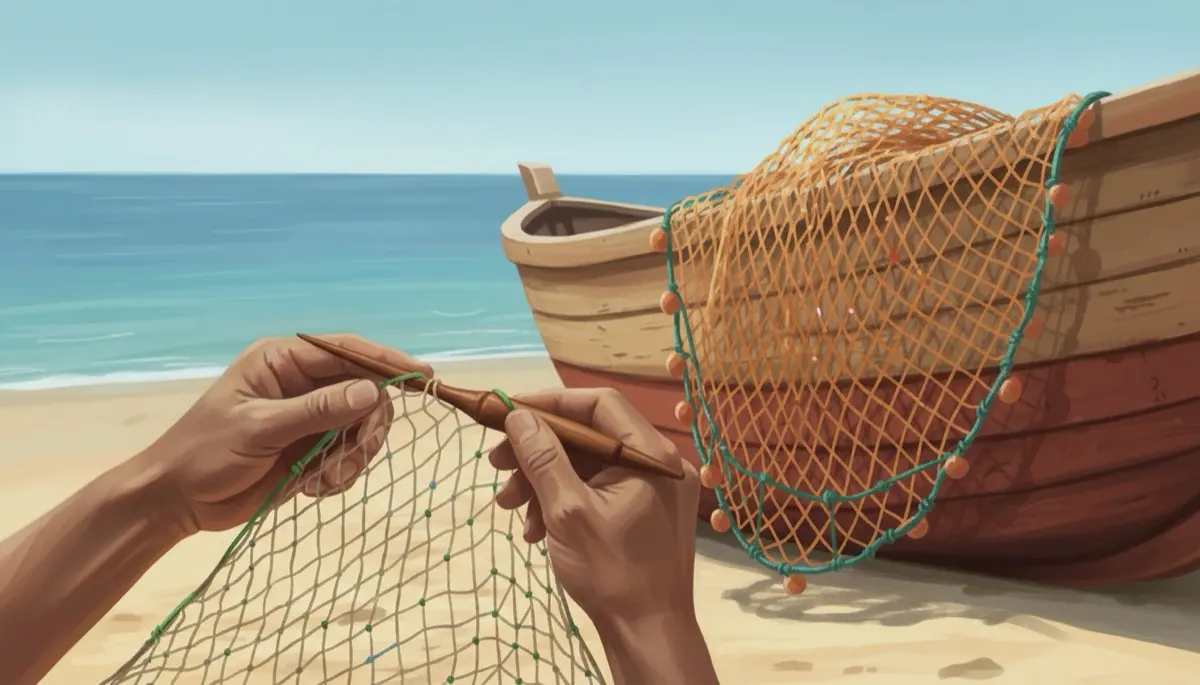
- Tell cast, gill and seine nets apart by how they catch
- Predict what a given mesh size will select for
- Repair a torn mesh by hand with a netting needle
Three nets, three ways of catching
A cast net is a weighted circle thrown by hand over a visible shoal, sinking fast and closing as you haul the retrieval line so the lead line purses under the fish. It is active, selective by where you aim, and legal in more places than the others. A gill net is a wall of fine mesh hung between a float line and a lead line that fish swim into and wedge behind the gill covers. It is passive and completely indiscriminate. A seine net is a long wall dragged in a loop to a beach or between two boats, sweeping everything in its path into the shallows.
Mesh size is the only selectivity a net has
Mesh is measured either as the bar, one side of a diamond, or as the stretched opening, and rules always state which. A 12 to 20 millimetre stretched mesh takes bait fish and sardines. Around 50 to 60 millimetres takes mullet and sea bass sized fish. Above 100 millimetres takes big fish only. Anything smaller than the mesh swims through and anything much larger bounces off, so a net selects a size band, not a species. That is the whole problem: every other animal in that size band, including juveniles of protected species, sea birds diving through and small cetaceans, is caught the same way.
The ecological cost
Indiscriminate netting takes bycatch you did not want and cannot release alive, because a gilled fish is usually dead or badly damaged by the time you reach it. A single gill net across a river mouth can strip a whole run of migrating fish in one night. Lost monofilament net is the worst ghost gear there is: it is invisible, it does not rot, and it keeps fishing indefinitely. This is why gill nets are banned for recreational use across most of Europe, tightly licensed elsewhere, and why several countries have outlawed drift netting entirely. Treat this section as the reason the law exists, not as a workaround.
Throwing and handling a cast net
A cast net is the one worth learning. Choose a radius you can actually open: 1.5 metres for a beginner, not the 3 metre net that looks impressive. Loop the hand line around your wrist, coil the rest, split the skirt into two roughly equal loads across your forearm and one hand, then throw flat and low with your hips rather than your arms, aiming to land a full circle. Haul steadily so the lead line stays on the bottom. Wet mesh, sharp shells and a wrist loop are a bad combination in deep water, so never throw from a boat with the line on your wrist.
Mending a net by hand
Cut the damage back to a clean diamond shape, trimming every half broken bar, because ragged edges tear again. Load a flat netting needle with twine of the same thickness. Work from one side of the hole, tying a sheet bend into each surviving loop in turn, keeping the new meshes exactly the same size as the old by measuring against a gauge, which can simply be a flat stick the width of one bar. Finish where you started and the repair disappears. Rinse nets in fresh water, dry them out of sunlight, and store them dark, since ultraviolet light destroys nylon faster than use does.
Check yourself
Fish swim into a hanging wall of mesh and stick behind the gill covers, which is why the method is passive and indiscriminate.
Anything smaller passes through and anything larger bounces off, so every animal in that size band is caught, protected species included.
Ghost netting continues to catch and kill for years, which is a main reason recreational gill netting is banned in most of Europe.
Trimming half broken bars away gives clean loops to knot into, so the repair holds and keeps the original mesh size.
Try it for real: Learn the mesh and the mend
- Look up whether cast nets and gill nets are legal for recreational use where you live
- Measure the stretched mesh of any net or netting you can find and write the number down
- Predict which local species that mesh would hold and which would pass through
- Cut a small hole in a scrap of netting and mend it with a sheet bend and a gauge stick
- Compare your repaired meshes against the originals for size
🛒 Gear for this skill
As an Amazon Associate I earn from qualifying purchases. It costs you nothing extra and keeps this site free.
Next lesson: A Pond That Feeds You →
Written and checked by the Human Skills team against the sources below. How we check our content
- FAO
- DGRM