Human Skills
Storing and Stretching Water
Tank sizing, greywater rules and keeping it clean
6 minIntermediateUpdated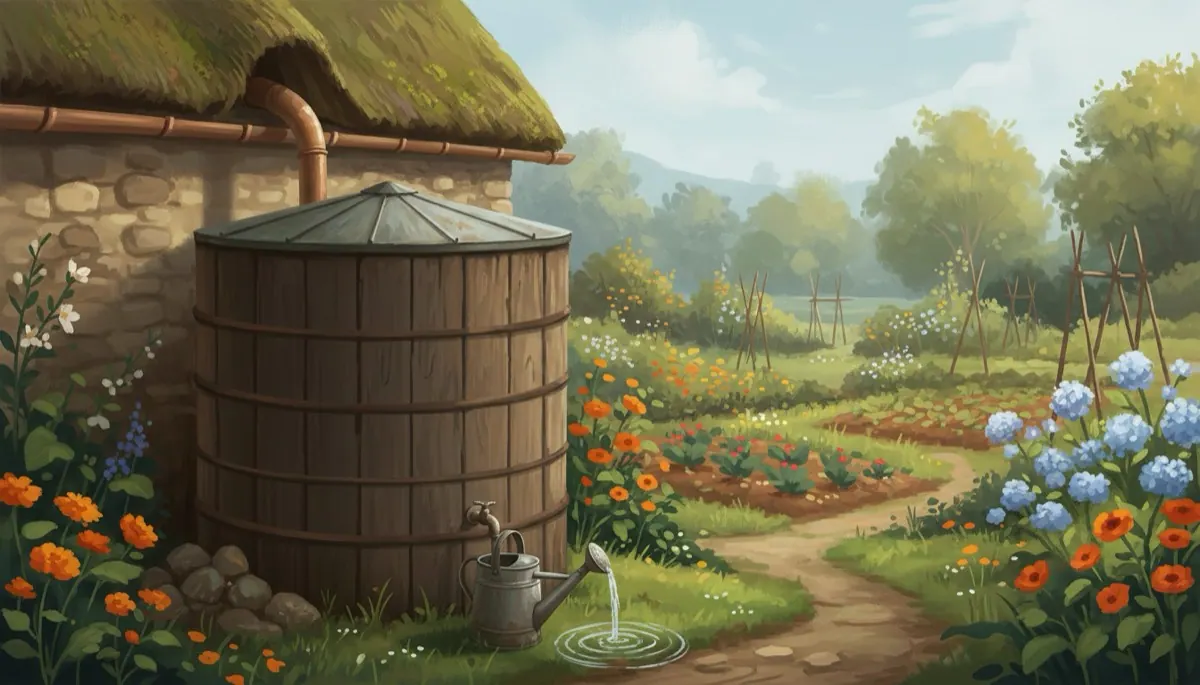
- Size a tank against your roof area, rainfall and weekly demand
- Use greywater within the real safety limits
- Keep stored irrigation water clean and separate from drinking water
What a roof gives you
The arithmetic is simple: roof area in square metres, times annual rainfall in millimetres, times 0.8 for losses, gives litres per year. A 100 square metre roof in Lisbon, with about 700 mm a year, yields roughly 56000 litres. The same roof in Manchester, at 800 mm, yields 64000, and in Faro at 500 mm about 40000. That sounds like plenty until you look at when it falls: in Portugal, 80 percent arrives between October and April, and almost none in the four months you need it. Harvest is therefore not the constraint, storage is. Work out your annual yield first, then your summer demand, then see how big the gap between them is.
Sizing the tank
Size against the dry gap, not the roof. Take your garden area in square metres, multiply by the weekly demand from the water lesson, 25 litres in a temperate summer or 40 in a Mediterranean one, then by the number of weeks with no useful rain. A 100 square metre garden in Portugal needs 100 times 40 times 16 weeks, which is 64000 litres to get through from June to September on stored water alone. That is a large and expensive tank, so most holdings do a mix: a 5000 to 10000 litre tank covering the shoulder months and the shortfalls, plus a well, mains or borehole for peak summer, plus dry farming and mulch to cut demand. A 1000 litre IBC costs 80 to 150 euros used and is the usual starting unit.
Greywater, with the real rules
Greywater comes from showers, baths, hand basins and rinse water, never from toilets or kitchen sinks, which carry grease and food. The rules are not optional. Use it within 24 hours, since bacteria multiply fast in stored greywater and it turns septic and foul within a day or two. Never apply it to leaves, stems or any part of a crop eaten raw, so no salad, no strawberries, no herbs you pick fresh; put it on fruit trees, vines, ornamentals and cooked crops, at the root and under mulch. Never use laundry water containing bleach, borax or softener, and switch to a low-sodium detergent if you want to use laundry water at all. Rotate where it goes so salts do not build up, and never use greywater from nappies or from anyone with a gut infection.
Keeping stored water clean
Dark, sealed and screened is the whole recipe. Light causes algae, so use opaque tanks or shade them. Fit a mosquito-proof mesh, 1 mm or finer, on every inlet, outlet and overflow, because a tank can breed thousands of mosquitoes in a week. Use a first-flush diverter that dumps the first 0.5 to 1 litre per square metre of roof, which carries the dust, bird droppings and debris. Draw water from 10 to 15 cm above the base so sediment stays put, and clean the tank out every one to two years. Keep gutters clear and cut back overhanging branches. Rainwater off a roof is fine for irrigation without treatment but is not clean drinking water, whatever it looks like.
Drinking water is a separate system
Say it plainly: the water in this lesson is irrigation water. Roof runoff, greywater, pond and stream water are not drinking water, and no amount of clear appearance changes that. Keep the two systems physically separate, with different tanks, different pipes and different taps, and label the irrigation taps clearly so nobody fills a bottle by mistake. Never cross-connect an irrigation line to a mains supply without a proper backflow preventer, which is also a legal requirement in most places. How to make water safe to drink, boiling, filtration and chemical disinfection at correct doses, is covered in the survival lessons on water, and that is the only place you should be taking your drinking water method from.
Stretching what you have
Before spending on storage, cut demand. Mulch at 7 to 10 cm saves 20 to 30 percent. Windbreaks cut evapotranspiration by up to a quarter on exposed sites. Shade cloth at 30 to 50 percent over summer salads cuts their demand sharply and stops them bolting. Drip instead of a sprinkler saves 30 to 50 percent. Growing thirsty crops in the cool half of the year, which in Portugal means October to May, removes them from the summer budget entirely. Reuse pasta and vegetable cooking water once cooled and unsalted, and keep a bucket in the shower for the cold water before it runs warm, which is 5 to 10 litres a day for free. Together these measures halve a garden's water bill without buying a single tank.
Check yourself
Area times rainfall times about 0.8 for losses: 100 times 700 times 0.8 gives roughly 56000 litres a year.
Bacteria multiply fast and greywater turns septic and smelly within a day or two, so it must be used the same day.
Greywater must never touch anything eaten raw. It goes at the root, under mulch, on trees, vines and cooked crops only.
It discards roughly the first 0.5 to 1 litre per square metre of roof, which carries dust, debris and bird droppings.
Try it for real: Work out your real water budget
- Measure your roof footprint and look up your local annual rainfall, then calculate the yearly yield
- Measure your bed area and multiply by the weekly demand and the number of dry weeks
- Write both numbers down side by side and see the size of the gap
- Fit mesh and a first-flush diverter to one downpipe and connect a butt or IBC
- Pick two demand cuts from the last section and put them in place this month
🛒 Gear for this skill
As an Amazon Associate I earn from qualifying purchases. It costs you nothing extra and keeps this site free.
Next lesson: Who Is Eating My Plants →
Written and checked by the Human Skills team against the sources below. How we check our content
- WHO Guidelines for the Safe Use of Wastewater, Excreta and Greywater
- FAO Water Harvesting Guidelines
- RHS Collecting and Storing Rainwater