 Human Skills
Goats and Rabbits
Milk and meat, and the daily tie that comes with them
6 minIntermediateUpdated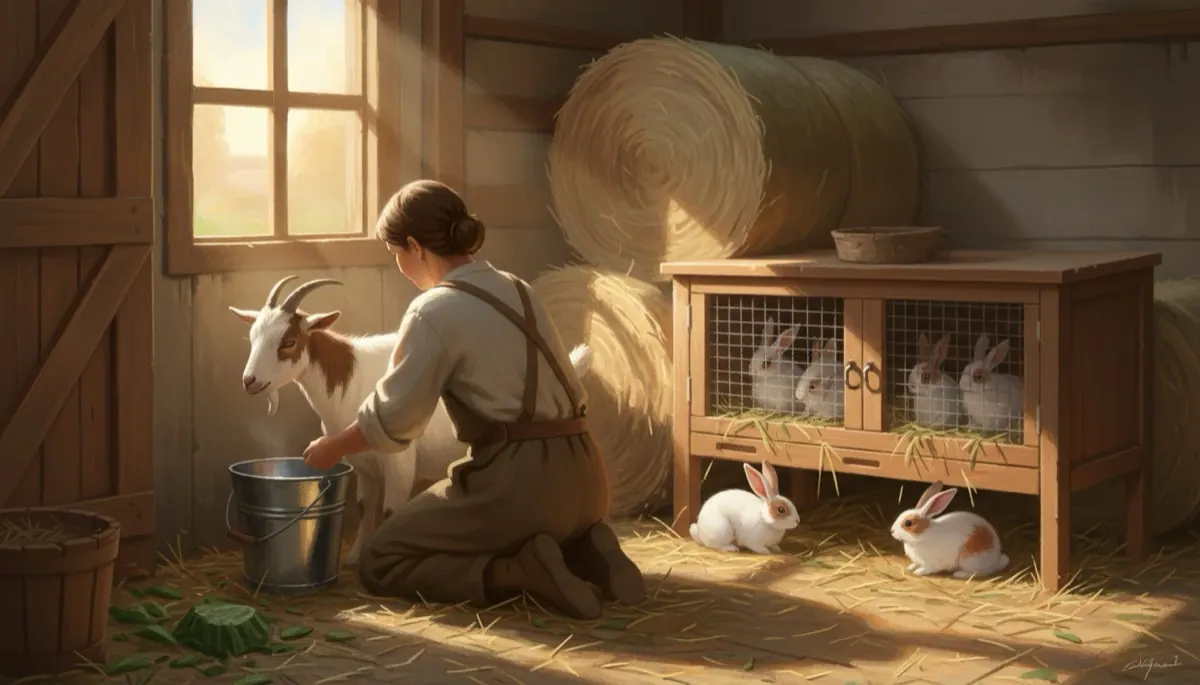
- Compare rabbits and goats on space, feed and daily time
- Handle milk hygienically from udder to fridge
- Understand registration and movement rules before you buy
Rabbits: the smallest serious meat animal
Rabbits convert garden greens and hay into meat faster than anything else you can keep in a small space. A doe with a buck can produce well over 20 kilograms of meat a year. Each adult needs a hutch of at least 0.75 square metres plus daily exercise space, shade, and total protection from heat: above 28 degrees Celsius rabbits suffer, above 32 they die. Feed is hay first, then greens and a measured ration of pellets, with water always available. Daily work is about 15 minutes. The hard part is not husbandry, it is whether you can kill and butcher an animal you raised. Be honest with yourself before you start.
Goats: milk, browse and escape
A good dairy goat gives 2 to 4 litres a day at peak, dropping through the lactation, and she must be bred roughly once a year to keep milking. Goats browse shrubs and rough ground rather than grazing grass, which suits Portuguese hillsides, but they need real shelter from rain, which they hate, and a companion, because a lone goat is a miserable and noisy goat. Allow at least 2 square metres of dry housing each plus a decent yard or browse area. They will destroy every fruit tree you own if they get out, and they will get out.
Fencing, feed and real costs
Goat fencing is the whole battle. Expect stock netting at least 1.2 metres high, strained tight, with a hot wire along the top and often another at nose height, and every gate latch goat-proof, because they learn. Budget for hay through the dry season when browse is gone: a goat eats roughly 2 to 3 percent of its body weight in dry matter daily, so a 60 kilogram goat gets through well over a tonne of forage a year if you are buying it all. Add minerals with copper, which goats need and sheep cannot tolerate, hoof trimming every 6 to 10 weeks, and worming based on faecal egg counts rather than habit.
Milk hygiene from udder to fridge
Clean milk is a routine, not a talent. Wash hands, clip the udder area, wash and dry the teats, discard the first squirt from each teat into a strip cup and look at it for clots or blood, then milk into a covered stainless bucket. Filter, then chill to below 4 degrees Celsius within an hour, because warm milk doubles its bacterial count fast. Raw milk can carry Brucella, Listeria, Campylobacter and tuberculosis. If you are not certain of the herd's health status, or anyone in the house is pregnant, elderly, very young or immunocompromised, pasteurise by holding at 63 degrees Celsius for 30 minutes or 72 degrees for 15 seconds.
The paperwork and the daily tie
In Portugal, goats are registered livestock: the holding needs a number, animals are identified with ear tags, movements are declared, and DGAV runs the health programmes including brucellosis and tuberculosis testing. Selling milk or cheese is a whole further layer of food-safety regulation. Then the honest part: a milking goat ties you to the property twice a day, every day, for most of the year. No weekends away unless someone competent can milk her, and skipping a milking risks mastitis. Rabbits and chickens can be left with a neighbour for a weekend. A dairy animal cannot.
Check yourself
A goat milks because she has kidded. Yield declines through the lactation and stops, so milk means kids and a plan for them.
Chilling below 4 degrees Celsius quickly slows bacterial growth. Warm milk multiplies its bacterial count within hours.
Rabbits tolerate cold well but suffer above 28 degrees and die above about 32. Deep shade and airflow are non-negotiable in summer.
Twice-daily milking, most of the year, with no easy weekends away, is the real cost of a dairy animal. Rabbits can be left with a neighbour.
Try it for real: Cost a year of small livestock before you buy
- Choose rabbits or goats and write the space and shelter each needs
- Price a year of hay, feed, minerals and bedding at local prices
- Ask DGAV or your local vet what registration and tagging your choice requires
- Write out your daily routine with times, and name your relief person
- Visit a local keeper and watch a full milking or a full feed round
🛒 Gear for this skill
As an Amazon Associate I earn from qualifying purchases. It costs you nothing extra and keeps this site free.
Written and checked by the Human Skills team against the sources below. How we check our content
- FAO Small-scale dairy farming manual
- DGAV (Direcao-Geral de Alimentacao e Veterinaria)
- WHO guidance on brucellosis
Related lessons
Keeping Backyard Chickens
Space, feed, water, predators and the rules
Eggs: Collecting, Cleaning and Storing
From nest box to kitchen without waste

Basic Animal Care Principles
The five freedoms, daily checks and when to call the vet
Designing a Coop That Works
Ventilation, perches, nest boxes and a run that stays dry