Human Skills
Fertility Without Buying Anything
Leaves, wood, manure, ash, urine and seaweed
6 minBeginnerUpdated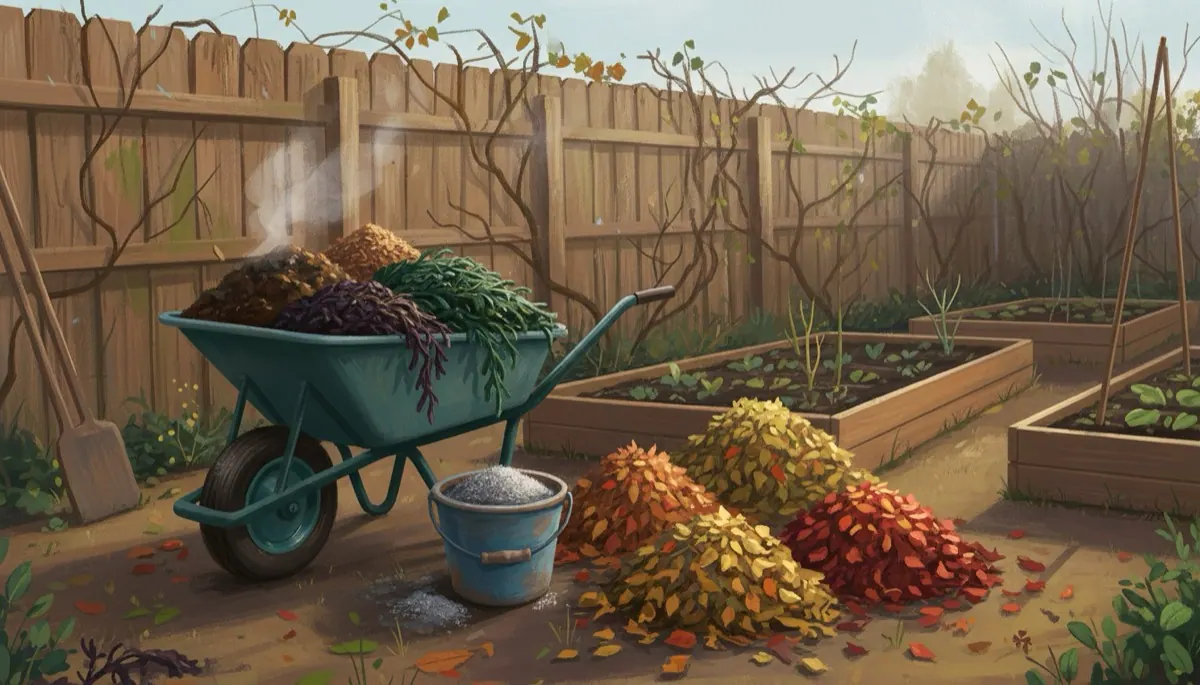
- Turn leaves, wood chip and prunings into fertility on site
- Rot manure long enough to be safe and use wood ash within its limits
- Dilute and apply urine safely as a free nitrogen source
Leaf mould and chop and drop
Leaves are the easiest free input. Pile them in a wire cage one metre across, tread them down, wet them, and leave them. In 12 months you have rough leaf mould for mulch, in 24 months a crumbly soil conditioner close to peat. Leaf mould feeds very little, under 0.5 percent nitrogen, but it holds water and builds structure. Oak and beech take longest, plane and chestnut break down faster. Chop and drop means cutting green growth, comfrey, nettles, bean haulm, weeds before they seed, and laying it straight on the bed as mulch. A 5 cm layer of green material adds nitrogen as it rots and shades the soil at the same time. Nothing leaves the plot.
Wood chip and ramial wood
Fresh wood chip from thin branches, under 7 cm thick and with leaves on, is called ramial chipped wood and is the best of it, because thin branches hold most of the tree's nutrients and feed fungi rather than bacteria. Spread it 5 to 8 cm deep on paths and around fruit trees, never dug in. Dug into the soil it pulls nitrogen out for a season as the microbes work. On the surface that nitrogen lock stays in the top centimetre and does no harm. Expect a path layer to shrink by half in a year and to become dark crumbly compost in two to three. Avoid chip from walnut, which suppresses tomatoes, and from treated timber.
Manure and how long it must rot
Fresh manure burns roots, stinks and can carry E. coli, salmonella and parasite eggs. Stack it in a heap at least one cubic metre, cover it against rain, and leave horse or cow manure six months, and chicken manure, which is much stronger, nine to twelve months. Properly rotted manure is dark, crumbly and smells of earth, not ammonia. Apply 5 kg per square metre, roughly a bucket, once a year to hungry beds such as squash, potatoes and brassicas. Chicken manure is around 1.5 percent nitrogen fresh, so use half that rate. If manure went on less than 120 days before harvest, do not eat the crop raw. Ask the source whether the pasture was sprayed with aminopyralid, a herbicide that survives the gut and the heap and deforms tomatoes and beans for years.
Wood ash and its limits
Wood ash is roughly 5 to 7 percent potassium, 1 to 2 percent phosphorus, plenty of calcium, and no nitrogen at all. It is also alkaline, with a liming effect about half that of ground limestone, so it is a potash feed and a liming agent in one. Use no more than 100 to 150 g per square metre a year, around a large handful, and only on beds that are not already alkaline. It suits fruit bushes, tomatoes and onions. Never put it on potatoes, where it worsens scab, or on blueberries. Keep it dry until you use it, because rain leaches the potash straight out of an open heap. Only clean untreated wood ash, never coal, charcoal briquettes or painted timber.
Urine, the free nitrogen
Urine from a healthy person is sterile as it leaves the body and carries roughly 8 to 10 g of nitrogen per litre, plus potassium and phosphorus, in a form plants take up at once. One adult produces about 500 litres a year, enough nitrogen for 50 to 100 square metres of vegetables. Dilute it 1 part to 10 parts water for growing plants, or 1 to 20 for seedlings, and water it into the soil around the plant, never onto leaves you eat and never onto the edible part. Use it within 24 hours, as stored urine turns to ammonia and smells. Stop applying one month before harvest. Never use urine from anyone on medication or with a urinary infection.
Seaweed on the coast
Storm-cast seaweed is a serious fertiliser: roughly 1 to 2 percent nitrogen, high potassium, plus trace elements and alginates that bind soil crumbs. Collect loose weed from the strandline only, never cut living weed off rocks, and check local rules first, since collection is regulated in many places including parts of Portugal. Rinsing is usually unnecessary, as the salt on a drained load is small compared to a winter's rain, but on a light sandy soil give it a rinse or a month in the rain. Spread it 5 cm deep on empty winter beds and it will vanish by spring, or add it to a compost heap as a nitrogen layer. Do not take it from beaches near outfalls or harbours.
Check yourself
Chicken manure is far stronger than horse or cow manure and needs nine to twelve months to stop burning roots and to reduce pathogens.
One to ten for established plants and one to twenty for seedlings, watered into the soil rather than onto leaves.
Ash is alkaline and raises pH, and common scab on potatoes gets worse as pH rises.
Microbes breaking down buried wood take nitrogen from the soil. On the surface that competition stays in the top centimetre.
Try it for real: Start three free fertility streams
- Build a one metre wire cage and fill it with autumn leaves, treading and wetting as you go
- Find a local source of manure, ask about herbicide spraying, and stack a cubic metre under cover with the date written on it
- Keep a labelled 5 litre container for diluted urine and feed one hungry crop such as sweetcorn or brassicas weekly
- Save clean wood ash in a dry lidded bin and weigh out 100 g per square metre for the fruit bushes in late winter
🛒 Gear for this skill
As an Amazon Associate I earn from qualifying purchases. It costs you nothing extra and keeps this site free.
Next lesson: Compost at Household Volume →
Written and checked by the Human Skills team against the sources below. How we check our content
- FAO Guidelines on the Use of Manure
- WHO Guidelines for the Safe Use of Wastewater, Excreta and Greywater
- RHS Soil Improvers and Mulches